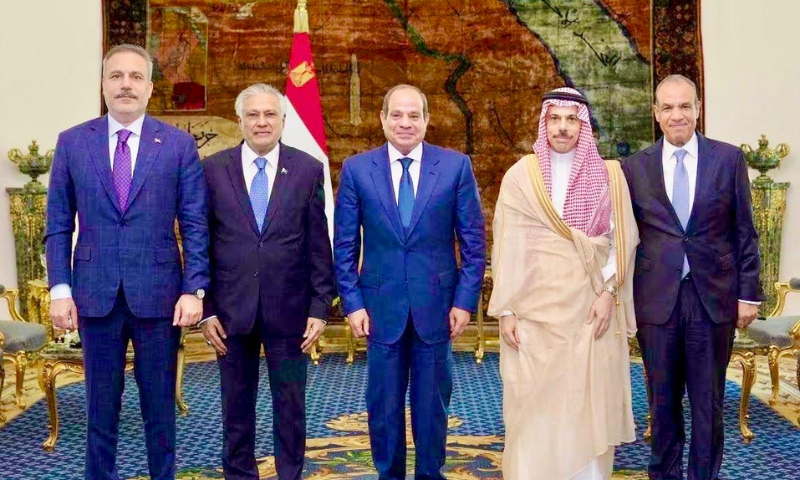
Cairo, June 21,2026: The foreign ministers of Egypt, Pakistan, Saudi Arabia and Türkiye have welcomed the signing of the Islamabad Memorandum of Understanding (MoU) between the United States and Iran, describing it as a significant step toward de-escalation and regional stability.
The endorsement came during the Fourth Consultative Meeting of the foreign ministers of the four countries, held in Cairo on Saturday at the invitation of Egypt. The ministers discussed regional and international developments and reaffirmed their commitment to continued consultation and coordination in support of peace, security, stability and prosperity across the Middle East and the wider region.
The ministers expressed appreciation to Egyptian President Abdel Fattah El-Sisi for sharing his vision for the future of the region and acknowledged Egypt’s role in facilitating dialogue among regional partners.
In a joint statement issued after the meeting, the ministers particularly welcomed the Islamabad MoU signed between the United States and Iran on June 18, 2026, calling it a constructive development that could help end a conflict that had posed serious risks to regional security, energy markets, international maritime routes, global supply chains and international trade.
The four countries commended the efforts of regional and international stakeholders who helped facilitate the understanding and stressed the importance of fully implementing the commitments undertaken by the parties concerned.
The ministers specifically lauded Pakistan’s role in helping secure the breakthrough agreement, describing Islamabad’s diplomatic efforts as instrumental in achieving the outcome. They also acknowledged the support extended by Qatar in facilitating the negotiations that led to the successful conclusion of the MoU and appreciated Pakistan’s close coordination with partner countries throughout the process.
Building on the positive momentum created by the agreement, the ministers emphasized the need for a swift and successful next phase of negotiations aimed at achieving a lasting, verifiable and mutually acceptable resolution of remaining issues.
They underscored that future efforts should address the security concerns of countries across the region, particularly the Gulf Arab states and the Levant, with the objective of strengthening collective security and ensuring long-term regional stability.
The meeting also devoted significant attention to the Palestinian issue, which the ministers described as central to achieving lasting peace and stability in the Middle East. Discussions focused on the humanitarian and political situation in Gaza, the West Bank and occupied East Jerusalem.
Reaffirming their support for the legitimate rights of the Palestinian people, the ministers reiterated their backing for the establishment of an independent Palestinian state based on the pre-June 4, 1967 borders, with East Jerusalem as its capital, in accordance with relevant United Nations Security Council resolutions.
The joint statement emphasized that a just, comprehensive and lasting resolution of the Palestinian issue remains an indispensable foundation for a stable and secure regional order.
The Cairo meeting marked the latest round of consultations among Egypt, Pakistan, Saudi Arabia and Türkiye as the four countries seek to enhance coordination on regional challenges and promote diplomatic solutions to conflicts affecting the Middle East.