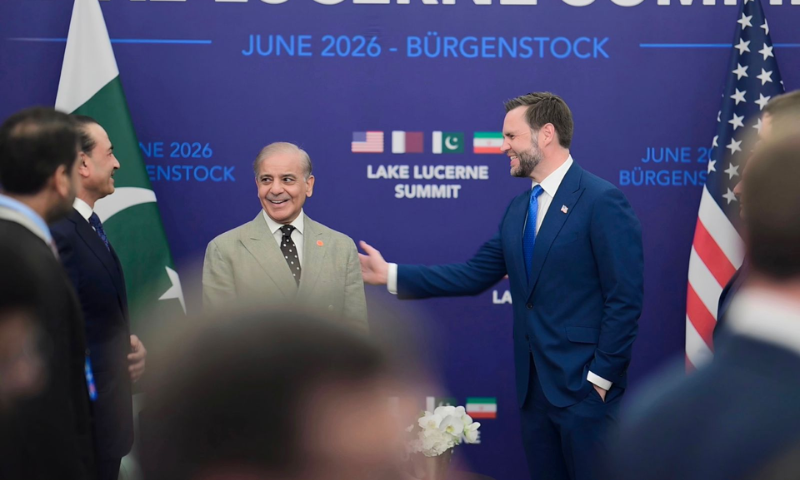
Bürgenstock, Switzerland, June 21, 2026: The United States and Iran on Sunday launched a new round of high-stakes technical negotiations in Switzerland aimed at implementing the June 18 Memorandum of Understanding (MoU) that ended nearly four months of conflict, with Pakistan and Qatar playing central mediatory roles.
The talks, being held at the Bürgenstock Resort near Lucerne, brought together senior political, diplomatic, security and economic officials from Washington and Tehran amid cautious optimism about advancing a broader peace framework for the region.
US Vice President JD Vance praised Pakistan’s leadership for its role in facilitating dialogue between the two adversaries, commending Prime Minister Shehbaz Sharif and Field Marshal Syed Asim Munir for their diplomatic efforts.
Standing alongside Pakistani and Qatari leaders ahead of the negotiations, Vance expressed hope that the discussions would yield tangible progress in the coming hours.
“I think we’re going to hopefully make progress on the nuclear issue and make progress on the Lebanon ceasefire issue,” he told reporters before departing for Switzerland.
Pakistan’s mediation praised
Vance described Pakistan’s contribution to regional stability as “commendable,” noting that he had remained in close contact with Field Marshal Munir throughout the conflict.
“I have recently jokingly said that there are two very important people in my life — an Indian, my wife, and a Pakistani, Field Marshal Asim Munir,” Vance remarked, drawing laughter from participants.
The US vice president said Pakistan’s diplomatic engagement during the nearly four-month conflict had been recognized globally and expressed Washington’s desire to build upon the momentum generated through Islamabad’s mediation efforts.
He reiterated that peace in the Middle East remained a top priority for President Donald Trump, while emphasizing the importance of Iran playing a constructive role in regional stability.
Shehbaz credits Trump, highlights Munir’s role
Prime Minister Shehbaz Sharif welcomed the launch of direct technical discussions, describing them as an important opportunity for global peace and regional stability.
The premier credited President Trump’s leadership for creating the conditions that made the negotiations possible and highlighted Field Marshal Munir’s contribution in facilitating dialogue between the parties.
“We can work together to establish unity in the world,” Shehbaz said.
Qatari Prime Minister and Foreign Minister Mohammed bin Abdulrahman bin Jassim Al Thani also paid tribute to Prime Minister Shehbaz and Field Marshal Munir for their role in advancing the diplomatic process.
US and Iranian delegations meet Pakistani mediators
Ahead of the formal technical talks, separate meetings were held between Pakistani mediators and the delegations from Washington and Tehran.
The US delegation, led by Vice President Vance and including Special Envoy Steve Witkoff and senior adviser Jared Kushner, met Prime Minister Shehbaz and Field Marshal Munir.
Speaking briefly before the meeting, Vance thanked Pakistan for its mediation efforts and remarked: “We love Pakistan.”
The Iranian delegation, headed by Parliament Speaker Mohammad Bagher Ghalibaf and Foreign Minister Abbas Araghchi, later held separate consultations with the Pakistani side, which also included Interior Minister Mohsin Naqvi.
According to Iranian officials, the negotiations are focused on implementing key provisions of the June 18 MoU, particularly the cessation of hostilities across all fronts, including Lebanon.
Iranian Foreign Ministry spokesman Esmaeil Baqaei said Tehran is determined to ensure full implementation of commitments before moving toward a final comprehensive agreement.
Iran has identified three key issues for discussion:
- Ensuring the ceasefire holds across all fronts, including Lebanon;
- The release of frozen Iranian assets abroad;
- Mechanisms for restoring and expanding Iranian oil exports.
Iranian officials stressed that progress on these issues would be necessary before entering the final phase of negotiations.
Pezeshkian sees benefits for Iran
Iranian President Masoud Pezeshkian described the understanding reached with Washington as largely beneficial for the Iranian people.
Speaking in Tehran, Pezeshkian said negotiations would allow Iran to regain access to its financial resources and determine independently how those funds are utilized.
He specifically pointed to approximately $6 billion in Iranian funds currently held in Qatar, expressing hope that the assets would be released as negotiations advance.
“Our $6 billion in Qatar will be returned,” he said, adding that the achievements of the talks would soon become evident.
The Iranian president also reiterated that Tehran would not pursue nuclear weapons, maintaining that the position aligns with both national policy and longstanding religious decrees against atomic arms.
Despite the ceasefire agreement, tensions remain high in the region.
Vance acknowledged that ceasefires are often “a little bit messy” and emphasized that President Trump remains committed to achieving a comprehensive regional ceasefire.
Washington and Tehran continue to differ over developments surrounding the Strait of Hormuz, a critical maritime route for global energy supplies. While Iranian Revolutionary Guard officials warned that maritime traffic could be at risk due to Israeli actions in Lebanon, US military officials reported that commercial shipping continued to transit the waterway without interruption.
The ongoing conflict between Israel and Hezbollah in Lebanon is expected to remain a major subject of discussion during the Swiss negotiations.
Iran has accused Israel of violating commitments linked to the ceasefire arrangement, while Israeli officials maintain they will continue responding to perceived security threats and insist they are not bound by the US-Iran agreement.
Pakistani media reports from the venue indicate that technical-level discussions could continue into Monday, with no formal deadline announced for the negotiations.
Iranian Foreign Minister Araghchi also held a bilateral meeting with Swiss Foreign Minister Ignazio Cassis before the start of the broader discussions.
Meanwhile, Switzerland officially welcomed the Pakistani delegation, recognizing Islamabad’s role as one of the principal mediators of the MoU that paved the way for the current negotiations.
Diplomatic observers say the outcome of the Bürgenstock talks will determine whether the June 18 ceasefire evolves into a comprehensive agreement addressing Iran’s nuclear programme, sanctions relief, regional security concerns and the future stability of the Middle East.
The negotiations represent the first direct technical engagement between American and Iranian teams under the new framework and are widely viewed as a critical test of whether recent diplomatic gains can be translated into a durable peace arrangement.