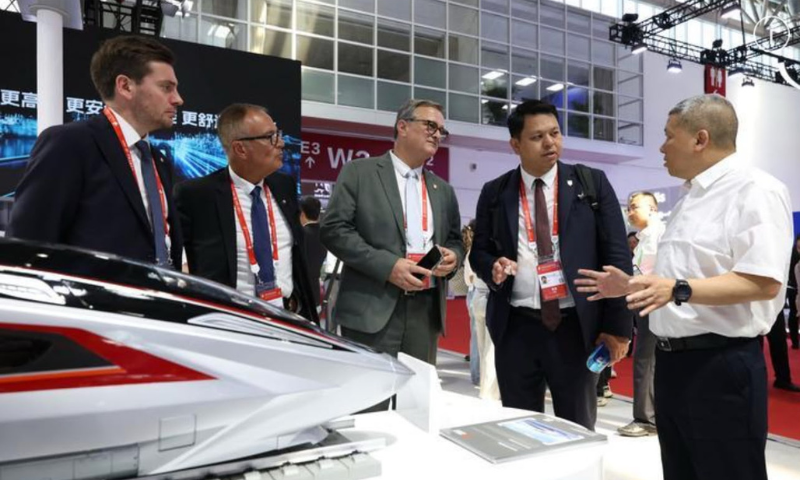
Beijing, June 23: At the ongoing Fourth China International Supply Chain Expo (CISCE) in Beijing, Honeywell’s 250-square-meter booth caught much attention — not just as the largest the company had built in its four years of participation, but because three of the four display walls were given to local partners.
Nearly 100 upstream and downstream Chinese suppliers and partners shared the spotlight, showcasing products across semiconductors, energy storage, data centers, shipbuilding, low-carbon energy and smart manufacturing.
For the U.S. industrial conglomerate, which has operated in China for 90 years, the message was clear: foreign companies in China are moving from going it alone to building ecosystems.
“China is the most comprehensive country across every industry sector, so you can find a pool of suppliers in every field,” Yu Feng, president of Honeywell China, told Xinhua. “China’s supply chain is resilient and globally leading in quality, cost, delivery and response speed. Multiple supply chain clusters have taken shape — from Bohai Bay and the Yangtze River Delta to the Pearl River Delta, all offering a wealth of excellent suppliers.”
He asked, “With a market this big, which multinational would want to leave?”
At this year’s expo, Honeywell and China’s Shenghong Petrochemical jointly launched an operator navigation system that visualizes production status in real time, predicts operational changes, and recommends optimal actions. It has achieved 100 percent automation coverage, cut manual operations by more than 50 percent, and saved over 10 million yuan (about 1.47 million U.S. dollars) annually on steam consumption alone.
Digitalization and low-carbon transformation are accelerating, Yu noted. “No single company can handle the growing complexity of industrial challenges alone. Only by strengthening industrial chain collaboration can we build core competitiveness.”
Despite mounting challenges in the global supply chain, multinational giants like Honeywell, Nvidia, and Apple used the expo stage to underscore their long-term commitment to China, demonstrating extensive industrial integration and ambitious investment plans. For them, success here means integrating with the world’s most complete supply chain while adapting to its rapid evolution.
According to the China Council for the Promotion of International Trade, the event’s organizer, exhibitor numbers climbed to 676 this year, with foreign companies accounting for 36.5 percent of participants and Fortune 500 and industry leaders making up over 65 percent. More than 200 foreign delegations visited the expo, surpassing last year’s figures both in number and scale.
The U.S. tech giant Qualcomm showcased the vision of a smarter, more connected life alongside Chinese partners including Honor, Xiaomi, Vivo, Oppo and Lenovo.
In the expo’s newly established AI zone, a robot was kicking a ball at Qualcomm’s booth. AI glasses, AI PCs and smartphones were lined up for visitors to test. Beside it, a Chinese-made vehicle displayed an onboard AI agent that could handle over 500 daily scenarios.
Nearby, at Nvidia’s booth, the company presented its “AI Five-Layer Cake” with demos spanning the full AI stack from energy, chips and infrastructure to models and applications, and brought together over 110 partners in what it called its largest AI ecosystem showcase in China.
CISCE celebrates one of the most important systems in the world — the supply chain, Nvidia CEO Jensen Huang said in a video address. “China is one of the world’s great centers of technology and industry. The engineers are excellent. Developers move fast, companies built at remarkable scale.”
Apple, a four-time exhibitor, joined with three Chinese suppliers, including Sunny Optical, an optical product maker based in eastern China’s Zhejiang Province. Its collaboration with Apple began in 2019 and has since expanded to imaging and sensing lenses for iPhone and iPad, as well as camera modules for MacBook.
At its booth, the focus was not on the products themselves, but on the equipment that makes them. Wang Wenjie, CEO of Sunny Optical, explained, “We chose to display equipment instead because equipment represents capability. Through our cooperation with Apple, our capabilities in advanced precision processes and automation equipment have been greatly strengthened.”
Foreign companies at the expo were not just showcasing their partnerships, but also their massive investments in China.
The Thai company TCP Group, which built its first Chinese plant in Hainan over 30 years ago, announced cumulative new investments of 4.36 billion yuan in China in recent years, including new production bases in Sichuan and Guangxi.
The continued hosting of CISCE demonstrates China’s commitment to high-standard opening-up and that it welcomes global enterprises to share development dividends, said TCP CEO Saravoot Yoovidhya. “China’s business environment, opening-up policies, improving supply chain infrastructure and consumption upgrades have made it a vibrant and stable place for multinationals to grow,” he added.
The healthcare giant Medtronic demonstrated a TAVR therapy simulator. With the help of local AI partners, the system simulates complex surgical procedures, predicts intraoperative risks and makes personalized treatment plans.
The company now works with nearly 7,000 supply chain partners in China. Its procurement in the country totaled about 5.7 billion yuan in fiscal year 2026. It said 90 percent of locally sourced direct-procurement components were for use in Medtronic’s global factories.
In the first five months of 2026, China saw 25,297 newly established foreign-invested firms, up 5.3 percent year on year, while actual foreign direct investment in high-tech industries expanded 19.4 percent year on year to 130.14 billion yuan during the period.
Liang Guoyong, senior economist at the United Nations Conference on Trade and Development, observed that the expo reflects a broader shift. “As China’s economy continues to upgrade, and its international competitiveness improves, the quality of foreign investment in China is optimizing. The concentrated presence of multinational ‘chain leaders’ at CISCE, showcasing their collaboration with Chinese partners, helps foreign companies deepen their roots in the Chinese market and achieve mutual benefit.”
Courtesy Xinhua