Islamabad, June 23, 2026: Prime Minister Shehbaz Sharif on Tuesday clarified that the memorandum of understanding (MoU) reached between the United States and Iran through Pakistan-facilitated talks does not include any provision related to Iran’s ballistic missile programme, stressing that the issue was never part of the negotiations.
The clarification came during delegation-level talks with visiting Iranian President Dr. Masoud Pezeshkian, hours after the prime minister had told the National Assembly that discussions under the agreement would cover nuclear facilities, ballistic missiles, and frozen assets.
Addressing the Iranian president and members of the delegation, PM Shehbaz stated that the earlier impression regarding ballistic missiles was incorrect.
“I want to state with full authority that this MoU does not mention ballistic missiles. It was never on the table or on the agenda. The Iranian side never sought to discuss it, and that is a matter of fact,” the prime minister said.
He emphasized that there should be no misunderstanding about the agreement, warning that certain elements opposed to peace could attempt to create confusion and undermine the diplomatic breakthrough achieved between Tehran and Washington.
The clarification followed reports by Iran’s Fars News Agency, which quoted Iranian officials as saying that the country’s missile programme was never part of the negotiations and was not included in the text of the memorandum.
PM Shehbaz further argued that Iran’s missile capabilities should not be viewed differently from those of other countries possessing similar defence systems.
“There cannot be double standards whereby some countries are allowed to possess ballistic missiles while Iran is denied that right. Such an approach would be unfair and counterproductive,” he remarked.
Later, responding to a question from a member of the Iranian delegation, the prime minister reiterated that ballistic missiles were never discussed during negotiations between Iran and the United States and were not mentioned anywhere in the MoU.
He cautioned that opponents of the agreement were attempting to generate doubts and delays by raising issues that were never part of the talks.
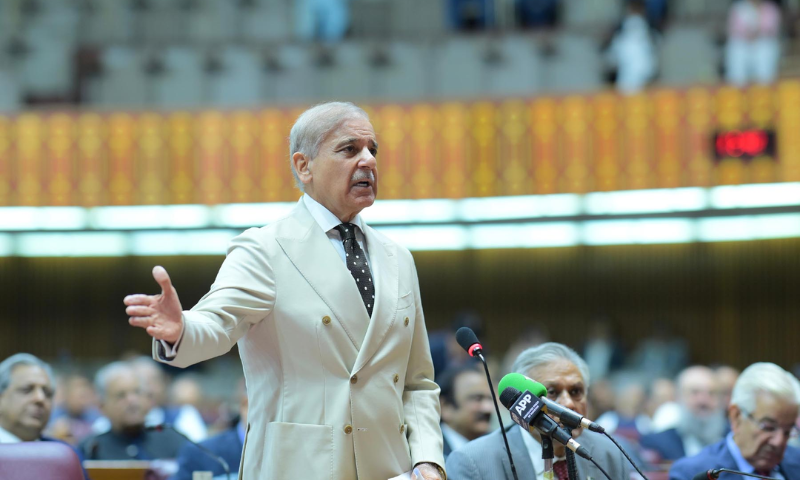
Earlier, while addressing the National Assembly during the debate on the Finance Bill 2026-27, PM Shehbaz highlighted Pakistan’s diplomatic efforts in facilitating dialogue between Iran and the United States.
He said an understanding had been reached through talks hosted in Switzerland with Pakistan playing a mediating role, resulting in a ceasefire and the signing of a memorandum that would guide technical negotiations over the next 60 days.
“Pakistan worked with sincerity and dedication to help bridge differences between Iran and the United States,” he told lawmakers.
The prime minister noted that negotiations had continued around the clock before all parties agreed on a joint framework aimed at achieving a lasting settlement.
Congratulating Parliament and the nation, he described Pakistan’s contribution as a historic diplomatic achievement that had earned international recognition and generated positive global attention.
During the same address, PM Shehbaz also responded to criticism from Opposition Leader Mahmood Khan Achakzai, who had questioned the legitimacy of the current government and accused it of undermining democratic institutions.
The prime minister rejected the allegations, arguing that if the 2018 general election was considered legitimate, then the current government should be viewed as legitimate as well.
“If there is to be an inquiry into elections, then it should begin with the 2018 polls. If that government was legitimate, then this government is equally legitimate,” he said.
PM Shehbaz further stressed that Pakistan’s development could only be achieved through balanced progress across all provinces, including Punjab, Sindh, Khyber Pakhtunkhwa, and Balochistan.
Responding to criticism regarding governance and constitutional matters, he maintained that national unity and equitable development remained central priorities of his administration.
Opposition Leader Mahmood Khan Achakzai, in his speech, had called for greater political dialogue, particularly in Balochistan, and urged Parliament to serve as the primary forum for democratic decision-making and constitutional governance.
The debate highlighted ongoing political differences within the National Assembly, while also underscoring the government’s emphasis on its diplomatic initiatives and national development agenda.