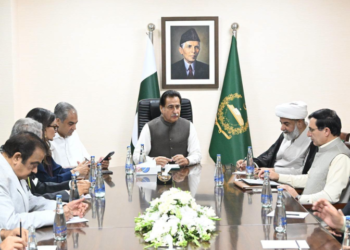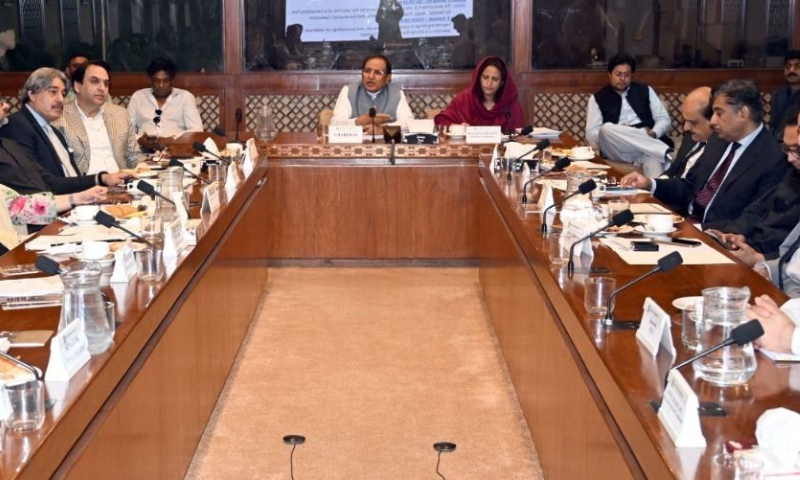
Islamabad, July 2,2026: The Senate Standing Committee on Inter-Provincial Coordination met under the chairmanship of Senator Dilawar Khan to review tourism development in Chitral, infrastructure projects aimed at promoting tourism, and the performance and functions of the Federal Land Commission.
The meeting was attended by Senator Aimal Wali Khan, Senator Rubina Qaim Khani, Senator Syed Kazim Ali Shah, and Senator Rubina Khalid. Senator Muhammad Talha Mahmood participated as the mover of the agenda item, while Senator Nasir Mehmood Butt, Senator Abdul Qadir, Senator Naseema Ehsan, Senator Hidayatullah Khan, and Senator Ahmed Khan attended as special invitees.
The Committee received a comprehensive briefing on the functions and achievements of the Federal Land Commission. It was informed that, out of a total of 3,756,227 acres of land across Pakistan, the Commission has allotted 3,223,193 acres to tenants, while approximately 177,386 acres remain unallotted due to ongoing litigation. Members were informed that the Commission exercises appellate jurisdiction, with aggrieved parties having the right to approach the High Courts and the Supreme Court. The Commission further informed the Committee that only 179 cases are currently pending.
Appreciating the Commission’s performance, the Committee urged it to explore revenue-generation opportunities by leasing unallotted land wherever legally feasible. Chairman Senator Dilawar Khan directed the Commission to propose constructive amendments to its governing law, assuring full parliamentary support. He emphasized that Standing Committees are an extension of Parliament and remain committed to promoting national development and public welfare.
The Committee also received a detailed briefing on efforts to coordinate, facilitate, integrate policies, and promote tourism in Chitral internationally. Members were informed that Chitral and adjoining areas, particularly Kalash, possess immense potential to attract international tourists. However, Senator Muhammad Talha Mahmood highlighted the deteriorating condition of road connectivity and energy infrastructure as major obstacles to tourism growth.
Expressing serious concern over delays in road infrastructure projects, the Committee urged the Federal Government to prioritize the development of Chitral’s tourism infrastructure. Members also voiced strong reservations over inadequate financial allocations for ongoing projects. The Chairman recommended that the Government allocate sufficient funds and focus on completing fewer priority projects to ensure timely execution.
The National Highway Authority (NHA) briefed the Committee on safety measures at the Lowari Tunnel, informing members that installation of tunnel lighting has commenced and is expected to be completed within one month. The Committee was also informed that maintenance work on the Garam Chashma Road is underway but has experienced delays. The Chairman directed the NHA to expedite all ongoing projects, remove bottlenecks without delay, and submit a report on action taken against the consultant responsible for the allegedly faulty feasibility report of the Chitral–Shandur Road (N-140).
The Committee also reviewed the electricity situation in Chitral during a briefing by PESCO. Members expressed concern over reports that local residents had collected donations to repair damaged transformers, describing the situation as unacceptable. The Chairman directed PESCO to submit a detailed report and resolve the issue without delay.
The Committee further observed that, since electricity is generated in Chitral, local consumers should receive electricity at concessional rates similar to the model adopted by PEDO. The Chairman directed the relevant authorities to submit comprehensive details regarding electricity generation and consumption in Chitral, along with a report on the feasibility of providing discounted electricity tariffs to local consumers.
Concluding the meeting, the Committee called for strict action against corruption and irregularities in development projects. It urged the Government to prioritize nationally significant projects, ensure adequate financial allocations, and strengthen oversight mechanisms to prevent unnecessary delays and maximize public benefit.