Tehran, July 3, 2026: Iran on Friday began formal funeral ceremonies for its slain Supreme Leader Ayatollah Ali Khamenei, as clerics, military commanders, foreign dignitaries and thousands of mourners gathered at Tehran’s Grand Mosalla to pay their respects to the leader who ruled the Islamic republic for 37 years.
Khamenei, who was killed in US-Israeli airstrikes on February 28 at the outset of a four-month war, is being honoured through a week of funeral processions and commemorative ceremonies that Iranian authorities are presenting as a national display of mourning, resistance and loyalty to the Islamic republic.
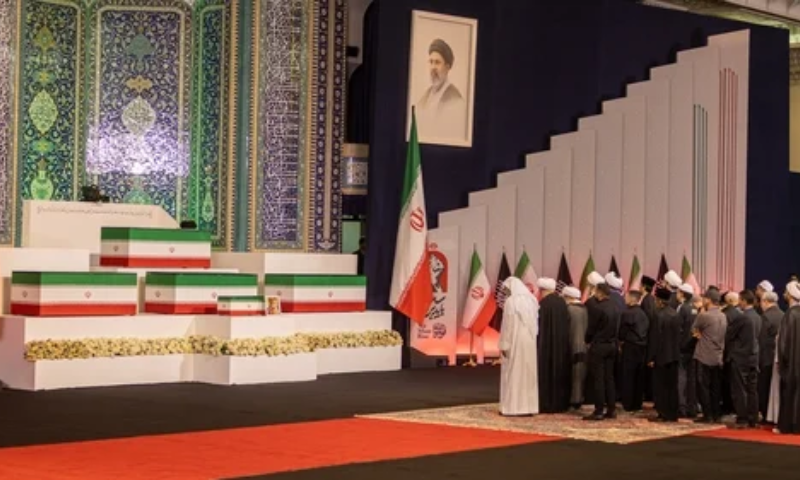
His coffin, draped in Iran’s tricolour flag, was placed in state at the vast prayer hall in Tehran, where mourners dressed in black filed past in grief. The coffins of several family members killed alongside him were also placed nearby as part of the official mourning ceremony.
Coffin placed at Grand Mosalla amid scenes of mass mourning
Khamenei’s body was unveiled late Thursday before a large crowd of supporters, many of whom were seen weeping, chanting and beating their chests in a display of traditional Shi’ite mourning. On Friday, the coffin was laid in state at the Grand Mosalla, one of Tehran’s most important ceremonial venues, where state officials, clerics, military leaders and visiting dignitaries paid tribute.
Images and footage from the ceremony showed the coffins being carried above the hands of mourners before being placed on a white stepped dais inside the prayer hall. A black turban — traditionally worn by clerics who trace their lineage to the Holy Prophet Muhammad (PBUH) — rested atop Khamenei’s coffin on a folded chequered scarf, a symbol often associated in Iran with revolutionary ideals and solidarity with Palestine.
The funeral rites are taking place under extraordinary security, with police, military vehicles and members of the Basij paramilitary force deployed across Tehran. Iranian authorities have also warned the United States and Israel against any hostile action during the funeral period.
Funeral comes at a critical moment for Iran
The funeral of Ayatollah Khamenei comes at a pivotal time for the Islamic republic, which is still navigating the aftermath of the war with Israel and the United States, as well as a fragile ceasefire and ongoing diplomatic contacts with Washington.
Iran’s ruling establishment has portrayed the funeral as both a moment of national mourning and a demonstration of state resilience after what it sees as an existential military confrontation. At the same time, the ceremony is unfolding against the backdrop of economic strain, internal political divisions and public discontent that have tested the authority of the clerical leadership in recent years.
Khamenei’s son, Ayatollah Seyyed Mojtaba Khamenei, who has assumed the position of supreme leader, has remained largely out of public view since reportedly being wounded in the strike that killed his father.
Funeral processions to continue in Iran and Iraq
Iranian authorities have planned a series of funeral events across multiple cities in Iran and Iraq before Khamenei is laid to rest.
According to Iranian media reports, after the main ceremonies in Tehran, the body will be taken to Qom, one of the foremost centres of Shi’ite scholarship in Iran, before funeral events continue in the Iraqi shrine cities of Najaf and Karbala. Khamenei is expected to be buried on Thursday in Mashhad, near the shrine of Imam Reza, in the northeastern city where he was born.
The extended funeral schedule reflects both Khamenei’s religious stature and Iran’s desire to underscore the transnational Shi’ite and political significance of his legacy.
The funeral had initially been delayed due to the security risks posed by the war, but it is now proceeding after a temporary truce and diplomatic understandings helped lower tensions in the region.
From Pakistan, Prime Minister Shehbaz Sharif arrived in Tehran on a one-day visit to participate in the funeral rites. According to the Prime Minister’s Office, he was accompanied by National Assembly Speaker Sardar Ayaz Sadiq, Deputy Prime Minister and Foreign Minister Senator Ishaq Dar, Information Minister Attaullah Tarar, PPP Chairman Bilawal Bhutto Zardari, PPP Secretary General Nayyar Hussain Bukhari, and Sindh Chief Minister Syed Murad Ali Shah.
Pakistan’s Chief of Defence Forces and Chief of Army Staff Field Marshal Syed Asim Munir also arrived in Tehran to attend the funeral prayers, according to Iranian state media.
Separately, Senate Chairman Syed Yousaf Raza Gilani reached Tehran with a parliamentary delegation to attend the funeral ceremonies. Speaking to the media, Gilani described Ayatollah Khamenei as an influential and respected figure in the Muslim world and said Pakistan would use the visit to reaffirm its longstanding ties with Iran.
Other foreign figures attending the funeral included former Iraqi president Abdul Latif Rashid, Armenian Prime Minister Nikol Pashinyan, and delegations from countries aligned with Tehran across the region. Families of slain Hezbollah leaders Hassan Nasrallah and Imad Mughniyeh also attended the ceremony, underlining the regional dimension of the funeral.
Iranian President Masoud Pezeshkian separately held meetings in Tehran with a number of visiting leaders and representatives, including the President of Tajikistan Emomali Rahmon, the Prime Minister of Armenia, the president of Iraq’s Kurdistan region, and the national leader of Turkmenistan, according to Iranian media.
The funeral has also focused attention on the family members killed alongside Khamenei in the February strike. Iranian media reported that the coffins of his daughter, son-in-law and infant granddaughter, as well as the wife of his son Mojtaba, were placed beside his during the mourning ceremony.
The deaths have been invoked by Iranian officials and mourners as part of a broader narrative of martyrdom, sacrifice and resistance that has long held a central place in Shi’ite religious tradition and in the revolutionary ideology of the Islamic republic.
In central Tehran overnight, mourners chanted elegies and religious slogans associated with Imam Hussain, the central figure of Shi’ite martyrdom, while funeral banners and black flags were hung across the capital.
Ghalibaf warns Iran could resume action if ceasefire commitments are not honoured
As funeral ceremonies continued, Iranian officials also used the occasion to deliver political messages about the war and the future of the ceasefire.
Parliament Speaker Mohammad Bagher Ghalibaf warned on Friday that if the United States and Israel failed to honour their commitments to end the conflict, Tehran would respond.
“We strongly demand full implementation of the agreements, and if the US and the Zionist regime fail to fulfil their commitments, Iran will resume proportionate actions,” he was quoted as saying by ISNA.
Ghalibaf said the United States and Israel had failed to achieve their military objectives in the war and claimed that both had ultimately been forced to seek a ceasefire. He also said Iran would not allow American interference in the management of the Strait of Hormuz, adding that arrangements regarding the waterway should be handled by Iran and Oman in accordance with international law.
According to ISNA, he said understandings had been reached during a recent visit to Oman under Article Five of the memorandum of understanding signed to regulate post-war arrangements.
Tehran says it has ‘no trust’ in Washington despite memorandum
Iran’s acting defence minister, Seyyed Majid Ibn Reza, also struck a cautious tone on Friday, saying Tehran did not trust the United States despite the signing of a memorandum aimed at restoring regional stability.
According to Press TV, he said the agreement with Washington had been reached in support of regional peace efforts and at the request of friendly neighbouring countries, but warned that Iran’s armed forces remained on full alert.
“Given the United States’ long history of failing to honour its commitments, Iran has no trust in the other party,” he said, adding that Iran would respond proportionately to any violation of the agreement.
The funeral also unfolded amid continuing diplomatic and military tensions in the region.
An Iranian lawmaker, Ebrahim Rezaei, called for a review of Iran’s nuclear doctrine following Israeli threats against Supreme Leader Mojtaba Khamenei, saying such developments provided a compelling reason for Tehran to reconsider its position.
Meanwhile, The Washington Post reported that senior US officials had feared Israel intended to assassinate Iran’s top negotiators during Washington’s diplomatic push to end the conflict and reopen the Strait of Hormuz.
In Washington, US President Donald Trump said negotiations with Iran were progressing and claimed Tehran had agreed to “just about everything” the United States wanted. He reiterated that Washington was not seeking regime change in Iran, but insisted the US objective remained preventing Tehran from acquiring a nuclear weapon.
Former US-Iran negotiator Alan Eyre also urged Washington to accelerate talks with Tehran once the funeral ceremonies conclude, arguing that the current pace of negotiations had been too slow.
Qatari and Pakistani mediators said on Thursday that the next round of US-Iran talks would be held “at the earliest possible time” after the funeral of Ayatollah Khamenei.
For Iran’s leadership, the funeral is more than a farewell to a supreme leader; it is also an attempt to project continuity, ideological cohesion and national endurance after one of the most serious crises in the Islamic republic’s history.
The week-long ceremonies — stretching from Tehran to Qom, Najaf, Karbala and Mashhad — are blending religion, statecraft and geopolitics, as Iran seeks to honour a leader whose death has transformed the country’s political landscape while also signalling that the institutions he led remain firmly in control.