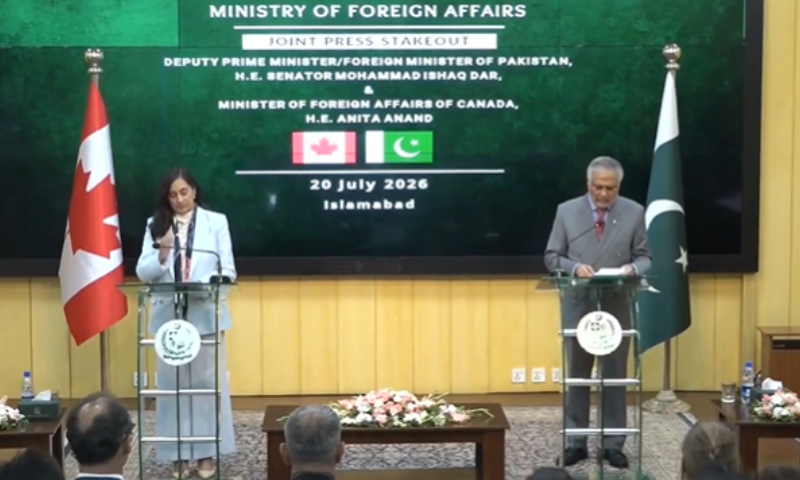
Islamabad, July 20, 2026: Pakistan and Canada on Monday agreed to strengthen bilateral relations by expanding cooperation in trade, investment, renewable energy, agriculture, mining, security and people-to-people exchanges, following talks between Deputy Prime Minister and Foreign Minister Senator Mohammad Ishaq Dar and Canadian Foreign Minister Anita Anand.
The understanding was outlined in a joint statement issued after Anand’s official visit to Pakistan—her first since assuming office.
During their meeting, both sides reaffirmed their commitment to deepening bilateral engagement through increased trade, investment and institutional cooperation. They also reviewed Pakistan’s mediation efforts aimed at easing regional tensions, with Canada appreciating Islamabad’s role in facilitating the Islamabad Memorandum of Understanding (MoU). The two countries stressed the importance of maintaining a sustainable ceasefire and fully implementing the commitments under the agreement.
The ministers welcomed the successful sixth round of Pakistan-Canada Bilateral Consultations held in February 2026 and agreed to expand cooperation through stronger economic, academic and institutional linkages.
Recognising the contribution of more than 300,000 Pakistani-origin residents and over 9,000 Pakistani students in Canada, both governments agreed to promote greater people-to-people contacts, cultural exchanges, tourism and improved mobility while encouraging closer parliamentary cooperation.
Trade and investment featured prominently in the discussions, with both sides welcoming progress towards concluding a Pakistan-Canada Foreign Investment Protection Agreement (FIPA) and agreeing to revive the Pakistan-Canada Joint Working Group on Trade and Investment to accelerate economic cooperation.
The two ministers also agreed to encourage greater business collaboration in priority sectors, including clean energy, mining and critical minerals, infrastructure, agriculture, emerging technologies and environmental sustainability, while promoting more business delegations between the two countries.
Highlighting cooperation in renewable energy, both sides welcomed regulatory approval for Canadian company JCM Power’s 240-megawatt Dhabeji Hybrid Wind-Solar Project, being developed in partnership with K-Electric, describing it as a major contribution to Pakistan’s clean energy transition.
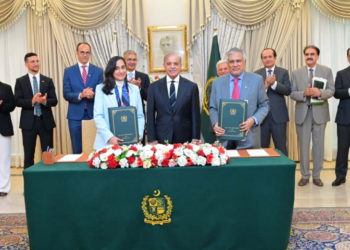
In agriculture, Pakistan and Canada signed a protocol establishing predictable phytosanitary import requirements for Canadian canola intended for food, feed and processing. They also agreed to enhance cooperation in agri-food value chains, food safety, sanitary and phytosanitary standards, and technical capacity building, while promoting two-way trade in canola, oilseeds, lentils, soybeans, cereals, rice, spices and fruits.
The two sides recognised Pakistan’s vast mineral resources and Canada’s expertise in responsible mining, agreeing to promote bilateral cooperation across the mining value chain. Canadian Foreign Minister Anita Anand also invited Deputy Prime Minister Ishaq Dar to attend the 2027 Prospectors and Developers Association of Canada (PDAC) conference.
Pakistan and Canada reaffirmed their close cooperation at multilateral forums, including the United Nations, and exchanged views on regional peace and security, developments in Afghanistan and the continuing threat of terrorism.
The two countries also agreed to enhance collaboration on counterterrorism and combating transnational organised crime. Canada announced that it would continue supporting Pakistan’s counterterrorism efforts through projects implemented with the United Nations, INTERPOL and other international organisations.
On climate and development cooperation, Canada announced new assistance projects focused on education, climate resilience and healthcare.
Concluding the talks, both sides agreed that Pakistan-Canada relations had entered a new phase of opportunity and committed to sustaining high-level engagement, with annual reviews to monitor progress across key areas of cooperation.