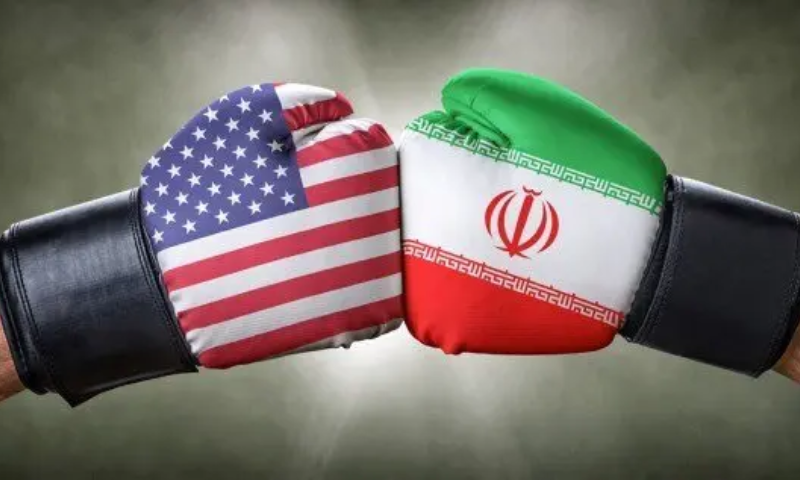
Tehran/Washington, July 29, 2026: United States President Donald Trump on Wednesday warned that Washington would strike Iran “hard” in response to attacks on American forces in Jordan, as tensions across the Middle East deepened amid renewed military exchanges, maritime security concerns and diplomatic efforts to prevent a wider regional conflict.
Speaking in a telephone interview with Fox News, President Trump said the United States would respond forcefully to Tehran after Iran claimed responsibility for launching ballistic missiles at a US military base in Jordan.
“We’ll be hitting them hard,” Trump said. “They’re going to get a beating.”
The US president also confirmed that overnight airstrikes against Iran-backed militias in Iraq had been carried out in coordination with the Iraqi government. Despite the military action, Trump indicated that diplomatic channels with Tehran remained open.
“We’re going to let them keep talking,” he said, referring to ongoing indirect negotiations aimed at easing tensions.
Earlier this week, Trump had described the talks with Iran as “good” and expressed hope for an agreement, while warning that US military operations could resume if diplomacy failed.
The latest escalation followed Iran’s missile attack targeting US forces in Jordan. The Jordanian Armed Forces said their air defence systems intercepted and destroyed five missiles before they reached their targets, adding that no casualties or damage were reported.
Iran’s Islamic Revolutionary Guard Corps (IRGC) said the missile launches were in retaliation for what it described as US military aggression against Iranian interests and warned that operations would continue as long as threats against Iran persisted.
Meanwhile, the US Central Command (CENTCOM) confirmed that all Iranian ballistic missiles fired toward American forces in the region had been intercepted.
In another development, Reuters reported that Yemen’s Houthi movement is considering imposing transit fees on commercial vessels passing through the Bab el-Mandeb Strait after declaring a maritime blockade against Saudi Arabia earlier this month.
According to regional sources, Houthi officials discussed the proposal with Iranian counterparts during a recent visit to Tehran. The reported plan would establish a mechanism to regulate shipping through the strategic waterway linking the Red Sea and the Gulf of Aden. Chinese vessels would reportedly be exempt from the proposed charges.
The move has raised concerns among Gulf and Western governments, which fear further disruption to global energy supplies and international shipping. Analysts warn that any restrictions in the Bab el-Mandeb could significantly affect maritime trade, particularly if combined with instability in the Strait of Hormuz.
Adding to regional uncertainty, Iran rejected Oman’s proposal for jointly managing navigation routes through the Strait of Hormuz. Iranian Deputy Foreign Minister Kazem Gharibabadi said Tehran instead proposed maintaining control over both its own shipping lane and part of the route passing through Omani waters.
He warned that if Oman rejected the proposal, the strategically vital waterway would remain closed.
The Gulf Cooperation Council (GCC) strongly condemned attacks targeting Saudi Arabia, describing them as a dangerous escalation and reaffirming full support for the Kingdom’s security and territorial integrity.
Saudi Foreign Minister Prince Faisal bin Farhan held consultations with his counterparts from Qatar, Kuwait and Bahrain, with the ministers stressing the importance of safeguarding freedom of navigation through both the Strait of Hormuz and the Bab el-Mandeb Strait while supporting diplomatic efforts to reduce regional tensions.
China also called for restraint, urging all parties to resolve differences through dialogue and consultation while ensuring the safety of international shipping lanes.
European Union foreign policy chief Kaja Kallas discussed the Gulf situation with Iranian Foreign Minister Abbas Araghchi, emphasizing the need to use the current pause in fighting to return to diplomacy and prevent another full-scale conflict.
Separately, Israel continued military operations in southern Lebanon, where Lebanese state media reported shelling, drone activity and demolition of homes despite an ongoing US-mediated framework agreement aimed at reducing hostilities.
The rapidly evolving crisis continues to raise concerns over regional stability, energy security and the safety of key international maritime routes, with diplomatic efforts intensifying to prevent further escalation.