Tehran, August 8, 2026: Iran has rejected suggestions that the reopening of the Strait of Hormuz is directly linked to its negotiations with Oman, while President Masoud Pezeshkian said Tehran would not surrender its military capabilities or bow to pressure from the United States and Israel.
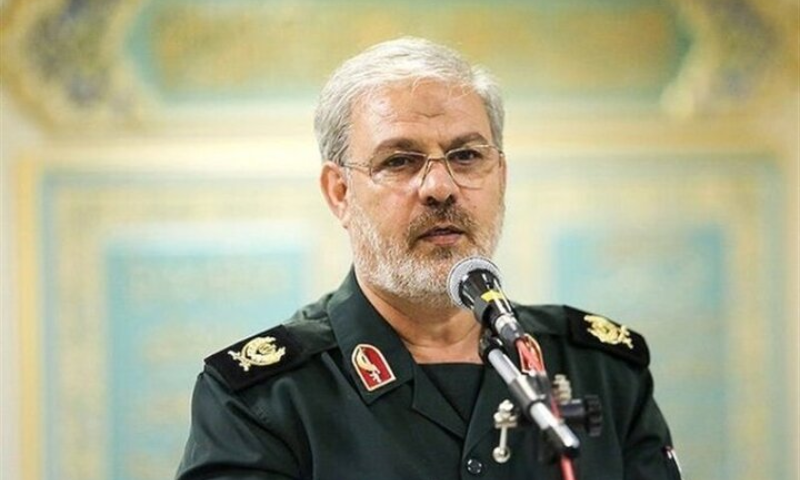
Islamic Revolutionary Guard Corps (IRGC) spokesperson Brigadier General Mohebbi said the reopening of the strategic waterway would depend on Iran’s own mechanisms and conditions.
“The reopening of the Strait of Hormuz is subject to the specific mechanisms and conditions of the Islamic Republic of Iran and is entirely unrelated to the negotiations between Iran and Oman,” Mohebbi said, according to Press TV.
His remarks came amid renewed reports of progress in talks between Iran and Oman aimed at restoring commercial shipping through the vital maritime passage. A US official told Reuters that Washington expected an agreement between Tehran and Muscat soon, potentially allowing normal oil traffic to resume.
The official said the United States would lift its blockade of Iranian ports once an agreement was announced to restore commercial shipping without impediments, while stressing that US measures would remain tied to Iran’s implementation of its commitments.
In a televised address, President Pezeshkian said Iran would not accept conditions designed to force the country into submission and would continue defending what it considers its national rights.
“If they seek to force us into submission, we will fight. We will not back down,” Pezeshkian said, according to Press TV.
He rejected any prospect of Iran abandoning its military and defensive capabilities, describing them as non-negotiable elements of national security.
Pezeshkian also praised Iran’s armed forces for their response during the latest conflict with the United States and Israel, saying the country’s Aerospace Forces, Army, IRGC and other military personnel had mounted what he described as a strong defensive response.
The Iranian president further accused Israel and the United States of attempting to unite Persian Gulf countries against Tehran. He said Iran sought stronger Muslim unity and rejected sectarian divisions between Sunni and Shia Muslims.
Pezeshkian also denied that Iran intended to attack neighbouring countries or expand its territory, saying Tehran wanted to maintain peaceful relations with regional states.
Amid the continuing uncertainty, US Chairman of the Joint Chiefs of Staff Gen Dan Caine has reportedly urged senior Trump administration officials to explore avenues for de-escalating the conflict with Iran.
CNN, citing sources familiar with the discussions, reported that Caine had raised concerns with senior officials including CIA Director John Ratcliffe, Secretary of State Marco Rubio and Vice President JD Vance.
According to the report, Caine and other officials believe airpower alone may not be sufficient to force Tehran to accept US demands, while a major escalation could trigger retaliation against American allies and regional energy infrastructure.
Concerns over US weapons stocks, particularly air-defence interceptors and precision munitions, have also reportedly complicated calculations over a prolonged military campaign.
The report said Washington was seeking an outcome that President Donald Trump could portray as a political success while preserving space for diplomacy, including a possible agreement concerning the Strait of Hormuz.
A US official said Friday that there had been progress between Iran and Oman and that an agreement could be reached soon.
The Strait of Hormuz is one of the world’s most important energy corridors, with a substantial share of global oil supplies traditionally passing through the waterway. Disruptions to shipping have contributed to higher energy prices and increased concerns over global inflation and energy security.
Iran, however, has repeatedly disputed claims that a final agreement on reopening the waterway has been reached, underscoring the gap between Washington’s assessment and Tehran’s public position.
The uncertainty has also affected shipping activity, with energy companies and vessel operators closely monitoring developments before committing to voyages through the strategic waterway.
The developments come a day after Pakistan, Saudi Arabia and Türkiye signed a Joint Defence Agreement in Makkah, committing the three countries to collective security and mutual defence.
The agreement provides that an armed attack against any one of the three countries would be regarded as an attack against all, according to the countries’ statements. Türkiye has said the pact is defensive and is not directed against any particular country.
The agreement comes amid heightened regional tensions and concerns over the possibility of a wider conflict involving Iran and Gulf states.
Meanwhile, Washington is also seeking to address another front involving Israel and Iran-backed Hezbollah in southern Lebanon. A Lebanese official said Friday that Lebanon and Israel had agreed on a shortlist of countries that could participate in monitoring Hezbollah’s disarmament under a US-brokered arrangement.
Pezeshkian has also defended diplomatic engagement with the United States despite opposition from Iranian hardliners.
In an interview broadcast on Iranian state television, he argued that dialogue could provide a means of securing Iran’s interests without resorting to prolonged conflict.
“America’s biggest enemy is China; why don’t they fight?” Pezeshkian said, arguing that China had continued strengthening itself while pursuing its interests.
“When we can get our rights through dialogue, why not do it?” he added.
The contrasting positions highlight the uncertainty surrounding efforts to end the conflict. While Washington continues to signal that a deal on the Strait of Hormuz could be imminent, Tehran maintains that any reopening will be determined according to Iranian conditions and mechanisms, leaving the prospects for a broader settlement uncertain.