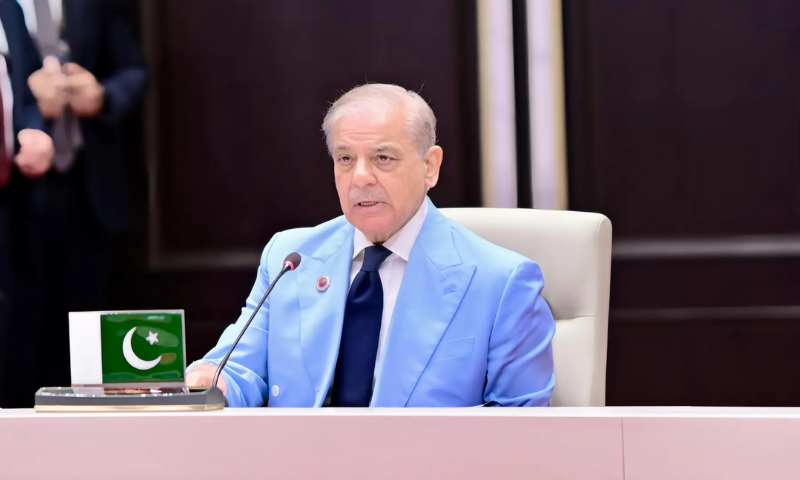
Bishkek, September 1, 2026: Prime Minister Muhammad Shehbaz Sharif has called for water to never be used as a weapon or instrument of political coercion, while urging Shanghai Cooperation Organisation (SCO) member states to promote peace, connectivity, economic cooperation and shared prosperity.
Addressing the SCO Council of Heads of State meeting in Bishkek on Tuesday, the prime minister said the region could not realise its full potential without lasting peace and stressed the need to uphold international commitments governing shared water resources.
“Water is the lifeblood of our region. It sustains millions of lives, nourishes our land and secures the very future of our coming generations,” he said.
Shehbaz stressed that water “must never be weaponised” or used as an instrument of coercion or political leverage.
“The treaties governing our shared waters are solemn, binding international commitments. They are not matters of political convenience to be cast aside at your will. They must be honoured unconditionally, in both letter and spirit,” he said.
His remarks came a day after the Permanent Court of Arbitration (PCA) ruled that the Indus Waters Treaty (IWT) remained fully in force and that India had no grounds to unilaterally suspend or terminate the agreement.
The prime minister also highlighted terrorism as one of the gravest threats facing the region. He said Pakistan had worked actively to strengthen regional counter-terrorism cooperation as chair of the SCO Regional Anti-Terrorist Structure (RATS).
“Few nations have fought against the scourge of terrorism as resolutely and valiantly as Pakistan,” Shehbaz said, adding that the country had lost more than 90,000 lives and suffered economic losses exceeding $150 billion over the past two and a half decades in the fight against terrorism.
On Afghanistan, the prime minister said Pakistan wanted a peaceful and stable neighbouring country but warned that lasting regional peace would remain elusive as long as terrorist groups continued to use Afghan territory against Pakistan and other countries.
Pakistan takes over SCO chairmanship
Pakistan formally assumed the chairmanship of the SCO Council of Heads of State for 2026-27, with Islamabad scheduled to host the next summit in 2027. Shehbaz said Pakistan would pursue its chairmanship under the theme “Turning vision into action, connectivity, innovation and shared prosperity”.
He outlined an agenda focused on information technology and artificial intelligence, energy development, poverty reduction, disaster management, health, culture and sports. Pakistan also proposed establishing an SCO framework for sovereign AI infrastructure and governance to promote responsible and inclusive development of artificial intelligence and ensure that no member state was left behind.
The prime minister urged SCO members to translate the organisation’s vision into practical outcomes, saying connectivity had become a strategic imperative amid geopolitical tensions, disruptions to supply chains and emerging security challenges.
He highlighted the China-Pakistan Economic Corridor (CPEC) as a gateway connecting regional economies with the Arabian Sea and reaffirmed Pakistan’s commitment to advancing trans-regional railway, road and energy connectivity projects.
Shehbaz also called for implementation of the SCO Development Strategy until 2035 and described the establishment of an SCO Development Bank as a critical step towards strengthening regional economic cooperation.
As permanent chair of the SCO Special Working Group on Poverty Reduction, Pakistan would continue promoting social protection and inclusive and sustainable development across the region, he said.
Pakistan highlights mediation role in US-Iran conflict
The prime minister also highlighted Pakistan’s diplomatic efforts to promote peace and de-escalation in the Middle East.
Referring to the conflict between the United States and Iran, Shehbaz said Pakistan had consistently acted as an “honest and sincere mediator and facilitator”.
He recalled that Pakistan’s diplomatic efforts had contributed to the signing of the Islamabad Memorandum of Understanding in June, describing it as a critical step towards regional de-escalation and restoration of peace.
“We firmly believe that the Islamabad MoU offers the most viable and enduring pathway to lasting peace in the region,” he said.
The prime minister also referred to the Makkah Defence Alliance between Pakistan, Saudi Arabia and Türkiye, describing the pact as fundamentally defensive in nature and stressing that it was not directed against any state.
He said the agreement strengthened prospects for regional peace by sending a message of unity and common resolve.
Shehbaz calls for UN reform
Addressing the SCO Plus Summit, the prime minister called for urgent reform of the United Nations, saying the global body must become more accountable and responsive.
Pakistan, he said, remained committed to the UN Charter and viewed the emergence of a multipolar world as an opportunity to build a more equitable, democratic and just international system.
As a non-permanent member of the UN Security Council, Pakistan had contributed to global peacemaking, he said, highlighting the Islamabad MoU as an example of the country’s diplomatic efforts.
Shehbaz also expressed deep concern over the situation in Gaza and the occupied West Bank, calling on the international community to act decisively to end the suffering of Palestinians and uphold their right to self-determination.
He also urged the SCO to condemn terrorism in all its forms and manifestations, including what he described as state terrorism.
Shehbaz meets Lukashenko, other leaders
On the sidelines of the SCO summit, Prime Minister Shehbaz Sharif met Belarusian President Aleksandr Lukashenko and discussed ways to further strengthen bilateral cooperation in trade, industry, agriculture, information technology and vocational training.
The two leaders expressed satisfaction with the positive trajectory of Pakistan-Belarus relations and reaffirmed their commitment to taking bilateral ties to new heights. Shehbaz also invited Lukashenko to visit Pakistan next year.
Meanwhile, Deputy Prime Minister and Foreign Minister Ishaq Dar held a series of meetings with his counterparts from China, Iran, Russia, Uzbekistan, Azerbaijan, Tajikistan, Belarus and other countries.
During his meeting with Iranian Foreign Minister Abbas Araghchi, Dar stressed that sincere implementation of the Islamabad MoU remained essential for achieving peace and stability in the region.
Dar also held a warm exchange with Chinese Foreign Minister Wang Yi, with both sides reaffirming the All-Weather Strategic Cooperative Partnership between Pakistan and China. They discussed bilateral relations, the upcoming UN General Assembly session and the election process for the next UN secretary-general.
The Pakistani deputy premier also met Türkiye’s National Intelligence Organisation Director İbrahim Kalın, with discussions focusing on regional developments, the Makkah Joint Defence Agreement and the inaugural meeting of its Strategic Political and Defence Committee.
His meeting with Russian Deputy Prime Minister Alexei Overchuk focused on strengthening the Pakistan-Russia partnership, expanding bilateral cooperation and maintaining high-level engagement.
SCO marks 25 years
The SCO summit brought together leaders from China, Russia, Iran, Türkiye, India, Kazakhstan, Tajikistan, Uzbekistan, Belarus and the host country Kyrgyzstan as the organisation marked its 25th anniversary.
At the outset of his address, Shehbaz congratulated Kyrgyz President Sadyr Zhaparov on the successful SCO chairmanship and commended Kyrgyzstan’s contribution to advancing practical cooperation among member states.
He also felicitated the governments and peoples of Kyrgyzstan and Uzbekistan on their respective independence anniversaries.
Describing the gathering as historic, Shehbaz thanked President Zhaparov and the Kyrgyz leadership for their hospitality and arrangements for the summit.
“Let us move forward together with the resolve that, in a time of uncertainty, history will record the SCO as having chosen cooperation over confrontation, dialogue over division, and hope over fear,” he said.
He added that the SCO should not merely witness a changing world but work collectively to shape it.