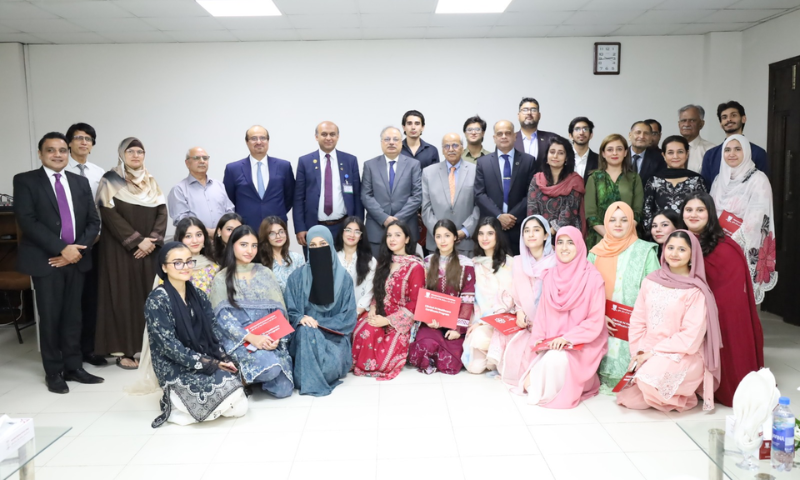
Islamabad, September 5, 2026: Islamabad Medical & Dental College (IMDC) has taken a significant step towards integrating Artificial Intelligence into healthcare education, with the Pakistan Medical and Dental Council (PMDC) endorsing the institution’s initiative to prepare medical professionals for the rapidly evolving healthcare landscape.
PMDC President Prof. Dr. Rizwan Taj commended IMDC’s efforts at a certificate-awarding ceremony marking the completion of the college’s first Clinical AI Healthcare Certificate Program, conducted in collaboration with Shaheed Zulfiqar Ali Bhutto Medical University (SZABMU).
The four-week, weekend-based programme brought together 24 medical and dental students and healthcare professionals for a 10-credit-hour course focused on practical applications of Artificial Intelligence in healthcare.
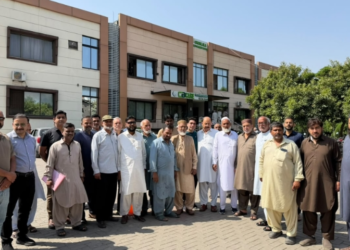
Prof. Dr. Rizwan Taj attended the ceremony as chief guest, accompanied by PMDC Registrar Brig. (R) Dr. Syed Rehan Naqvi and Director Academics Dr. Sitara. SZABMU was represented by Registrar Prof. Dr. Syed Tanseer Asghar and Head of Medical Education Dr. Fauzia Sultana.
Endorsing IMDC’s initiative, Prof. Dr. Rizwan Taj emphasised the importance of keeping medical education aligned with the evolving requirements of the healthcare profession and system.
Senior PMDC and SZABMU representatives also visited IMDC’s state-of-the-art computer laboratory established for Clinical AI training. SZABMU management reaffirmed its support for the initiative and expressed commitment to a long-term academic partnership with IMDC in Artificial Intelligence education, research and innovation.
IMDC said it welcomed the encouragement and confidence expressed by PMDC and reaffirmed its commitment to advancing AI in healthcare education in line with the evolving direction and roadmap of PMDC and the Government of Pakistan for innovation and the future of medical education.
Yasir Khan Niazi, Group CEO of GAK HealthCare International and IMDC, said Pakistan was entering a new era in healthcare as Artificial Intelligence was rapidly transforming the way healthcare was being delivered worldwide.
“AI is no longer the future of healthcare; it is already redefining it. The institutions that understand this transformation today will shape the healthcare of tomorrow,” he said.
He said the completion of the first Clinical AI cohort represented the first milestone in IMDC’s long-term vision to lead the transformation of healthcare education.
“We are moving beyond teaching AI as a new subject towards leading the integration of AI, digital medicine and emerging technologies across medical, dental, nursing and allied health sciences education, preparing graduates not simply to use tomorrow’s technologies, but to innovate and excel with them,” Niazi said.
He said the ultimate objective was to use technology to make quality healthcare more accessible.
“We envision a connected healthcare ecosystem where major hospitals, local clinics and general practitioners can harness AI and global medical advances to deliver timely, high-quality care. That is how we see technology advancing our vision of Quality Healthcare for All,” he said.
The initiative is supported academically by Dr. Muhammad Usman Hadi of Ulster University, Belfast, UK, and Adjunct Professor of AI at IMDC, bringing international academic expertise to the college’s Clinical AI education and development.
Imran Ali Ghouri, Head of IMDC Communication, said the institution was building on the milestone by advancing its Center for AI in Healthcare as a platform for Clinical AI education, applied research, innovation and collaboration.
“Building on this milestone, IMDC is advancing its Center for AI in Healthcare as a platform for Clinical AI education, applied research, innovation and collaboration, while expanding its AI programs and research,” Ghouri said.
He said continued support from PMDC and collaboration with SZABMU would provide a strong institutional foundation for the next phase, positioning IMDC to lead the integration of AI into healthcare education and prepare professionals for global advances in the field.
He added that the initiative would also create new opportunities for healthcare professionals to excel both in Pakistan and internationally.