
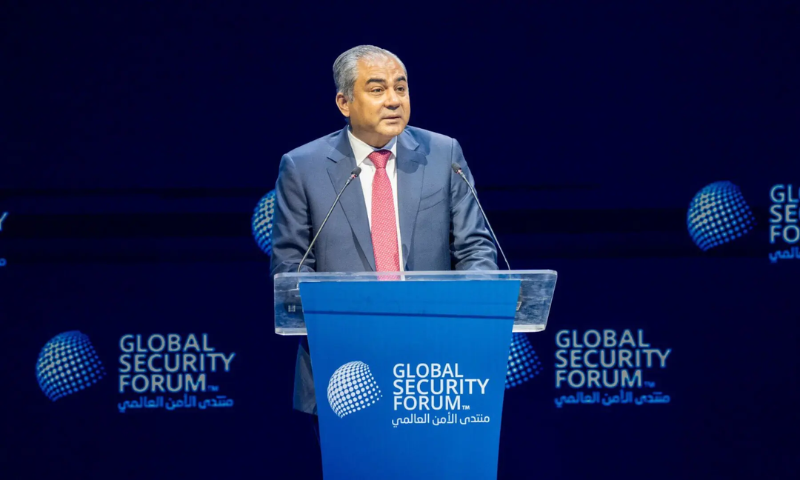
Doha, October 19,2026: Interior Minister Mohsin Naqvi has said Pakistan never abandoned its efforts to mediate between the United States and Iran, emphasizing that Islamabad remained committed to dialogue and peace despite heightened regional tensions.
Addressing the 8th Global Security Forum in Qatar’s capital on Monday, Naqvi said Pakistan had made every possible effort to reduce tensions during the conflict involving Washington and Tehran.
Held under the theme “The Future of Alliances”, the forum has brought together senior officials and dignitaries from more than 100 countries, according to Qatar News Agency.
“The last few months have been very difficult for our region. The conflict involving Iran and the United States created serious risks not only for the Middle East, but for the entire world,” Naqvi said.
He added that Pakistan had chosen the path of peace and continued engaging the parties even when the situation became extremely tense.
“We continued talking, listening and working to build trust. And I can tell you from my experience: peace is not achieved in one meeting; it requires patience, trust and continuous efforts,” he said.
The interior minister particularly praised Chief of Defence Forces and Chief of Army Staff Field Marshal Syed Asim Munir for his role in Pakistan’s diplomatic efforts to ease regional tensions.
Field Marshal Munir, accompanied by Naqvi, visited Iran in August as part of Islamabad’s efforts to promote regional peace and stability. Naqvi also travelled to Iran in September for engagements with Iranian officials.
Recalling the signing of the Islamabad Memorandum of Understanding (MoU) between Iran and the United States on June 18, Naqvi said the 14-point agreement, facilitated by Pakistan, provided a framework for ending the conflict that began with US-Israeli strikes on Iran on February 28.
He said the MoU was followed by the Lake Lucerne Summit in Switzerland, organized by Pakistan and Qatar as mediators.
Recalling the negotiations, Naqvi said Qatar’s Prime Minister Mohammed bin Abdulrahman Al Thani and Field Marshal Munir worked for more than 16 hours without a break in an effort to keep the talks on track.
“There were no cameras, no announcements; only two men who refused to let the talks fail,” he remarked.
He said the objective of Pakistan and Qatar was to prevent further conflict and save innocent lives.
Naqvi also praised Qatar’s diplomatic efforts, saying the country had continued to facilitate dialogue at a time when others had chosen sides.
“Pakistan has seen this closely because we have worked beside you,” he said.
The minister stressed that Pakistan believed dialogue was preferable to war and identified three key lessons from recent diplomatic efforts: keeping the door open to negotiations, building trust between parties and ensuring sincere commitment from all sides.
He said no single country could achieve regional peace on its own and reaffirmed Pakistan’s commitment to supporting dialogue, cooperation and peaceful solutions.
“We believe that winning peace is far more important than winning a war,” Naqvi said.
He added that Pakistan was not seeking recognition for its mediation efforts but wanted to help create a future in which wars could be prevented.
Naqvi’s remarks come as diplomatic efforts to end the US-Iran conflict continue amid disagreements over the terms of a settlement and the reopening of the Strait of Hormuz, a key route for global oil shipments.
Following the collapse of an interim ceasefire, Iran presented a proposal in September to reopen the strategic waterway. The United States rejected the proposal, while Iranian officials said negotiations had stalled over Washington’s response to Tehran’s conditions.
On Sunday, Iranian Foreign Minister Abbas Araghchi said Tehran’s offer to reopen the strait within seven days remained on the table.
Meanwhile, tensions have also intensified on another regional front following reported attacks by Yemen’s Houthi rebels against Saudi Arabia, after a truce in the country’s long-running conflict unravelled in July.
During his address, Naqvi cited the Makkah Joint Defence Agreement, signed by Pakistan, Saudi Arabia and Turkiye in August, as an example of Islamabad’s commitment to regional security.
“It is a pact for defence, not for war,” he said, adding that no country could enjoy lasting peace while its neighbours remained embroiled in conflict.
The agreement established the Makkah Defence Alliance, under which the three signatory states are committed to treating an attack against one member as an attack against all.
Naqvi said the arrangement was intended to strengthen collective security and deter aggression rather than promote conflict.
The interior minister also called for greater international cooperation to address terrorism and other security challenges.
“As Pakistan’s interior minister, I also understand the price of terrorism and insecurity. Pakistan has suffered greatly; thousands of our citizens, soldiers, and policemen have lost their lives. Even today, we continue to fight,” he said.
Describing terrorism as a common enemy, he urged countries to strengthen cooperation, improve intelligence-sharing and undertake joint efforts to combat the threat.
Naqvi said Pakistan had not only sought international cooperation against terrorism but had also contributed to global security through its participation in United Nations peacekeeping missions.
He highlighted the role of Pakistani police peacekeepers in protecting civilians, supporting local law enforcement and helping restore peace in conflict-affected countries.
“We are proud of their services and sacrifices,” he said, reaffirming Pakistan’s commitment to international peace and security.