
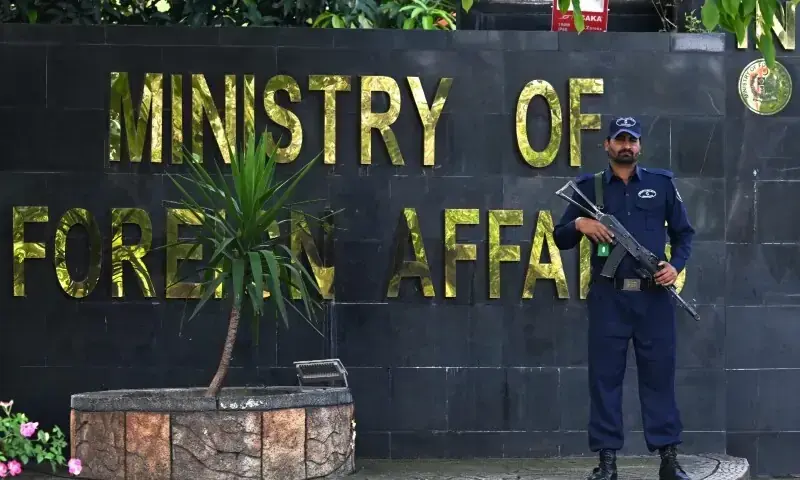
Islamabad, October 26,2026: The Foreign Office (FO) on Monday rejected allegations by the Afghan Taliban government that Pakistani counterterrorism operations in Afghanistan had caused civilian casualties, saying Pakistan’s actions reflected restraint and were proportionate to the level of threat.
The Afghan Taliban have repeatedly alleged civilian casualties in Pakistani strikes in Afghanistan, while Islamabad has maintained that its operations target terrorist networks and their military infrastructure.
Recently, a spokesperson for Afghanistan’s Ministry of Foreign Affairs claimed in an interview with CNN that 1,119 Afghan civilians had been killed or injured in Pakistani military strikes since late 2021, according to Afghan media reports.
In a statement issued on Monday, the FO described the allegations as “baseless and unsubstantiated”, rejecting claims of civilian casualties attributed to Pakistan’s counterterrorism operations.
“Disinformation and misleading narratives will neither obscure the threat posed by the terrorist networks operating from Afghan territory nor absolve the Afghan Taliban regime of its responsibility to prevent Afghan soil from being used to plan and launch attacks against Pakistan,” the FO said.
It added that attacks originating from Afghan territory had caused more than 3,500 casualties in Pakistan in 2026. The FO also referred to reports by relevant United Nations mechanisms, saying the issue had been raised as a serious concern for the international community.
The statement accused the Afghan Taliban of continuing to shelter terrorist organisations, including the Tehreek-i-Taliban Pakistan (TTP), the Balochistan Liberation Army (BLA) and their affiliates, which it said posed a serious threat to regional and international peace and stability.
The FO said thousands of Pakistani civilians had been martyred in terrorist attacks that were “planned, financed, supported and carried out” from Afghan territory, alleging that the Afghan Taliban had enabled such activities through “watch, patronage and active facilitation”.
“No responsible state can remain passive when its civilians and security forces are repeatedly targeted,” the statement said.
The FO maintained that Pakistan’s response to terrorist attacks was an exercise of its right to self-defence, guided by the principles of necessity and undertaken as a last resort.
It said Pakistani operations were “directed only and exclusively against terrorists and their logistical support bases in Afghanistan”, adding that the response was proportionate to the threat and adhered to the principles of distinction and precaution.
“The scale and scope of the action reflected restraint, particularly in light of the severity and frequency of terrorist attacks faced by Pakistan. Pakistan rejects any insinuations otherwise,” the statement added.
The FO urged the international community to hold the Afghan Taliban government accountable for what it described as a failure to fulfil its obligations under international commitments.
“Pakistan reserves the right to take all necessary measures in order to safeguard its sovereignty, territorial integrity, and the safety and security of Pakistani nationals,” it said.
A UN Security Council-mandated monitoring report covering December 16, 2025, to June 9, 2026, said the Afghan Taliban’s continued support for the TTP had contributed to an increase in the frequency and lethality of terrorist attacks in Pakistan, although Kabul had taken some initial steps to rein in the group.
Relations between Pakistan and Afghanistan have remained strained in recent years, with Islamabad repeatedly expressing concern over cross-border terrorism and urging the Taliban administration to dismantle terrorist sanctuaries on Afghan soil, particularly those linked to the banned TTP. Pakistani officials say these demands have gone unheeded.
In September, the two neighbours experienced another bout of conflict, with Pakistan carrying out calibrated airstrikes in border areas following terrorist attacks in Khyber Pakhtunkhwa. The strikes were followed by drone incursions from across the border, which Islamabad said were intercepted, and two further rounds of retaliatory airstrikes.
Over the weekend, Pakistan’s Information Ministry also rejected what it called “baseless and misleading allegations” by former US envoy Zalmay Khalilzad that Pakistan was “arming Afghans to fight the Taliban”.
The ministry also disputed the Afghan Taliban’s assertion that it lacked the capability to fuel insecurity in other countries, accusing the group of making diversionary allegations instead of preventing Afghan territory from being used to launch terrorist attacks against Pakistan.