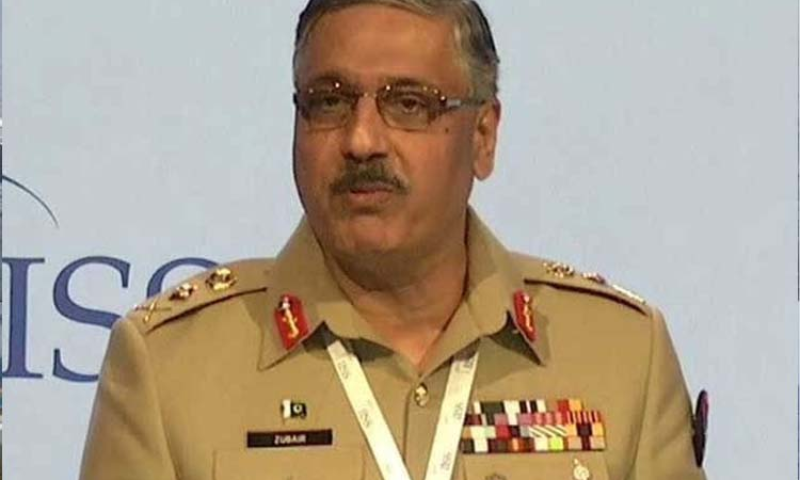
Islamabad, July 11, 2025: South Asia is teetering on the brink of crisis and instability, warned General Zubair Mahmood Hayat, NI(M), HI(M), former Chairman Joint Chiefs of Staff Committee (CJCSC), during a keynote address at the Institute of Strategic Studies Islamabad (ISSI). Speaking at the latest session of the Thought Leaders Forum (TLF), General Hayat delivered a stark assessment of the region’s deteriorating strategic environment under the theme “Peace and Stability in South Asia and Beyond.”
General Hayat cautioned that South Asia “lingers just below the threshold of stability,” gripped by a complex security quagmire marked by the absence of crisis management mechanisms, weak regional cooperation, and India’s aggressive strategic realignment.
“The doomsday clock for South Asia now stands at 30 seconds to midnight,” he warned, citing India’s escalating military build-up, ideological drift, and shifting doctrines—from the so-called ‘Doval doctrine’ to the more provocative ‘Modi doctrine’. He said this evolution in India’s security policy reflects “grand strategic delusions” that have not only heightened regional tensions but also destabilized the delicate deterrence balance.
General Hayat emphasized that India’s evolving posture has triggered “reverse deterrence,” strengthening Pakistan’s resolve rather than weakening it. He highlighted Kashmir’s long-standing role as a nuclear flashpoint, but noted that after the May 2025 military standoff, water has now emerged as an additional dimension in regional disputes, further complicating the security calculus.
He stressed that true peace in South Asia cannot be imposed or externally driven, but must be “earned through justice, mutual trust, and sovereign equality.” He urged Pakistan to leverage this critical moment for internal revitalization, strategic clarity, and proactive diplomacy to secure long-term peace and stability.
The session also featured remarks by Ambassador Sohail Mahmood, Director General of ISSI, who criticized India’s baseless allegations against Pakistan following the recent terrorist incident in Indian Illegally Occupied Jammu & Kashmir (IIOJK). He noted that India’s response nearly escalated into a full-scale war in May 2025, but Pakistan managed the crisis with “a calibrated military response and diplomatic restraint.”
Ambassador Sohail Mahmood also highlighted the erosion of multilateralism, stalled SAARC cooperation, and deepening regional securitization, calling for enhanced defense preparedness and proactive diplomacy by Pakistan.
Earlier, in his introductory remarks, Dr. Talat Shabbir, Director of the China-Pakistan Study Centre, emphasized the strategic importance of promoting peace and stability amid South Asia’s fragile security architecture, which now faces both traditional and non-traditional threats.
The session concluded with a lively Q&A, during which diplomats, scholars, and policy experts engaged General Hayat on issues ranging from water security to deterrence stability and future conflict trajectories.
A memento was presented to General Hayat by Ambassador Khalid Mahmood, Chairman of ISSI’s Board of Governors, in recognition of his contributions to national security and strategic thought.
The forum underscored the urgent need for regional crisis communication mechanisms, confidence-building measures, and renewed efforts toward resolving long-standing disputes—especially the Kashmir conflict—to prevent South Asia from sliding further toward confrontation.