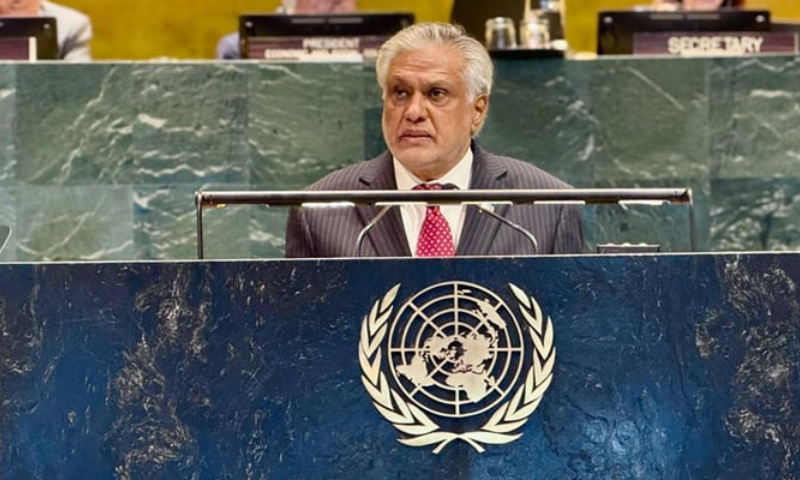
New York, July 21, 2025: Deputy Prime Minister and Foreign Minister Senator Ishaq Dar has called for urgent global financial reforms, including debt relief and greater access to grant-based financing for developing countries, in order to meet sustainable development targets.
Speaking at the United Nations High-Level Political Forum on Sustainable Development, Dar emphasized that developing nations are facing mounting pressures from overlapping crises — particularly the global food shortage and climate change — which threaten to derail progress on the 2030 Agenda.
“Achieving the Sustainable Development Goals requires not just commitment, but also equitable access to financial resources,” Dar said. “Debt relief and concessional financing must be prioritized to help vulnerable economies stay on track.”
Reaffirming Pakistan’s commitment to the SDGs, Dar outlined a series of national initiatives aimed at promoting inclusive growth, environmental resilience, and economic reform. He cited the Uraan Pakistan programme as a transformative step towards sustainable national development, alongside the expansion of Danish schools for underprivileged children, verified through NADRA.
He also highlighted Pakistan’s efforts to uplift the middle class through the Benazir Income Support Programme (BISP), ensuring that social safety nets are extended to all segments of society.
Dar reaffirmed Pakistan’s environmental commitments, stating that the country aims to source 60% of its energy from renewable resources by 2030. He noted key climate initiatives such as Recharge Pakistan and Living Indus, which are designed to bolster climate resilience and restore ecosystems.
On youth empowerment, the Deputy Prime Minister pointed to initiatives like the Digital Youth Hub and the nationwide expansion of Danish Schools, which aim to provide opportunities for education and entrepreneurship.
He also drew attention to Pakistan’s ongoing macroeconomic reforms, which he said are stabilising the economy and improving investor confidence. He lauded the Special Investment Facilitation Council (SIFC) for streamlining foreign investment into key sectors.
Calling for a “fundamental overhaul” of the global financial system, Dar stressed that without a more just and responsive international financial architecture, the SDGs will remain out of reach for many nations.
He concluded by describing the UN’s upcoming 80th anniversary as a pivotal moment to strengthen multilateralism. “This is a chance to make the UN more responsive to the needs of today’s world and ensure no country is left behind,” he said.