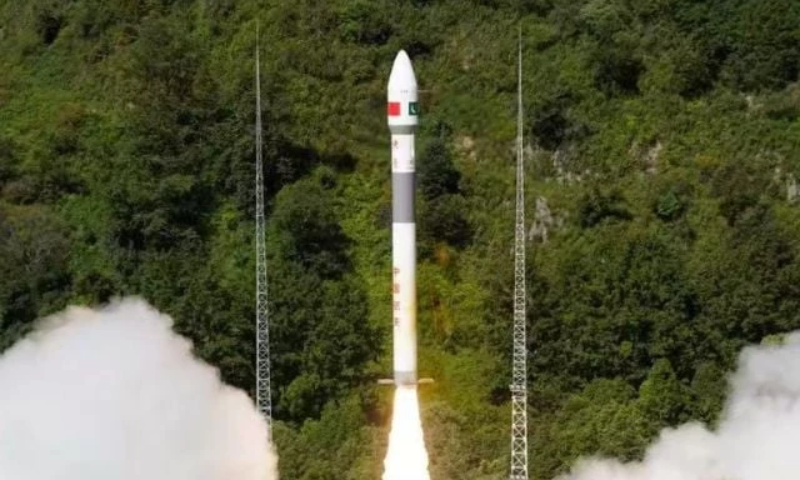
Islamabad, July 31, 2025: In a significant step forward for its space ambitions, Pakistan successfully launched a high-resolution remote sensing satellite on Thursday from China’s Xichang Satellite Launch Centre (XSLC), marking a new milestone in the country’s Earth observation capabilities.
The launch was conducted by SUPARCO, Pakistan’s national space agency, in collaboration with the China Electronics Technology Group Corporation (CETC) and MICROSAT China. The satellite was placed into orbit aboard a Kuaizhou-1A carrier rocket, launched from southwest China’s Sichuan province.
The mission marked the 29th successful flight of the Kuaizhou-1A rocket, according to Chinese state media and the China Science official platform.
“The satellite will significantly enhance Pakistan’s capacity for high-resolution, round-the-clock Earth observation,” the Foreign Office said in a statement.
“It will support critical sectors including disaster management, urban planning, environmental protection, agricultural monitoring, climate change analysis, food security, and water resource management.”
The satellite is part of an integrated Earth observation system aimed at strengthening Pakistan’s socio-economic development, sustainability efforts, and climate resilience.
“Pakistan Joins Ranks of Spacefaring Nations”: Foreign Office
Deputy Prime Minister and Foreign Minister Senator Mohammad Ishaq Dar praised the successful launch, lauding the “exemplary cooperation and unwavering commitment” of Pakistani and Chinese engineers involved in the mission.
“This achievement reaffirms Pakistan’s standing in the community of spacefaring nations,” the Foreign Office noted.
Officials say the satellite will also enhance early warning systems, improving the country’s ability to respond to natural disasters and environmental risks more effectively.
Minister for Planning, Development, and Special Initiatives Ahsan Iqbal also hailed the launch, calling it “another proud moment” for the nation. In a message on X (formerly Twitter), he commended SUPARCO’s team for their dedication and technical excellence.
“This accomplishment not only strengthens our space exploration capabilities but also takes the Pakistan–China iron brotherhood beyond the skies,” Iqbal wrote.
Analysts say the satellite launch reflects Pakistan’s expanding cooperation with China in science and technology, and contributes to Islamabad’s long-term goals in climate security, food systems management, and disaster preparedness.
SUPARCO officials indicated that this is one of several planned launches under Pakistan’s National Space Program 2047, which envisions building indigenous capacity in satellite manufacturing, telemetry, and deep space communications.