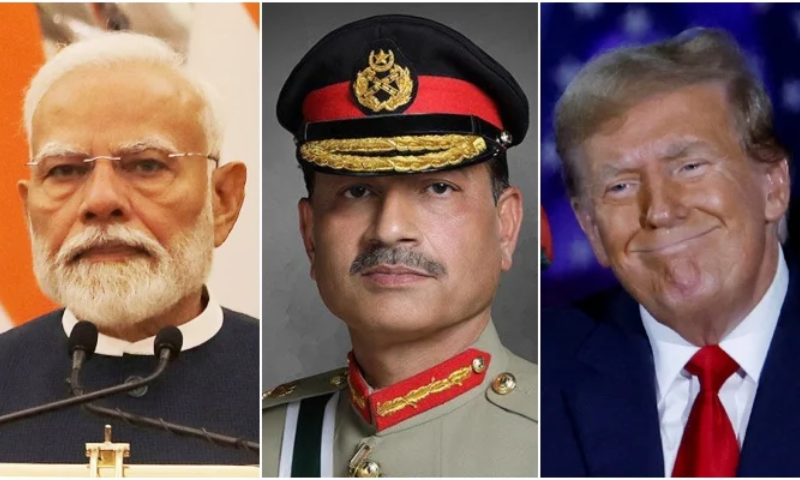
Islamabad, August 8, 2025: Indian Prime Minister Narendra Modi declined a meeting with US President Donald Trump in June, fearing a potential encounter with Pakistan’s Army Chief, Field Marshal Asim Munir, Bloomberg reported Friday, citing officials in New Delhi.
According to the report, Indian officials were concerned that if Modi and COAS Munir were both at the White House at the same time, Trump might arrange a meeting between them — a move New Delhi considered damaging to its narrative. While India was open to Trump meeting Pakistan’s civilian leadership, hosting the army chief was seen as unacceptable.
The episode occurred weeks after India and Pakistan agreed to a ceasefire in May, ending a four-day conflict. Tensions between Modi and Trump had been building, particularly after Trump publicly claimed credit for preventing a nuclear war, prompting Indian diplomats to push back.
Matters came to a head on June 17, when Trump and Modi spoke for 35 minutes after the US president left the G7 summit in Canada early. In the call, Modi stressed that any ceasefire talks were held directly between the two nations at Pakistan’s request following Indian strikes, and reiterated that India “does not and will never accept mediation.”
Indian officials said Modi learned during this period that Trump planned to host a lunch for Field Marshal Munir the next day at the White House. Modi then declined an invitation to stop in Washington on his return from Canada, choosing instead to visit Croatia.
Bloomberg reported that ties between Washington and New Delhi soured sharply afterward. Trump began openly criticising India, threatening — and later imposing — a 50% tariff on Indian exports. Modi and Trump have not spoken since the June phone call.
COAS Munir’s second US visit in two months
The Bloomberg account comes as foreign media report that Field Marshal Munir will visit the US this week — his second trip in less than two months — to attend the retirement ceremony of US Central Command chief General Michael Kurilla, who was awarded Pakistan’s Nishan-e-Imtiaz (Military) on July 26.
During his last visit in June, Munir held a rare one-on-one meeting with Trump in the White House Cabinet Room, joined by US Secretary of State Marco Rubio, Special Representative for Middle Eastern Affairs Steve Witkoff, and Pakistan’s national security adviser. The meeting took place amid the Pakistan-India conflict, during which Washington helped broker a ceasefire after Indian strikes inside Pakistan, which New Delhi said targeted those behind the Pahalgam attack in Indian Illegally Occupied Jammu and Kashmir (IIOJK).
Pakistan’s response, dubbed Operation Bunyan-um-Marsoos, saw multiple Indian fighter jets shot down, with casualties reported on both sides.
At the White House, Munir praised Trump’s “constructive and result-oriented role” in facilitating the ceasefire, while Trump commended Munir’s leadership during a period of “complex regional dynamics.” Talks also covered the Iran situation and explored cooperation in trade, economic development, minerals, AI, energy, cryptocurrency, and emerging technologies.
That visit paved the way for a breakthrough in bilateral economic relations, with Pakistan and the US finalising a trade agreement imposing reciprocal 19% tariffs on Pakistani exports to the US, marking a reset in economic cooperation.