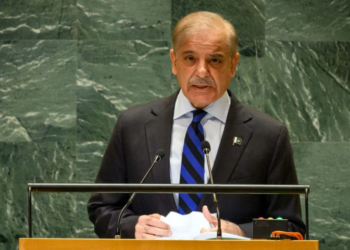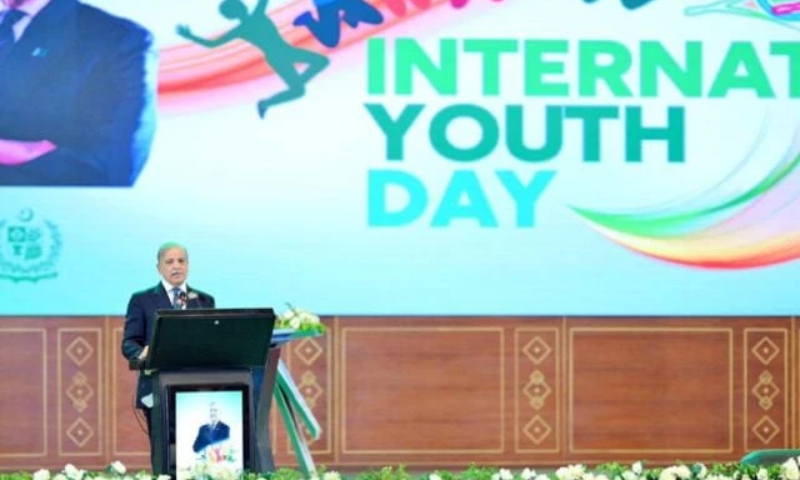
Islamabad, August 13, 2025: Prime Minister Shehbaz Sharif on Wednesday announced the distribution of 100,000 free laptops to talented students across Pakistan, pledging that the process would be purely merit-based and free from nepotism.
Speaking at an International Youth Day event in Islamabad, the prime minister said the laptops would be distributed among students from all four provinces, the federal capital, Gilgit-Baltistan, and Azad Jammu and Kashmir. He clarified that the initiative was separate from schemes offering laptops through interest-based loans.
Referring to Pakistan’s May 10 victory in Operation Bunyanum Marsoos, Shehbaz urged the youth to channel the same spirit and determination into achieving academic and professional excellence for the nation.
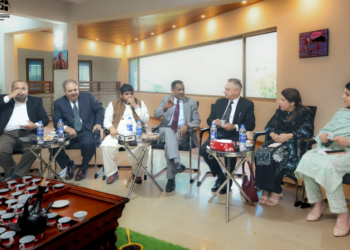
Chairman of the Prime Minister Youth Programme (PMYP) Rana Mashhood said merit-driven government schemes had enabled thousands of deserving students to pursue higher education. He highlighted landmark projects such as the Pakistan Education Endowment Fund, the Pakistan Daanish Authority, and earlier laptop distribution programmes.
Minister of State for Religious Affairs Kesoo Mal Khael Das praised the role of Pakistan’s minority communities in the country’s progress and development.
The laptop scheme, launched in 2014 under then-prime minister Nawaz Sharif, has so far provided around 600,000 laptops nationwide — 334,556 to male students and 265,444 to female students. In 2024 alone, 100,000 laptops were distributed, with 58,000 going to female students.
Provincially, Punjab has received 247,389 laptops, Sindh 107,034, Khyber Pakhtunkhwa 76,094, and Balochistan 30,513. The scheme has also reached 112,270 students in the federal capital, 9,290 in the former FATA region, and 14,312 in Azad Jammu and Kashmir.
Former recipient Waqas Arain, who received a laptop in 2014 as a final-year Mass Communication student at the University of Sindh, said the distribution process was “purely on merit” and greatly helped in academic work at a time when internet access was less common.