By Muhammad Mohsin Iqbal
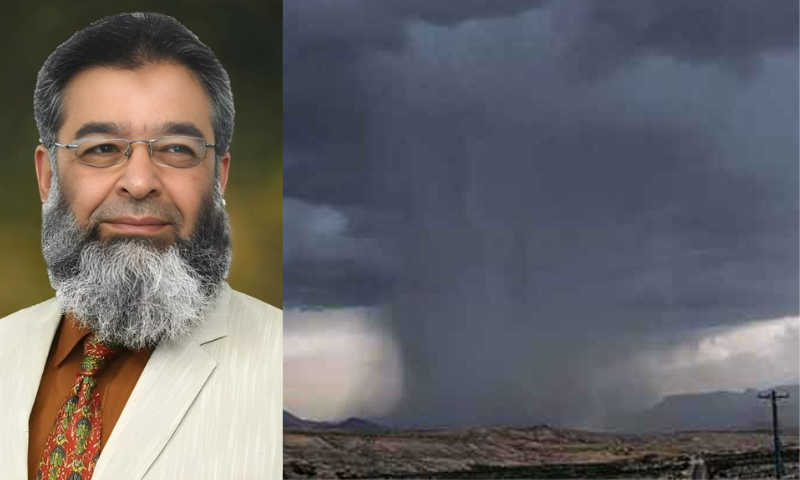
Cloudbursts have long remained one of nature’s most mysterious and destructive phenomena. They are sudden and violent downpours, often releasing several centimeters of rain within an hour over a small geographical area. The very term suggests the bursting of clouds, as if the sky itself has cracked open to let loose an overwhelming torrent. But in reality, a cloudburst is caused when warm air currents force dense clouds upward, where they become super-saturated. Unable to hold the accumulated moisture any longer, the clouds release it all at once in the form of an extraordinary deluge. Unlike ordinary rain, a cloudburst does not last long, yet in that brief span, it can cause devastation greater than a week of monsoon showers.
The question of when and where the first cloudburst was ever recorded is difficult to answer precisely, for ancient communities had no scientific means to document weather in detail. Yet historical accounts from India, Tibet, and parts of the Middle East speak of sudden rainstorms that washed away villages centuries ago. In modern records, cloudbursts have been observed more consistently in mountainous regions such as the Himalayas, where geography and weather conditions combine to create the perfect stage for their occurrence. Their violence is such that when they strike valleys or steep slopes, flash floods and landslides follow, sweeping away lives, livestock, homes, and farmlands in moments.
Pakistan, lying in the shadow of the Himalayas and Karakoram, has not been spared from this wrath of nature. Several cloudbursts have occurred in its northern regions, particularly in Gilgit-Baltistan, Azad Kashmir, and Khyber Pakhtunkhwa. In 2010, a cloudburst in Hunza caused massive flooding that destroyed villages and left thousands displaced. Similar events have struck Chitral, Skardu, and the Neelum Valley, each time leaving behind stories of sorrow and resilience. These incidents, though sporadic, are reminders of how vulnerable mountainous communities are to sudden shifts in weather. Roads, bridges, and communication lines are often severed, complicating rescue efforts, while farmlands and orchards are swept away in the torrents, undermining local economies.
The destruction cloudbursts have caused in Pakistan, though not always documented with full accuracy, is immense. Entire communities have been washed away in minutes, and the loss of human life has been grievous. These disasters not only disrupt the lives of those directly affected but also place a heavy burden on the national exchequer in terms of rehabilitation, reconstruction, and emergency relief. The pattern suggests that cloudbursts, once rare, are becoming more frequent, pointing towards changes in the environment that demand serious reflection.
The causes of cloudbursts are both natural and aggravated by human action. Naturally, they occur in areas where monsoon winds meet high-altitude mountains. Warm moist air, rising rapidly, collides with cold air, leading to an explosive release of precipitation. However, scientists now argue that environmental pollution and climate change have intensified these phenomena. Rising global temperatures increase the capacity of the atmosphere to hold moisture, and when released, the rainfall is far heavier than in the past. Deforestation, unplanned urbanization, and the destruction of natural drainage systems further compound the problem, turning heavy rain into catastrophic floods. In this sense, humanity has become a partner in its own peril.
Can cloudbursts be predicted in advance? This remains one of the most pressing questions. Modern meteorology has advanced to the point where short-term forecasts can detect atmospheric instability, but predicting the exact time and place of a cloudburst is still beyond reach. The phenomenon occurs too suddenly, over too small an area, for traditional weather models to capture accurately. Yet research continues, and satellite monitoring, combined with artificial intelligence, offers some hope that the warning time may be improved in the future. For Pakistan, investing in such technology is essential, for even a few hours’ notice could mean the difference between life and death for hundreds.
It is clear, however, that prevention is as important as prediction. Cloudbursts cannot be stopped, but their impact can be reduced. The world, and Pakistan in particular, must take concrete steps. At the global level, reducing carbon emissions to slow climate change is vital, for it is the root cause of extreme weather. Nations must adhere to environmental agreements, transition towards renewable energy, and adopt sustainable patterns of living. At the national level, Pakistan must strengthen its disaster management institutions, improve forecasting systems, and ensure that vulnerable communities are trained and prepared for emergencies. Early warning systems, evacuation plans, and community awareness campaigns can save countless lives.
Equally important is the restoration of nature’s balance. Reforestation in mountain areas, the protection of watersheds, and the development of proper drainage systems are indispensable. Traditional wisdom, where villagers-built homes on higher ground and left floodplains for cultivation, must be revived and respected. Unchecked construction along riverbanks and in valleys prone to flooding only increases the toll of disaster. Good governance, strict regulation, and public cooperation are necessary to minimize risks.
Cloudbursts remind us of the fragile relationship between humankind and nature. While they are natural events, their increasing frequency and intensity are signals of a planet under stress. Pakistan, situated in a region prone to climatic extremes, cannot afford complacency. The lessons of past tragedies must not be ignored. To safeguard lives and livelihoods, the nation must invest in science, respect the environment, and cultivate resilience among its people. Only then can the damage of cloudbursts be lessened, if not entirely avoided.