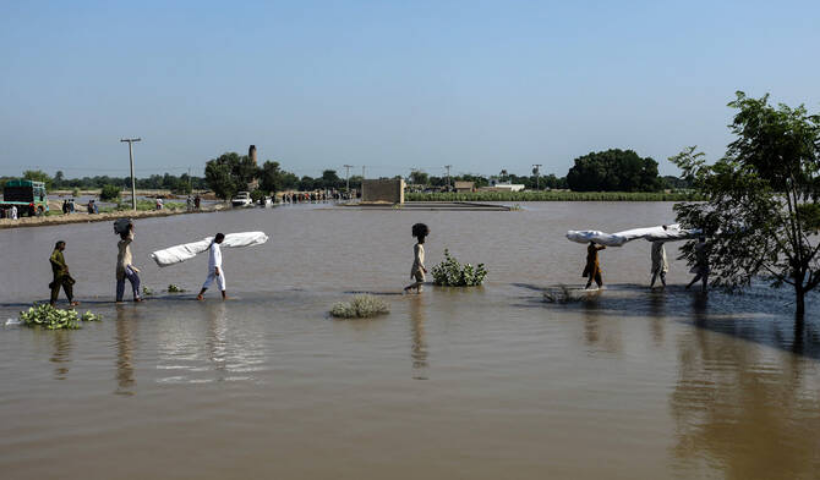
Islamabad, September 15, 2025: The nationwide death toll from this year’s monsoon rains has climbed to 985, officials said Monday, as floodwaters recede in Punjab and surge downstream into Sindh, raising fresh concerns for the country’s southern province.
Triggered by weeks of heavy downpours and excess water released from Indian dams, the flooding has submerged thousands of villages, displaced millions, and consolidated into a powerful flood wave moving through the Indus River system. Authorities say the immediate pressure on Punjab — Pakistan’s agricultural heartland — is easing, but Sindh’s Guddu and Sukkur barrages are now bracing for high inflows in the coming days.
According to official figures, the highest death toll has been recorded in Khyber Pakhtunkhwa (504), followed by Punjab (287), Sindh (80), Gilgit-Baltistan (41), Azad Kashmir (38), Balochistan (26) and Islamabad (9) since the monsoon season began on June 26.
Punjab’s Provincial Disaster Management Authority (PDMA) reported that flooding in the Ravi, Sutlej and Chenab rivers alone has affected more than 4,700 villages and displaced around 4.72 million people, of whom 2.56 million have been evacuated to safety. Relief efforts include 372 relief camps, 454 medical camps and 385 veterinary camps, while nearly 2.07 million livestock have also been moved to secure areas.
Water levels in the Ravi, Sutlej and Chenab have now “receded considerably,” with flows returning to normal at key points such as Marala, Khanki, Qadirabad and Trimmu headworks. However, Panjnad, where the five major rivers converge before joining the Indus, remains in very high flood at 369,085 cusecs, though easing from its peak last week.
At Sindh’s Guddu Barrage, inflows stood at 635,759 cusecs on Monday, with levels expected to rise to 650,000–700,000 cusecs by late September 15. The PDMA warned that the flood wave would continue across Sindh through the end of September before eventually draining into the Arabian Sea. Areas currently under stress include Kandhkot, Ubaro, Kashmore and Ghotki, with the pressure expected to move toward Jamshoro, Qambar Shahdadkot and later the Hyderabad–Thatta corridor.
Sukkur Barrage is forecast to receive inflows of around 600,000 cusecs by September 17–18, while Kotri Barrage, the final control point before the Indus meets the sea, is expected to face peak discharges of 400,000–450,000 cusecs between September 24 and 26.
The flooding has also disrupted power supply across Punjab, with the Ministry of Water and Power reporting 51 grid stations and 543 feeders affected. Of these, 309 feeders have been fully restored and 226 partially restored.
This year’s crisis has revived memories of the 2022 super floods, which killed more than 1,700 people, displaced millions, and caused damages exceeding $30 billion. Despite contributing less than one percent of global greenhouse gas emissions, Pakistan remains among the world’s most climate-vulnerable nations.