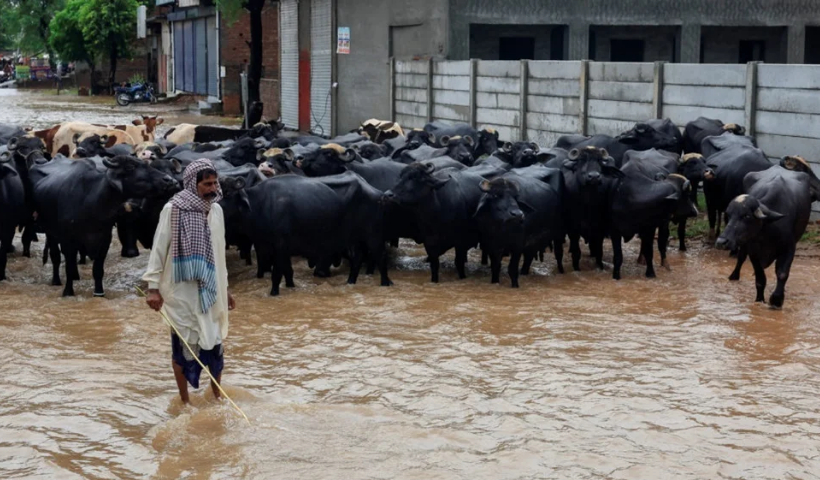
Islamabad, September 17, 2025: The World Food Programme’s (WFP) latest post-flood assessment has exposed the staggering scale of destruction across Pakistan, with Sialkot identified as the hardest-hit district.
According to the report, more than 1.5 million people in Sialkot have been directly affected, while nearly 149,748 hectares of land, including 135,096 hectares of cropland, remain submerged. The analysis warns of a looming food security crisis as some of the country’s most fertile regions lie under water.
Several other districts have also been severely impacted. Narowal has reported 640,940 people affected and 83,686 hectares flooded, followed by Gujrat (539,140 people, 63,064 hectares), Muzaffargarh (221,221 people, 65,120 hectares), Mandi Bahauddin (250,766 people, 55,528 hectares), Hafizabad (166,615 people, 45,123 hectares), Rajanpur (136,089 people, 70,457 hectares), and Kashmore (126,794 people, 44,671 hectares).
Nationwide, floods have inundated 1.26 million hectares of land, directly affecting nearly 6 million people. Among them, 1.88 million are considered particularly vulnerable, especially children and elderly citizens, who face heightened risks of disease, malnutrition, and displacement.
In Sialkot alone, more than 116,000 children under the age of nine and 348,000 people over 60 years old are estimated to be living in inundated areas. Other districts have also reported alarming figures of vulnerable populations: Narowal (54,000 children and 157,000 elderly), Gujrat (47,000 children and 118,000 elderly), Muzaffargarh (13,000 children and 63,000 elderly), Mandi Bahauddin (22,700 children and 56,000 elderly), and Hafizabad (14,400 children and 38,600 elderly).
The WFP cautioned that beyond the immediate human toll, the flooding has crippled agriculture and rural livelihoods. With vast croplands destroyed, the country faces serious food security challenges in the coming months.
The agency emphasized the urgent need for long-term resilience planning, stronger early warning systems, and climate adaptation measures, particularly in districts that are repeatedly devastated by seasonal floods.