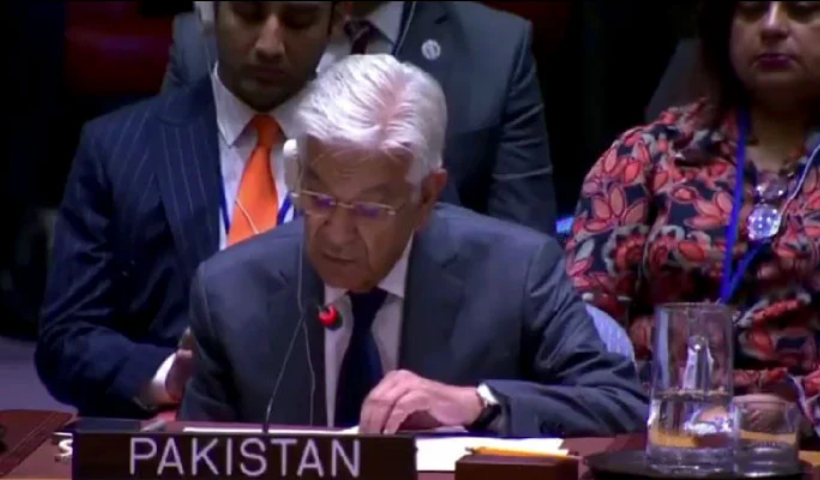
United Nations, September 24, 2025: Defence Minister Khawaja Asif has cautioned that the accelerating integration of artificial intelligence (AI) into military systems could make future wars significantly more perilous, posing grave risks for global peace and stability.
Speaking at a high-level UN debate on AI on Wednesday, the minister said that while artificial intelligence has simplified decision-making, it has simultaneously created alarming possibilities for conflict escalation.
“AI has simplified decision-making processes, but it has also created conditions where future wars may be significantly more dangerous,” Asif said. He urged member states to ensure that technological advances are developed and deployed in line with the UN Charter and for the benefit of humanity.
The defence minister highlighted Pakistan’s adoption of its first national AI policy earlier this year, describing it as evidence of the government’s commitment to responsible innovation and safeguards against misuse.
“The world must adopt collective measures to prevent an uncontrolled arms race in this domain,” he warned, stressing that AI should be used to foster peace and development, not fuel instability.
Asif concluded by reaffirming Pakistan’s support for international initiatives aimed at striking a balance between technological progress and global security.
UN Chief Calls for Global Guardrails
Earlier in the debate, UN Secretary-General Antonio Guterres stressed that AI is no longer “a distant horizon,” but a rapidly transforming force shaping economies, information spaces, and daily life.
“When used responsibly, AI can strengthen prevention and protection in a myriad of ways — from anticipating food insecurity and supporting de-mining to identifying potential outbreaks of violence,” he said.
However, Guterres warned of the growing threat of AI-enabled cyberattacks capable of crippling critical infrastructure within minutes, as well as risks to information integrity. “Innovation must serve humanity — not undermine it,” he emphasized.
The UN chief recalled that the General Assembly had recently established an Independent International Scientific Panel on AI, along with an annual Global Dialogue on AI Governance.
Outlining priorities, he urged that humanity’s fate must never be left “to an algorithm,” insisting that humans must always retain authority over life-and-death decisions. He called for a legally binding treaty by 2026 to ban lethal autonomous weapons systems operating without human control.
“Similarly, any decision in nuclear weapon use must rest with humans — not machines,” Guterres underscored.