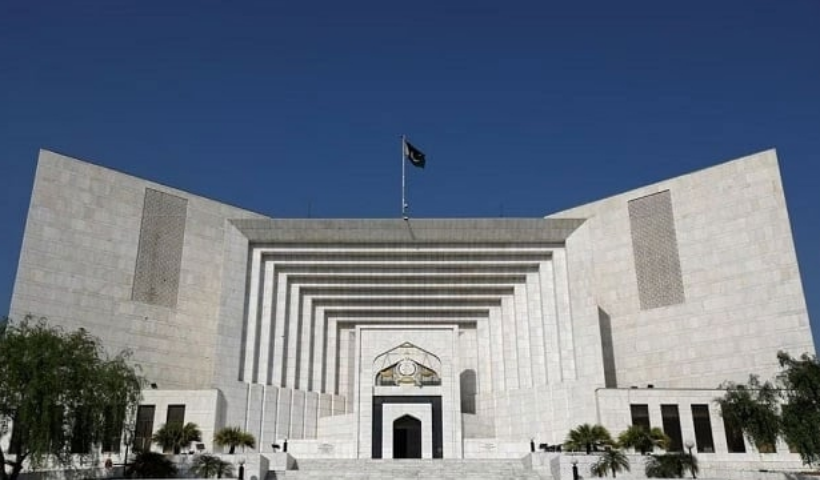
Islamabad, September 25, 2025: The Supreme Court’s Constitutional Bench on Thursday released a 55-page detailed verdict in a high-profile case concerning the transfer and seniority of Islamabad High Court (IHC) judges, ruling that the president’s power to transfer judges is independent but subject to constitutional safeguards.
The five-member larger bench was headed by Justice Muhammad Ali Mazhar and included Justices Naeem Akhtar Afghan, Shahid Bilal Hassan, Salahuddin Panhwar, and Shakeel Ahmad.
In its 3-2 majority judgment, the court stated, “It is clearly articulated under Article 200 of the Constitution that the powers of the president for the transfer of a judge of the high court from one high court to another high court is an independent Article in its application, but with some safety measures and safeguards and these powers are not dependent upon any other article of the Constitution.”
The case originated in February when five IHC judges — Justices Mohsin Akhtar Kiyani, Tariq Mehmood Jahangiri, Babar Sattar, Sardar Ejaz Ishaq Khan, and Saman Riffat Imtiaz — petitioned the apex court under Article 184(3). They challenged the appointment of Justice Sarfraz Dogar as acting IHC chief justice and questioned the president’s authority to transfer judges.
The petitioners argued that Article 200(1) does not grant the president unfettered discretion to transfer judges without demonstrating public interest or in a manner that compromises judicial independence. They further sought clarity on seniority rules, asserting that new appointees should rank below them based on their oath-taking dates.
The petitions were taken up on April 17, and on June 19 the court issued a short 3-2 order dismissing the pleas. Justices Mazhar, Hassan, and Panhwar rejected the petitions, while Justices Afghan and Ahmad sided with the petitioners, annulling the transfer notifications.
In its detailed verdict, the bench emphasized that while the president holds transfer powers under Article 200, such powers are not absolute. No judge can be transferred without their consent, and consultation with the chief justice of Pakistan as well as the chief justices of the relevant high courts is mandatory. “The exercise of the powers of transfer by the president under Article 200 of the Constitution is not unregulated or unfettered,” the ruling stated.
The court also clarified that presidential powers under Article 200 are distinct from those under Article 175A, which governs judicial appointments through the Judicial Commission of Pakistan, and the two provisions must not be conflated.
Concluding the matter, the bench held that a judge’s transfer under Article 200 does not constitute a fresh appointment. The verdict thus reinforced constitutional safeguards while upholding the president’s authority and dismissing the IHC judges’ petitions.