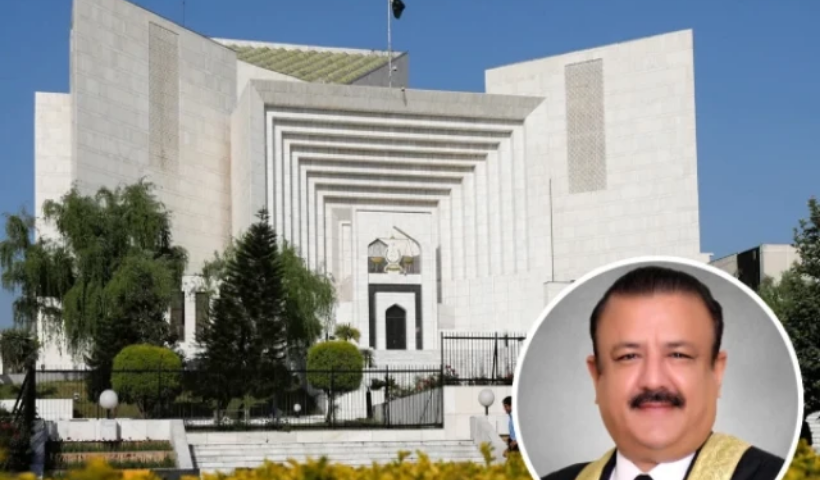
Islamabad, September 29, 2025: The Supreme Court on Monday suspended an Islamabad High Court (IHC) order that had restrained Justice Tariq Mehmood Jahangiri from judicial work in connection with an alleged fake degree case.
The matter was taken up by a five-member constitutional bench headed by Justice Aminuddin Khan and comprising Justices Jamal Khan Mandokhail, Muhammad Ali Mazhar, Hasan Azhar Rizvi and Shahid Bilal Hasan.
Justice Jahangiri appeared in person alongside IHC judges Mohsin Akhtar Kayani, Babar Sattar, Ejaz Ishaq and Saman Rafat Imtiaz, all of whom entered the court through the public entrance.
The controversy stems from the University of Karachi’s decision to cancel Justice Jahangiri’s LLB degree, declaring his academic record “fictitious” after its Unfair Means Committee concluded he was never enrolled at Islamia Law College and engaged in malpractice during exams in the 1980s. The KU Syndicate endorsed the findings, which later became the basis of a complaint now before the Supreme Judicial Council (SJC).
Speaking to a journalist outside the court, Jahangiri said: “It is astonishing that they are cancelling a degree after 34 years. This has never happened in world history.”
During the hearing, Justice Mandokhail noted that the case before the bench was limited to reviewing the IHC’s interim order, while the SJC had already scheduled a meeting for October 18. He also observed: “The SC has already ruled that a judge cannot be barred from judicial work.”
Justice Shahid Bilal questioned how the petition against Jahangiri was numbered by the IHC despite pending registrar objections.
Representing Jahangiri, senior counsel Muneer A. Malik argued that the IHC order violated precedent, stressing that “a judge cannot be stopped from performing judicial duties while a complaint is pending before the SJC.” He termed it the first instance in history where a high court bench had restrained one of its own judges.
Malik contended that the petition against Jahangiri, filed in July 2024, remained pending with objections unresolved. He added that the interim order was issued “without hearing the other side” and “did not meet the requirements of justice.”
Advocate Mian Dawood, the petitioner, argued that the SC had earlier barred Justice Sajjad Ali Shah from judicial work. Justice Mazhar, however, distinguished the precedent, noting that the Sajjad Ali Shah case was decided under Article 184(3) and involved “entirely different facts.”
After deliberations, the bench suspended the IHC’s September 16 order restraining Justice Jahangiri, issued notices to the Attorney General, Advocate General Islamabad, and other parties, and adjourned proceedings until Tuesday.
The case has triggered debate on judicial independence. Justice Jahangiri has termed the allegations “political victimisation,” linking them to his role in the March 2024 IHC judges’ letter on surveillance and to his work as an election tribunal judge whose rulings unsettled ruling party candidates.
The Islamabad Bar Council and District Bar Association have also sought to become parties to the case.
Earlier this month, the Sindh High Court dismissed Jahangiri’s petitions against KU’s decision after his counsels staged a walkout, with the bench describing their conduct as “highly unbecoming.”
The IHC order marked the first time in Pakistan’s history that a high court had restrained its own sitting judge from judicial duties — a step Jahangiri’s counsel described as “a blow to judicial independence.”