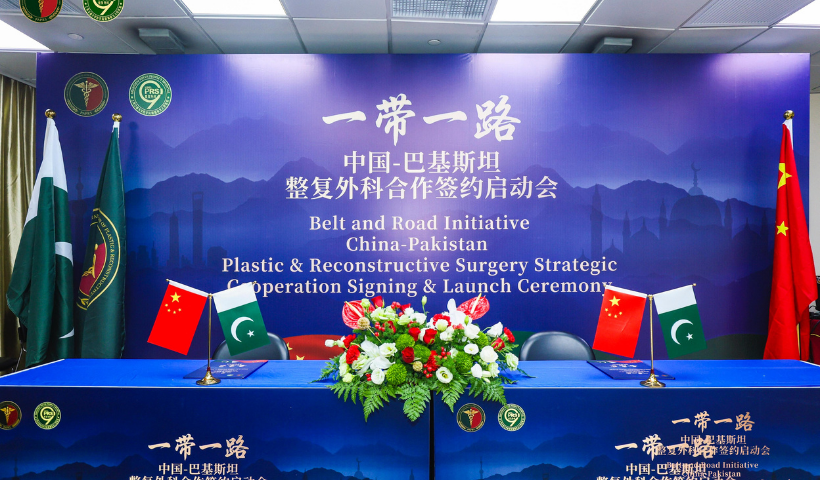
Lahore, October 15, 2025: In a significant step toward strengthening bilateral cooperation under the Belt and Road Initiative (BRI), the Pakistan Association of Plastic and Reconstructive Surgery (PAPRS) and Shanghai Ninth People’s Hospital, affiliated with Shanghai Jiao Tong University School of Medicine, have launched a strategic cooperation project to advance plastic and reconstructive surgery in Pakistan.
An opening ceremony was held to mark the beginning of this collaboration, which aims to enhance Pakistan’s medical capacity in facial trauma management, burn treatment, and microsurgical reconstruction. The long-term objectives include improving healthcare standards, reducing disability rates, and promoting the internationalization of medical research and training.
The partnership comes as Pakistan and China celebrate 75 years of diplomatic relations and enter what both nations have termed the “second golden decade” of the Belt and Road Initiative. The new collaboration extends their cooperation beyond economic projects, focusing on healthcare advancement, talent development, and medical education.
Pakistan continues to face growing demand for reconstructive and burn care, particularly in regions affected by terrorism and conflict. Limited specialized facilities have strained the country’s healthcare system, making this partnership crucial in improving access to modern surgical care.
Under the agreement, PAPRS and Shanghai Ninth People’s Hospital will collaborate in microsurgical reconstruction and facial trauma repair, building local capacity through training, technology transfer, and on-ground clinical support.
The cooperation framework includes a long-term exchange and training program between the two countries. Chinese experts will visit Pakistan regularly to conduct on-site and online training, while Pakistani doctors will receive systematic fellowships and advanced surgical training at Shanghai Ninth People’s Hospital.
To extend reach to underserved areas, the partners will also establish “Mobile Microsurgery Training Camps”, bringing hands-on surgical education to remote regions.
In addition, both sides plan to introduce AI-assisted telemedicine, modernize Pakistan’s medical infrastructure, and co-develop standardized clinical pathways. They will also conduct joint research in wound repair, tissue engineering, and microsurgical nerve regeneration, while launching multicenter clinical studies to strengthen evidence-based medical practices.
The partnership also envisions establishing a Pakistan–China Plastic and Reconstructive Surgery Summit Forum, along with a systematic certification mechanism for physicians and joint formulation of Pakistan–China Clinical Guidelines for plastic and reconstructive surgery.
PAPRS Chairman Dr. Khalid Mahmood Khan said Pakistan continues to face significant challenges in burn care and post-blast reconstruction.
“Both military personnel and civilians suffer from a large number of burn injuries and congenital deformities. Our goal is to establish a nationwide humanitarian and reconstructive network that delivers high-quality care to all, especially underserved populations,” he stated.
“By combining Pakistan’s humanitarian initiatives with China’s advanced medical expertise, we aim to create sustainable healthcare models that can benefit developing countries globally.”
Professor Li Qingfeng, Vice President of Shanghai Ninth People’s Hospital and Chairman of the Chinese Society of Plastic and Reconstructive Surgery, expressed admiration for the skill and dedication of Pakistani surgeons.
“Pakistan’s plastic surgeons have made impressive progress in complex reconstructive cases. Through this partnership, both nations can further enhance their capabilities in managing trauma and rebuilding lives,” he said.
Professor Li, a world-renowned microsurgeon, has been widely recognized for pioneering work in total facial reconstruction—techniques that have set new international benchmarks in the field.
Rashid Kamal, Senior Advisor to PAPRS, described the partnership as a “transformative opportunity” for Pakistan’s healthcare sector.
“This collaboration will greatly enhance our capacity to manage trauma and burn cases effectively,” he noted.
Pakistani liaison Dr. Arsalan Khan and Chinese counterpart Ms. Yalin Zhang have played key roles in coordination and implementation. Dr. Aawrish Khan, a Pakistani plastic surgeon based in Shanghai and Secretary-General of the collaboration, has been instrumental in bridging communication and strengthening academic exchange between the two countries.
The Department of Plastic and Reconstructive Surgery at Shanghai Ninth People’s Hospital is the largest such center in Asia, receiving over 400,000 outpatients and performing 64,000 surgeries annually. With 350 inpatient beds and 200 specialized physicians, it is an internationally recognized hub for microsurgery and craniofacial reconstruction, training hundreds of graduate students and visiting surgeons from around the world each year.
This landmark collaboration between Pakistan and China marks a new chapter in bilateral medical diplomacy under the Belt and Road Initiative. It is expected to greatly enhance Pakistan’s ability to treat trauma and burn patients while fostering deeper cooperation in medical technology, talent training, humanitarian missions, scientific research, and AI-driven telemedicine.
Both sides reaffirmed their commitment to jointly safeguard the health and well-being of the people of Pakistan and China, setting a new standard for cross-border medical collaboration in the developing world.