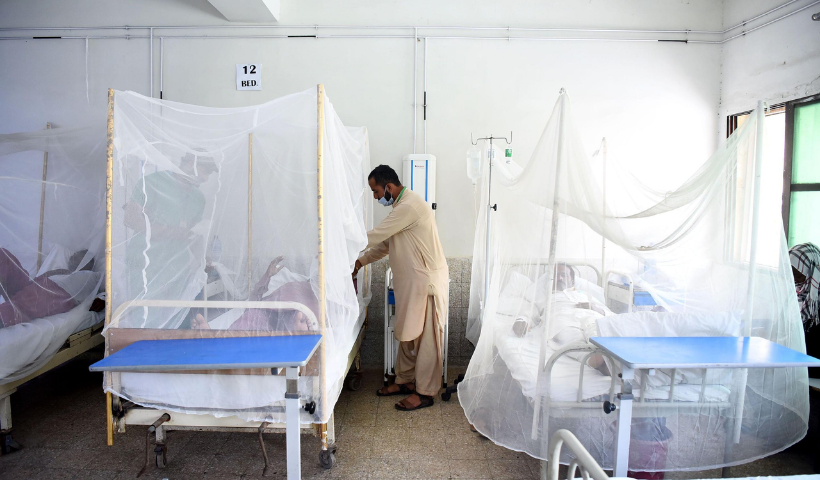
Karachi, October 26, 2025: The Sindh Health Department has released its latest report on confirmed dengue cases across the province, revealing 439 new cases so far in October, bringing the total number of confirmed cases in 2025 to 1,083.
Dengue — a mosquito-borne viral infection transmitted by the Aedes aegypti mosquito — remains a recurring public health concern in Sindh, particularly during the monsoon season when stagnant water and poor sanitation accelerate its spread. The illness causes high fever and, in severe cases, can lead to life-threatening complications.
While official data puts this year’s total at 1,083, figures obtained from major hospitals and a diagnostic network in Karachi and Hyderabad suggest a much higher number — exceeding 12,000 cases within just six weeks.
In a statement, Sindh Minister for Health and Population Welfare Dr Azra Fazal Pechuho said:
“Karachi Division remains the most affected, with 188 cases reported this month, followed by Hyderabad with 154, Mirpurkhas with 83, Sukkur 10, Shaheed Benazirabad three, and Larkana one.”
She clarified that the Health Department’s data includes only confirmed cases from government hospitals, excluding tests conducted in private laboratories.
“If a patient undergoes testing at a private lab, that report is not included in our official data,” she explained, urging the public not to believe unverified figures circulating on social media.
Dr Pechuho added that anti-dengue measures — including fumigation, spraying, and drainage improvement — had been intensified in all districts.
“Deputy commissioners and district health officers have been directed to ensure that no stagnant water remains, as it serves as a breeding ground for mosquitoes,” she said, noting that separate dengue units offering free treatment and testing have been set up in government hospitals.
Data collected from three major Karachi hospitals — Indus Hospital (IH), Liaquat National Hospital (LNH), and the Sindh Infectious Diseases Hospital and Research Centre (SIDHRC) — recorded 2,972 dengue cases from September 1 to October 16, while the Jinnah Postgraduate Medical Centre (JPMC) reported 1,062 cases since July.
At Aga Khan University Hospital (AKUH), sources confirmed a higher caseload than last year, with several fatalities also reported.
In Hyderabad, the Diagnostic and Research Laboratory (DRL) of the Liaquat University of Medical and Health Sciences (LUMHS), Jamshoro, and its branches recorded 9,075 confirmed dengue cases from September 1 to October 14, pointing to an outbreak-like situation.
Medical experts have raised concerns over the credibility of official figures, describing the situation as far more serious than what government data depicts.
PMA-Sindh President Dr Bashir Ahmed Khaskheli said the lack of a mechanism to collect feedback from private clinics and hospitals means thousands of cases go unreported.
“Many people constrained by their financial resources don’t even opt for laboratory tests,” he noted.
Dr Faisal Mahmood, Professor of Infectious Diseases and Associate Chief Medical Officer at AKUH, confirmed the seasonal surge:
“The end of October is classically when dengue peaks. These cyclic patterns are seen every few years — influenced by weather patterns and changing strains. This year’s floods have likely contributed.”
Health experts attribute the surge to ineffective fumigation and poor drainage systems following monsoon rains.
Dr Mirza Ali Azhar of the Pakistan Medical Association (PMA) said:
“If rainwater remains accumulated, it becomes a breeding ground for mosquitoes. In many areas, water stands like ponds, turning into homes for vectors.”
Dr Khaskheli echoed these concerns, saying dengue outbreaks are preventable through proper vector control and solid waste management.
“Pools of sewage and garbage heaps across cities provide breeding grounds for all kinds of germs and insects,” he said. “Unfortunately, few effective government fumigation drives have been carried out.”