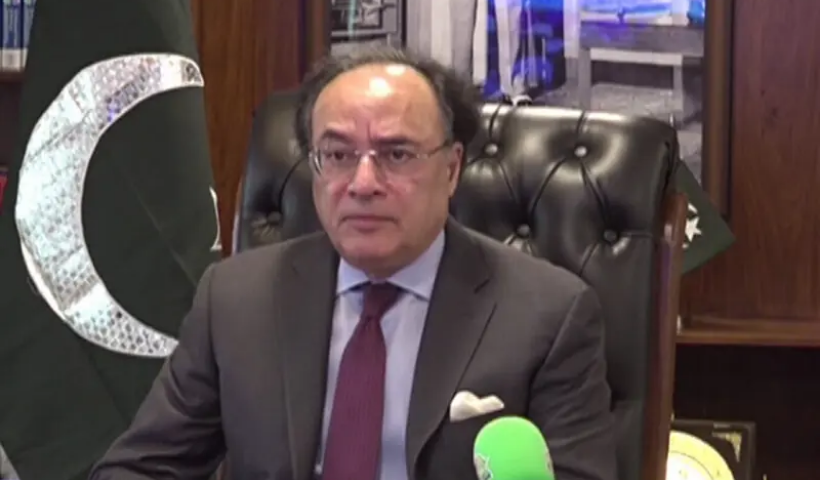
Islamabad, November 4, 2025: Finance Minister Muhammad Aurangzeb has said that Pakistan’s blue economy has the potential to be a “game changer” for the country, backed by a clear roadmap and ambitious growth targets set by the Ministry of Maritime Affairs.
Speaking at a virtual maritime conference, the minister noted that Pakistan’s current contribution from the blue economy stands at a modest 0.4% to 0.5% of national GDP — roughly around $1 billion.
“The Ministry of Maritime Affairs has set an ambitious but achievable goal to expand this figure to $100 billion by 2047,” Aurangzeb said. “This billion dollars getting to a hundred billion blue economy number by the time we get to 2047 is transformational — and it’s the right ambition for Pakistan’s future.”
The finance minister emphasised that the blue economy — encompassing fisheries, ports, logistics, renewable energy, and marine biotechnology — holds vast potential for national economic transformation.
He said Pakistan’s strengthening international relationships and trade links would play a key role in supporting economic stability.
“Relationships that have been strong for decades are now evolving from government-to-government dialogues to actual trade and investment flows into the country,” he remarked. “This, Inshallah, should help us move toward a sustainable growth path.”
Outlining the roadmap to achieve the $100 billion target, Aurangzeb said the plan is built on “strong pillars.” Excellence in fisheries and aquaculture tops the list, with efforts focused on value-added processing, modernising cold chain logistics, and ensuring world-class hygiene standards.
Seafood exports, currently worth around $500 million, are projected to rise to $2 billion over the next three to four years. The minister added that these initiatives would be guided by a national fisheries and aquaculture policy developed in partnership with the Food and Agriculture Organization (FAO) to ensure long-term policy consistency.
Aurangzeb also underscored the importance of modernising Pakistan’s ports and logistics infrastructure. “We are digitising and upgrading operations at Karachi Port, Port Qasim, and Gwadar to replicate international best practices and strengthen regional trade partnerships,” he said. These reforms aim to improve trade efficiency and enhance regional cooperation.
Highlighting renewable energy and marine biotechnology as key growth areas, the finance minister revealed that Pakistan is launching pilot projects in tidal and offshore wind power generation, alongside developing marine biotechnology value chains. “These represent significant opportunities for innovation and growth,” he noted.
He further said that innovative financing tools such as blue bonds and blended funding models will be introduced to support sustainable development within the blue economy.
Aurangzeb concluded that, together with improved trade and investment flows and ongoing structural reforms, these initiatives would help steer Pakistan toward a resilient and sustainable growth trajectory.
“This is a game-changing sector where the potential is huge,” he said, adding that the blue economy — along with digital infrastructure, artificial intelligence, and mining — will serve as a central engine for Pakistan’s long-term economic growth.