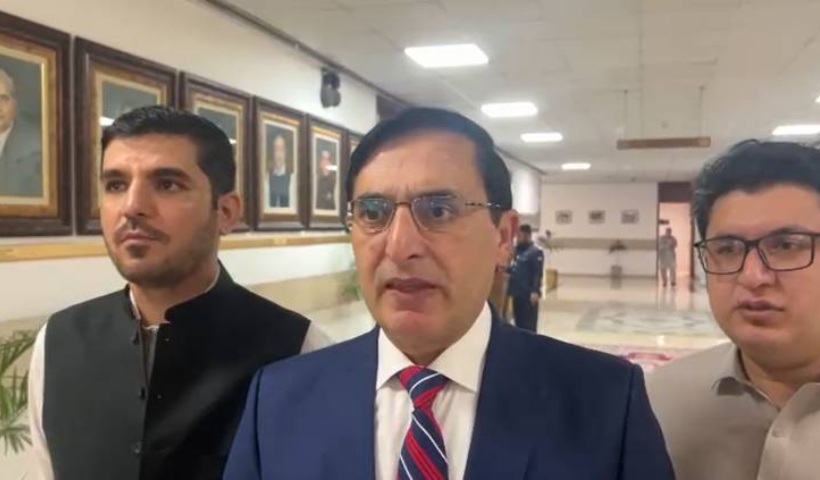
Islamabad, November 7, 2025: Pakistan Tehreek-e-Insaf (PTI) Chairman Barrister Gohar Ali Khan met National Assembly Speaker Ayaz Sadiq on Friday and asserted that the appointment of the Leader of the Opposition was PTI’s legal and constitutional right, citing the party’s requisition supported by 74 members.
Speaking to the media at Parliament House after the meeting, Barrister Gohar said that the Leader of the Opposition “is the right of those who sit on the opposition benches,” emphasizing that PTI, being the largest group in opposition, must be granted that position.
“Due to the large number of our members, PTI should have the Leader of the Opposition after the signatures of 74 members,” he said.
Gohar said the Speaker informed the PTI delegation that the matter regarding the Leader of the Opposition was currently pending before the Supreme Court. “The Speaker told us that a notice had come from the Supreme Court, and as soon as the National Assembly Secretariat receives the official copy, progress will be made,” he stated. According to Gohar, Ayaz Sadiq assured the PTI delegation that efforts were underway to obtain the Supreme Court’s copy and deliver it to the Speaker’s office promptly. “He hoped that by Monday, the process for appointing the opposition leader will be completed,” Gohar added.
Commenting on the government’s proposed 27th Constitutional Amendment, Barrister Gohar said PTI would only engage in discussions related to Article 243, which pertains to the armed forces, once the specific draft is made public.
He reiterated PTI’s stance on provincial autonomy, saying the National Finance Commission (NFC) Award ensures that the provinces’ shares “cannot be reduced below their previous allocations.”
“The NFC Award was designed not to weaken the federation but to strengthen it,” he said.
The PTI chairman added that any amendment to the Constitution must be achieved through consensus rather than a simple majority, underscoring that “the Constitution is a document of the entire nation.”
He also referenced past constitutional structures, noting that “during Ayub Khan’s era, an individual could hold two assembly seats,” but stressed that modern governance demands broader agreement on constitutional changes.