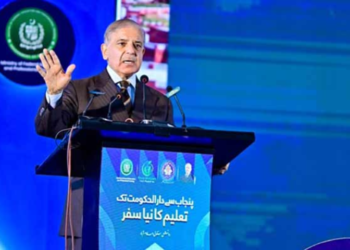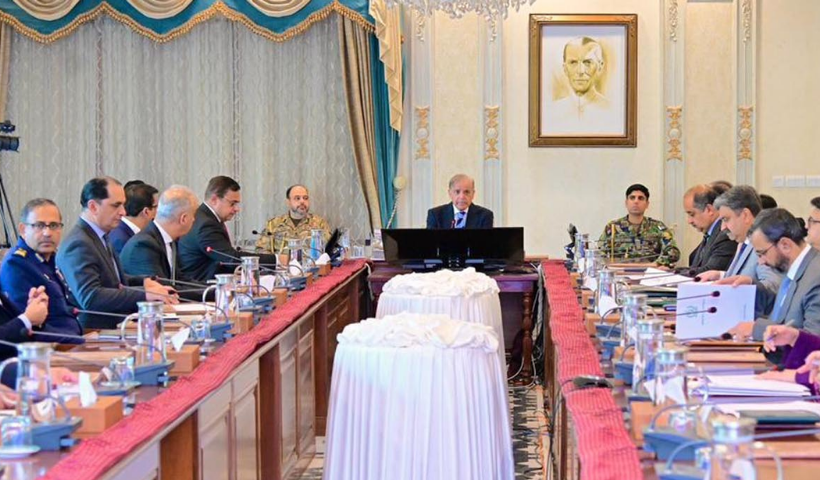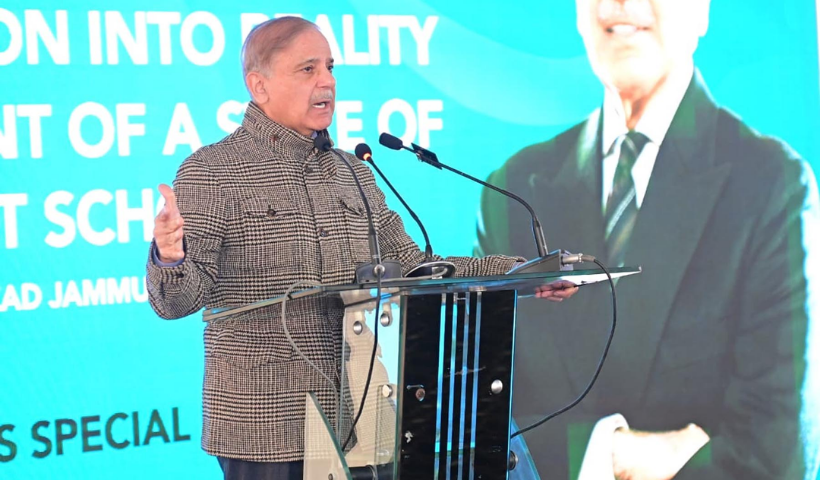
Bagh, AJK, November 20,2025 — Prime Minister Shehbaz Sharif on Thursday said that US President Donald Trump’s frequent references to the “downing of seven brand-new Indian aircraft by Pakistan” serve as global acknowledgment of the country’s military strength and its performance during the May conflict with India.
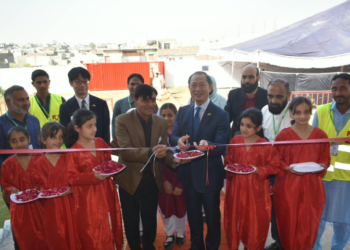
Speaking at the foundation-laying ceremony of a Danish School in Bagh, the prime minister said the latest report submitted to the US Congress had “stamped Pakistan’s stance,” adding that India “received a stinging slap from Pakistan’s armed forces.”
“Allah Almighty has honoured Pakistan through the bravery of our soldiers,” he said.
A report presented to the US Congress earlier this month credited Pakistan with “military success over India” during the four-day conflict in May, confirming that Pakistan used modern Chinese weaponry to bring down Indian fighter aircraft, including French-made Rafales.
PM Shehbaz said the Pakistan Air Force (PAF) and Pakistan Army had forced India “to its knees within four days,” noting that President Trump’s repeated praise of Pakistan in public speeches further validated that battlefield performance.
Turning to education reforms, the premier said the Danish School system was opening new opportunities for children nationwide. The network — which provides free education, accommodation, uniforms, and merit-based support — was expanding beyond Punjab, he said.
Shehbaz announced that the Bagh campus would be inaugurated on March 23, 2026, and added that a Danish School for Forward Kahuta would also be approved soon.
The US-China Economic and Security Review Commission report, which analyses US-China strategic affairs, highlighted Pakistan’s deepening defence cooperation with Beijing and said the May conflict marked the first real-time combat use of Chinese advanced weapons by Pakistan — including the HQ-9 air-defence system, PL-15 air-to-air missiles and J-10C fighter jets.
The report said Pakistan’s successful downing of seven Indian jets, including Rafales, became a “selling point” for China’s arms export efforts. It also noted Beijing’s June offer to provide Pakistan with 40 J-35 fifth-generation fighters, KJ-500 surveillance aircraft, and ballistic missile defence systems.
According to the report, both Pakistan and India struck targets deeper inside each other’s territory than at any time in the past five decades, underscoring the intensity of the clashes.
The confrontation erupted after India launched missile strikes inside Pakistan on the night of May 5 and 6, which it claimed targeted “terror facilities” following a deadly attack in Pahalgam, Indian Illegally Occupied Jammu and Kashmir, that killed 26 people.
The strikes resulted in civilian and security personnel casualties in Pakistan. Islamabad responded forcefully, shooting down multiple Indian aircraft and dozens of drones.
Pakistan’s armed forces then launched Operation Bunyan-um-Marsoos, hitting more than 20 Indian military sites across multiple regions. The PAF also used JF-17 Thunder jets to destroy India’s S-400 air defence battery in Adampur using hypersonic missiles.
The conflict ended on May 10 after a ceasefire agreement brokered by the United States.