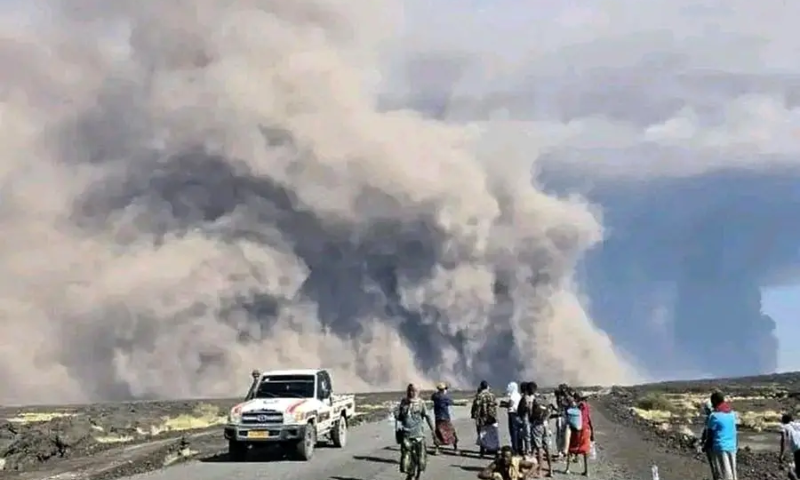
Karachi, November 24, 2025: An ash cloud from the first recorded eruption of Ethiopia’s Hayli Gubbi volcano in nearly 12,000 years is expected to drift over Yemen and Oman before reaching southern Pakistan, the Toulouse Volcanic Ash Advisory Centre (VAAC) said.
The volcano, located in the Afar region about 800 kilometres northeast of Addis Ababa near the Eritrean border, erupted on Sunday, sending plumes of ash up to 14 kilometres (45,000 feet) into the atmosphere. The eruption blanketed nearby villages in ash and triggered tremors felt as far away as Djibouti, Tigray, and towns in the Wollo area.
According to local media reports, the eruption occurred eight kilometres from the main mountain. Afar TV described it as a “massive eruption,” with residents reporting shock from the sound and tremors. The ash cloud reportedly plunged surrounding settlements into near-darkness.
While projections from the Toulouse VAAC suggest the ash cloud will pass over southern Pakistan, a spokesperson for the Pakistan Met Office, Anjum Nazeer Zaighum, said its effects would be minimal over Karachi and other populated areas.
“The projections indicate that the ash cloud will mostly pass over the deep Arabian Sea, Oman, and within the Mumbai Flight Information Region,” Zaighum told an English daily. He added that the cloud would be passing at around 50,000 feet altitude. Today, the ash cloud was observed 60 nautical miles south of Gwadar, and authorities have been issued warnings.
Flight tracking services, including FlightRadar, also showed that the ash cloud could reach southern Sindh in roughly 18 hours, before moving northeast toward India. Aviation authorities are monitoring the situation closely to prevent disruption to commercial flights in the region.
The Smithsonian Institution’s Global Volcanism Program confirmed that Hayli Gubbi had no known eruptions during the Holocene epoch, which began around 12,000 years ago. Michigan Technological University volcanologist Simon Carn described the eruption as unprecedented in modern history.
Residents in the Afar region reported a forceful explosion that continued for several hours, with the ash plume affecting air quality and reducing visibility in nearby areas. The Dutch news agency BNO News and Ethiopian outlet The Addis Standard reported that the eruption began at 8:30am UTC (1:30pm PKT), with activity gradually subsiding later in the afternoon.
Authorities in Ethiopia have been coordinating disaster response for affected villages, while regional aviation and meteorological agencies across the Arabian Peninsula are closely monitoring the ash cloud’s trajectory.