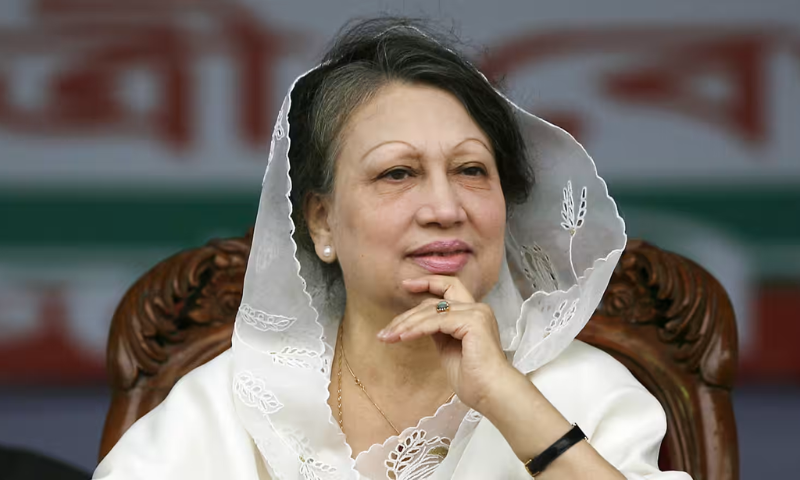
Dhaka, December 30, 2025: Bangladesh’s first female prime minister and veteran opposition leader Begum Khaleda Zia passed away early Tuesday after a prolonged illness, her party, the Bangladesh Nationalist Party (BNP), confirmed. She was 80.
In a statement, the BNP said Khaleda Zia died at 6:00am local time, shortly after the Fajr prayer. “The BNP chairperson and former prime minister, the national leader Begum Khaleda Zia, passed away today,” the party said, praying for forgiveness for her soul and urging the nation to offer prayers.
Doctors said Khaleda Zia had been suffering from multiple health complications, including advanced liver cirrhosis, arthritis, diabetes, and heart and chest problems. Her condition deteriorated sharply in late November, when she was rushed to hospital. Plans to airlift her to London for advanced treatment were later abandoned as she was deemed too unstable to travel.
Interim leader Muhammad Yunus paid glowing tribute, calling her a “great guardian” of the nation. “Through her uncompromising leadership, the nation was repeatedly freed from undemocratic conditions and inspired to regain liberty,” the Nobel Peace Prize laureate said. Former prime minister Sheikh Hasina also expressed condolences, saying she prayed for Khaleda Zia’s eternal peace.
Despite years of ill health and imprisonment, Khaleda Zia had vowed in November to campaign for the general elections scheduled for February 2026 — the first polls since a mass uprising last year toppled Sheikh Hasina’s government. The BNP is widely seen as a frontrunner in the upcoming vote.
The government announced three days of state mourning. Khaleda Zia’s funeral prayers will be held on Wednesday after midday prayers in front of parliament, followed by her burial beside her late husband, former president Ziaur Rahman. In a televised address, Yunus appealed for calm and discipline during mourning rituals.
Leadership condoles “committed friend of Pakistan”
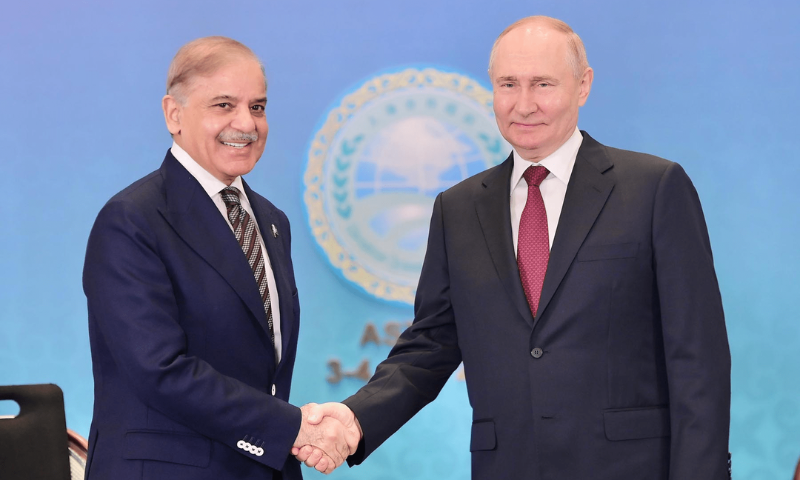
Condolences poured in from across the region and beyond. Pakistan’s Prime Minister Shehbaz Sharif said Khaleda Zia’s lifelong service left a lasting legacy, calling her a “committed friend of Pakistan.” President Asif Ali Zardari and Deputy Prime Minister Ishaq Dar also expressed sorrow.
Meanwhile, Indian Prime Minister Narendra Modi said he hoped her “vision and legacy” would continue to guide bilateral relations.
A towering political legacy
Often referred to simply as Khaleda, she entered politics after the assassination of her husband, military ruler-turned-president Ziaur Rahman, in a failed coup in 1981. Three years later, she took charge of the BNP, the party founded by her husband, and emerged as a central figure in Bangladesh’s turbulent politics.
She initially joined forces with Sheikh Hasina to lead a popular movement that toppled military ruler Hossain Mohammad Ershad in 1990. Their alliance soon gave way to an intense rivalry, earning them the moniker “the battling begums,” a feud that would dominate Bangladeshi politics for decades.
Khaleda Zia won the 1991 general election, becoming Bangladesh’s first female prime minister and only the second woman to lead a democratic government in a Muslim-majority country after Pakistan’s Benazir Bhutto. During her first term, she restored the parliamentary system, encouraged foreign investment, and made primary education free and compulsory.
She returned to power in 2001 with a landslide victory, but her second term was marred by allegations of corruption, the rise of militant groups, and political violence. After leaving office in 2006, an army-backed interim government briefly jailed both Khaleda and Hasina on corruption charges.
In 2018, Khaleda Zia was imprisoned again in a corruption case she described as politically motivated, later being placed under house arrest due to deteriorating health. She was freed in August 2024 following Sheikh Hasina’s ouster. Earlier this year, Bangladesh’s Supreme Court acquitted her and her son, BNP leader Tarique Rahman, in the case that had led to her imprisonment.
Tarique Rahman, who returned to Bangladesh last week after 17 years in exile, is expected to lead the BNP into the February 12 election and is widely seen as the party’s prime ministerial candidate if it secures a majority.
Khaleda Zia’s death marks the end of an era in Bangladeshi politics, closing a chapter defined by fierce rivalry, mass movements, and the struggle for democratic rule in the South Asian nation.