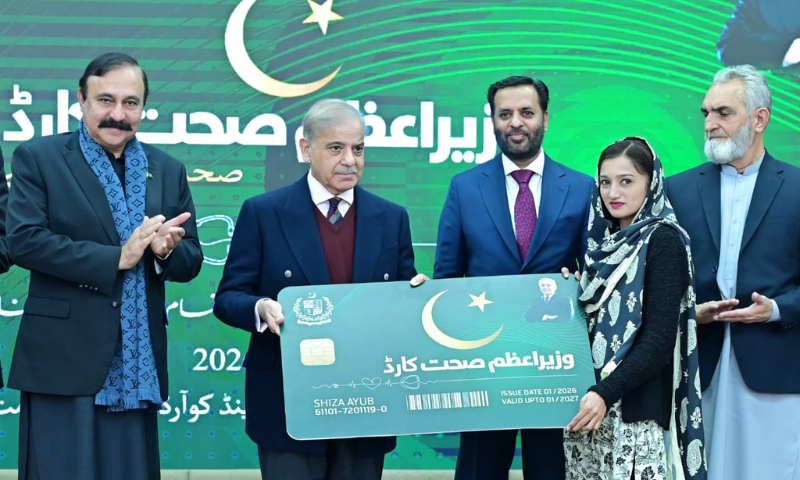
Islamabad, January 16, 2026: Prime Minister Muhammad Shehbaz Sharif on Friday revived and expanded the Prime Minister’s Health Card programme to Islamabad Capital Territory (ICT), Azad Jammu and Kashmir (AJK), and Gilgit-Baltistan, reaffirming the federal government’s commitment to providing quality healthcare as a fundamental right for every citizen, regardless of social or economic status.
Addressing the launch ceremony, attended by Federal Minister for Health Mustafa Kamal, the Chief Minister of Gilgit-Baltistan, parliamentarians, and senior officials including the Secretaries of Health and AJK’s Chief Secretary, the Prime Minister said the initiative marked a significant step toward delivering healthcare facilities directly to the people.
Recalling the programme’s origins, he said the health card scheme was first introduced in 2016 under former Prime Minister Mian Muhammad Nawaz Sharif and subsequently expanded across provinces. “There is nothing more valuable than health. If there is health, there is education; if there is health, there is dignified employment; if there is health, there is progress in every field of life,” he remarked.
Highlighting the state’s role in protecting the vulnerable, PM Shehbaz Sharif said, “Affluent citizens can afford treatment anywhere, but the true test of a government lies in safeguarding the poor, widows, orphans, and daily wage earners. Healthcare is the right of every Pakistani, whether a prime minister or a street vendor.”
He congratulated Federal Health Minister Mustafa Kamal, Secretary Health, and their teams on the programme’s revival, urging transparent implementation through third-party monitoring to ensure treatment is provided at the right facilities and standards. He assured that he would personally monitor the programme through inspections and collaboration with Islamabad’s health leadership, parliamentarians, and the leadership of AJK and Gilgit-Baltistan.
Responding to calls for expanding the programme to Sindh, the Prime Minister acknowledged the proposal and said he would take it up with the Chief Minister of Sindh. He noted that while Punjab has already made significant progress, with billions being spent on healthcare, efforts would be made to extend similar facilities nationwide.
Earlier, Federal Health Minister Mustafa Kamal said the revived programme will provide free, cashless healthcare to nearly 10 million residents of ICT, AJK, and Gilgit-Baltistan, ensuring treatment without financial burden during moments of illness or distress. He described the revival of the dormant programme within four to five weeks as a major administrative achievement.
Kamal emphasized that healthcare extends beyond treatment to prevention, safe childbirth, child vaccination, clean drinking water, and preventive care. He said approximately 70 hospitals are being empanelled under the health card programme in these regions, including 20 additional hospitals in Islamabad alone. Cardholders living in Karachi will also have access to treatment at 16 designated hospitals in the city.
He noted that Sindh remains the only province where the Prime Minister’s Health Card is not operational. A proposal covering 10 rural and urban districts of Sindh, estimated at Rs24 billion, has been prepared. Kamal expressed hope that with two years of funding, the programme could become self-sustaining from the third year onward, helping to address healthcare deprivation in Sindh.
The Prime Minister concluded by expressing hope that the programme would gain momentum nationwide, bringing relief to millions of families. “May Allah help us in serving the people,” he said, offering prayers for the initiative’s success and the prosperity of Pakistan.