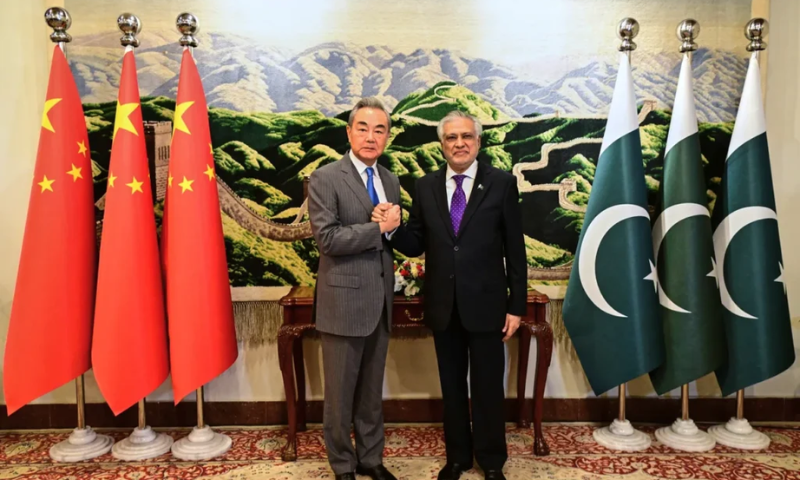
Beijing / Islamabad, January 5, 2026: Deputy Prime Minister and Foreign Minister Senator Mohammad Ishaq Dar visited China from January 3–5, 2026, at the invitation of Wang Yi, Member of the Political Bureau of the Communist Party of China (CPC) and Foreign Minister of the People’s Republic of China. On January 4, the two ministers co-chaired the Seventh Round of the China-Pakistan Foreign Ministers’ Strategic Dialogue in Beijing, focusing on strengthening bilateral cooperation and charting the next phase of the China-Pakistan Economic Corridor (CPEC).
During the dialogue, the two sides engaged in a comprehensive exchange of views on strategic, political, economic, trade, investment, defence, security, cultural, and people-to-people cooperation. International and regional developments of mutual interest were also discussed, underscoring the importance of coordinated approaches in a complex global landscape.
Launch of CPEC 2.0
Both sides agreed to deepen synergy between their national development strategies and key priority areas, marking the launch of CPEC 2.0, envisioned as a high-quality and sustainable expansion of the flagship Belt and Road Initiative project. The upgraded corridor aims to:
- Develop industry, agriculture, and mining sectors.
- Ensure high-quality operation of Gwadar Port and maintain the Karakoram Highway.
- Strengthen business, investment, IT, science and technology, cyber security, vocational training, and education.
- Expand cultural and people-to-people exchanges and promote trade via the year-round opening of Khunjerab Pass.
- Welcome third-party participation under mutually agreed terms.
- Enhance financial and banking sector cooperation, including support at regional and multilateral financial platforms.
CPEC progress and human impact
China-Pakistan economic and trade cooperation has seen remarkable growth. By 2025, the Gwadar Port Free Zone transformed from a fishing village into a regional hub, while the Rashakai Special Economic Zone attracted high-tech manufacturing companies. The China-Pakistan Agricultural Cooperation Demonstration Zone boosted Pakistan’s agricultural exports, reflecting the corridor’s tangible economic benefits.
CPEC’s impact extends beyond statistics. In Sindh, Chinese-funded solar streetlights have brought safe mobility to remote villages, and along the coast of Gwadar, wind turbines symbolize renewable energy collaboration. Training and job opportunities provided by Chinese enterprises have enabled countless individuals to realize their potential, giving the corridor a distinctly human and social dimension.
Solidarity amid challenges
China has consistently supported Pakistan through economic and social challenges. On December 8, 2025, the All-Pakistan Chinese Enterprises Association launched the 2025 Pakistan Flood Disaster Relief Campaign, donating 36.89 million Pakistani rupees ($132,000) to aid over 1,850 affected families with essentials such as food and blankets. These initiatives exemplify the enduring “ironclad friendship” between the two nations.
As CPEC enters a new phase in 2026, both countries aim to accelerate development, broaden industrial foundations, improve livelihoods, and strengthen shared destiny. The vision of CPEC 2.0 underscores the principle that mutual benefit and win-win cooperation are the foundations for enduring bilateral relations. The partnership between China and Pakistan continues to shine as a model of strategic cooperation and people-centered development, illuminating opportunities for both nations and the wider region.