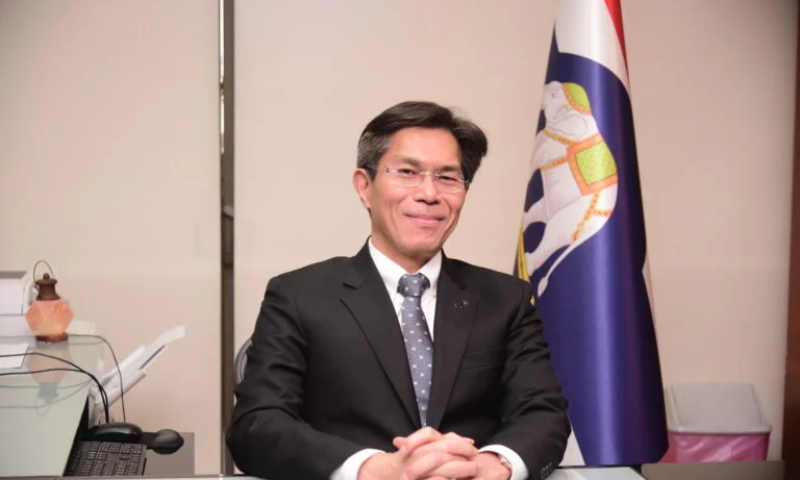
Islamabad, February 1, 2026: Ambassador of the Kingdom of Thailand to Pakistan, H.E Rongvudhi Virabutr, has vowed to double bilateral trade and build a strong economic partnership with Islamabad, saying that Pakistan offers a wealth of opportunities for Thai investors, particularly in high-growth sectors.
In an interview, the ambassador said that current bilateral trade stands at USD 1.1 billion, and his goal is to increase it to USD 2.2 billion within the next two to three years. He added that the greatest potential for growth lies in unlocking new areas of collaboration and breaking down existing barriers.
He said that Thailand sees immense potential in halal trade, where Thailand’s world-class halal food industry can easily meet the growing demand in Pakistan. “We also see opportunities for Pakistan’s high-quality seafood and textile products to gain greater access to the Thai market,” he added. The key, according to the ambassador, is to move beyond traditional goods and embrace a more diversified trade portfolio that responds to modern market demands.
Replying to a question, he said that diversifying trade is a cornerstone of Thailand’s forward-looking vision. “We are moving beyond the conventional focus on automobiles and seafood to embracing new high-growth sectors. We believe in creating a new narrative for our economic partnership—one that is not limited by geography but driven by shared economic goals,” he remarked.
The ambassador said that Thailand’s strategy involves a strong push into the services sector, particularly information technology, as well as fostering collaboration in the halal food industry, halal tourism, and the defence industry. Furthermore, he said, Thailand is committed to empowering women in the economic sphere by using e-platforms to sell their products, which will unlock new and innovative revenue streams and contribute to inclusive economic growth.
He added that Thailand is also working with UN Women Pakistan through projects such as women in agriculture and home beauty salons to enhance women’s economic independence at the household level. “This is a prime example of how we are thinking outside the box to create a more dynamic and equitable trade relationship,” he said.
Responding to a question regarding new agreements or joint ventures between the two countries in the coming days, the ambassador replied in the affirmative, saying that the most significant and transformative agreement on the horizon is the Free Trade Agreement (FTA). “This is not merely a technical document; it is a strategic framework that will fundamentally change the way we do business,” he said, adding that the current focus is on building a shared understanding of the mutual benefits of the FTA for Pakistan.
He explained that for Pakistan, the FTA would mean lower costs for raw material imports from Thailand, making local production more efficient and competitive. It would also offer Pakistani consumers access to a wider range of high-quality goods at more competitive prices.
Beyond the FTA, the Thai ambassador said efforts are underway to elevate bilateral dialogue, with discussions in progress to transform the existing Joint Economic Commission into a more comprehensive Joint Commission led by the respective foreign ministers. This, he said, would provide a broader platform to discuss not only trade but all facets of the bilateral relationship, ensuring a more integrated and coordinated approach to the shared future.
Answering another question on enhanced connectivity between the two countries, the ambassador said that connectivity is the lifeblood of the economic partnership. While air and sea links already exist, he said the vision is to further strengthen them to facilitate the rapid movement of goods, people, and ideas. “We must streamline customs procedures and explore new direct air routes to boost tourism and business travel. Increasing the frequency and capacity of air services is also among our top priorities,” he added.
He said that by improving logistics and creating more efficient shipping channels, both countries can reduce the cost and time of trade, making their economies more competitive and attractive to investors. “We are committed to exploring all avenues for collaboration, from logistics and port management to pilot projects on paperless customs procedures with ASEAN, if possible,” he added.
Responding to a question regarding attractions in Pakistan for Thai investors, the ambassador said that Pakistan offers vast opportunities, particularly due to its large and young population. He highlighted Pakistan’s agriculture, IT, renewable energy, and mining sectors as areas of immense promise. He noted that the Pakistani government’s Special Investment Facilitation Council (SIFC) has made significant strides in creating a more investor-friendly environment and encouraged Thai businessmen to explore these prospects.
Conversely, the ambassador said that for Pakistani businesses, Thailand presents itself as a hub of manufacturing and innovation. He pointed out that opportunities abound in Thailand’s advanced manufacturing and data centre sectors, adding that Thailand’s strong infrastructure and strategic location at the heart of ASEAN make it an ideal base for Pakistani companies seeking access to the broader Southeast Asian market.
Commenting on the role of free trade agreements and future economic relations, the Thai ambassador said that such agreements and regional groupings are not just part of the landscape but are the very scaffolding upon which future economic relations will be built. “The FTA is the linchpin of our bilateral economic vision, and its successful conclusion will be a game changer,” he said, noting that it would formalise a partnership that benefits both economies while fostering a predictable and transparent trading environment.
He further said that Thailand’s role as a key ASEAN member and Pakistan’s strategic location in South Asia create a powerful synergy. “We are actively promoting a ‘Look West’ policy, which complements Pakistan’s ‘Vision East Asia’ policy. By strengthening our bilateral ties, we are not just connecting two countries—we are building a bridge between two dynamic regions and unlocking unprecedented opportunities for trade and investment,” the ambassador said.
The Thai envoy concluded by saying that while significant work remains, it should be viewed not as a challenge but as a tremendous opportunity. He said Thailand’s vision is comprehensive and rests on four key pillars: trade and investment, business cooperation, people-to-people connections, and enhanced diplomatic and security collaboration.
“We are tackling these areas with renewed urgency and purpose. Immediate steps include accelerating FTA negotiations, fostering stronger collaboration between business councils, and initiating high-level meetings to ensure a coordinated and strategic approach. By focusing on concrete and measurable outcomes, we are building a foundation that will ensure our economic potential becomes a reality,” the Thailand ambassador opined.