Islamabad, February 7, 2026: The state visit of President Kassym-Jomart Tokayev of Kazakhstan to Pakistan on February 3-4 has marked a significant shift in Central Asia’s geo-economic paradigm, signaling the region’s transition from being perceived as “landlocked” to emerging as a “land-linked” connectivity hub.
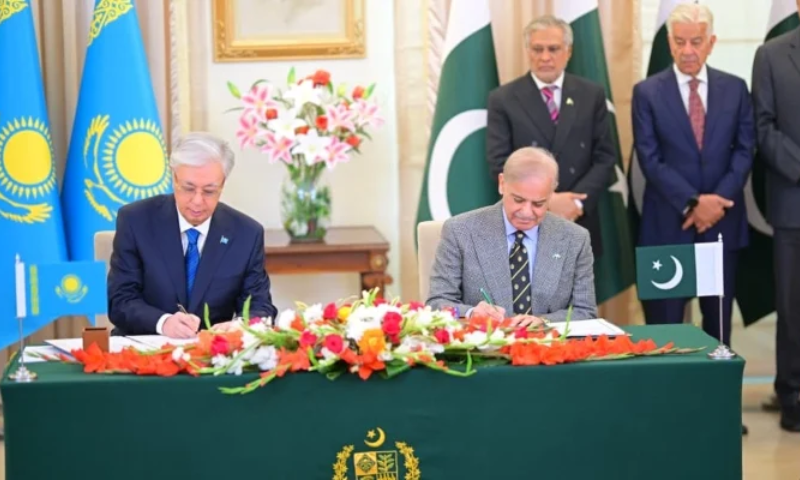
The visit went beyond formal diplomacy, translating dialogue into actionable agreements. The accompanying business forum saw over 30 documents signed, valued at approximately $200 million. Key projects include Falcon EuroBus’s supply of 600 electric buses to Pakistan and the construction of a sugar factory in Kazakhstan with participation from Pakistan’s Almoiz Group. Kazakhstan’s exports are diversifying to include high-tech engineering products, with a concrete path toward achieving the ambitious target of $1 billion in bilateral trade.
A landmark Joint Declaration on Establishing a Strategic Partnership elevates political ties, while agreements on transit trade and administrative mutual assistance in customs matters are removing barriers for businesses. Cooperation in technology and education was also emphasized, with memorandums signed on Artificial Intelligence and university partnerships, recognizing Pakistan as a promising IT hub.
Transport connectivity is central to the partnership. Pakistani ports—Karachi, Qasim, and Gwadar—are being integrated as strategic nodes in Eurasia’s transport network. Direct cooperation between logistics operators, including KTZ Express and Pakistan’s NLC, will launch multimodal services connecting the port of Aktau to Karachi and Gwadar, creating a “seamless” transit corridor. This initiative also lays the foundation for a Kazakhstan-Pakistan-East Africa multimodal corridor, enabling Kazakh goods to reach African markets efficiently.
For Pakistan, the partnership addresses multiple priorities: securing energy imports from Kazakhstan, optimizing port infrastructure, and opening premium markets for textiles, pharmaceuticals, and agro-industrial products. The collaboration also strengthens Islamabad’s strategic positioning in regional and global trade networks.
The visit also strengthened the intellectual and research foundation of the partnership. Agreements between universities and think tanks in both countries will provide synchronized expert analysis to support political and economic decision-making.
Looking ahead, the roadmap for 2026-2027 focuses on operationalizing agreements, creating a unified digital and logistical environment, implementing a “single window” system, and establishing end-to-end tariffs. From 2028 onwards, the emphasis will shift to infrastructure development, including modernization of railways and specialized port nodes.
Ultimately, Kazakhstan’s southern engagement enhances its geopolitical sovereignty, providing alternative access to the sea and increasing the region’s leverage with global partners. President Tokayev’s visit has set in motion a transformative process for integrating Central and South Asia, heralding a new economic reality for the region.