Islamabad, April 11, 2026: Following the arrival of a high-level United States delegation led by Vice President JD Vance, Pakistan has expressed optimism that Washington and Tehran will engage constructively in the Islamabad Talks to secure a durable end to the Middle East conflict.
The high-powered American delegation, comprising Special Envoy Steve Witkoff and President Donald Trump’s son-in-law Jared Kushner, arrived in Islamabad on Saturday to participate in the negotiations.
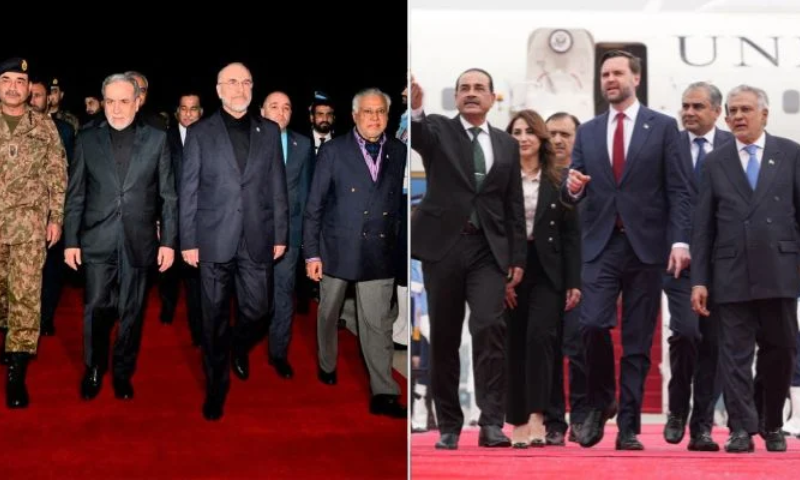
The visiting delegation was received at the airport by Deputy Prime Minister and Foreign Minister Ishaq Dar, Chief of Defence Forces and Chief of Army Staff Field Marshal Asim Munir, and Interior Minister Mohsin Naqvi.
Welcoming the U.S. Vice President, Ishaq Dar appreciated Washington’s commitment to promoting regional and global peace. He expressed optimism that both sides would engage meaningfully in the Islamabad Talks and reiterated Pakistan’s resolve to continue facilitating dialogue toward a lasting and durable settlement of the Middle East conflict.
“Make-or-break” opportunity for peace
Prime Minister Shehbaz Sharif described the Islamabad Talks as a “make-or-break” opportunity to transform the existing truce into a permanent ceasefire.
The negotiations follow a two-week ceasefire announced by Donald Trump after weeks of conflict involving U.S. and Israeli strikes on Iran. Despite the pause, tensions remain high, particularly over the Strait of Hormuz and ongoing hostilities involving Israel and Iran-backed Hezbollah in Lebanon.
Iranian delegation arrives for talks
Earlier, a senior Iranian delegation led by Mohammad Bagher Ghalibaf also arrived in Islamabad. The delegation includes Foreign Minister Abbas Araghchi, who is expected to play a pivotal role in the negotiations.
The Iranian officials were receive by Ishaq Dar, National Assembly Speaker Sardar Ayaz Sadiq, Field Marshal Asim Munir, and Mohsin Naqvi. During the reception, Pakistan’s leadership conveyed its expectation of constructive engagement and reaffirmed its commitment to facilitating dialogue.
Ahead of the talks, Ghalibaf stressed that Washington must fulfil prior commitments, including easing restrictions on Iranian assets and ensuring a ceasefire in Lebanon, warning that progress would otherwise remain difficult.
Diverging positions and global stakes
Vice President Vance expressed cautious optimism about the outcome, while warning that any attempt to undermine the process would draw a firm response.
The conflict, which began on February 28 following coordinated U.S.-Israeli strikes targeting Iran’s leadership and infrastructure, has resulted in more than 2,000 deaths and widespread regional instability. Tehran responded with retaliatory operations, including disruptions to shipping through the Strait of Hormuz and attacks on U.S. and Israeli interests in the region.
A ceasefire was eventually announced on April 8, with Pakistan playing a central mediating role. However, key disagreements persist. Washington has reportedly proposed a 15-point framework focusing on nuclear and missile issues, sanctions relief, and reopening of the Strait of Hormuz, while Tehran has presented a 10-point plan seeking sanctions removal, access to frozen assets, and enhanced control over regional transit routes.
International support for Pakistan’s diplomatic role
The international community has broadly welcomed Pakistan’s diplomatic efforts, backing its role in de-escalating tensions and facilitating negotiations aimed at achieving lasting peace.
As the Islamabad Talks unfold, global attention remains fixed on the Pakistani capital, with hopes that sustained diplomacy will pave the way for stability and a peaceful resolution to one of the most volatile conflicts in the Middle East.