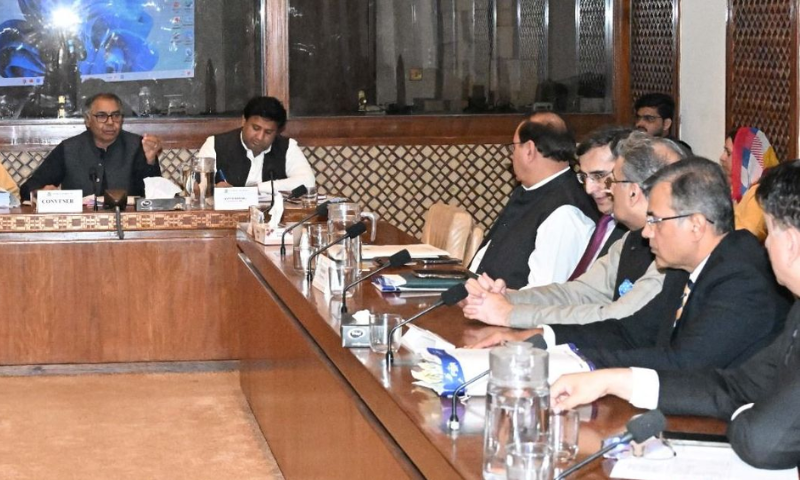
Islamabad, April 14, 2026: A meeting of the Sub-Committee of the Senate Standing Committee on Interior and Narcotics was held at Parliament House under the convenership of Saifullah Abro, where serious concerns were raised over smuggling, tax evasion, and significant losses to the national exchequer.
Officials from the Federal Investigation Agency (FIA) briefed the committee on key agenda items. They informed members that, in compliance with the Sub-Committee’s directives, an inquiry report regarding Chota Lahore had been prepared and submitted. Notices were issued to relevant authorities, and a letter was dispatched to the Chief Secretary Balochistan concerning petroleum-related matters.
Senator Abro expressed alarm over the seizure of petroleum worth Rs. 222 million by customs authorities over the past five years, questioning its origin and intended destination. He highlighted reports of convoys comprising dozens of vehicles involved in smuggling petroleum products and called for a comprehensive report to trace their movement. The Chief Secretary Balochistan was directed to provide detailed information and appear before the Committee for a personal hearing.
The Committee was also informed that a letter had been sent to the Member Customs regarding tax exemptions in FATA, PATA, and adjoining regions. The Convener warned that these areas were increasingly becoming hubs of smuggling, undermining national economic interests.
To ensure transparency, the Sub-Committee decided to summon the CEO of TESCO in the next meeting. Customs authorities were directed to compile detailed data on goods transported to tax-exempt regions and products manufactured there but sold elsewhere without payment of duties.
Senator Abro highlighted disparities in the tax system, noting that compliant taxpayers face increased burdens while tax evaders escape scrutiny. He also emphasized that individuals assisting the Committee in national interests should be encouraged, directing the withdrawal of a notice issued to a supportive stakeholder.
The FIA informed the Committee that progress had been made in ongoing investigations and that cases would be concluded within ten days. It was also revealed that 2,202 cigarette cartons were reported missing from a warehouse.
The Chairman called for strict action against irregularities in the tobacco industry and directed the installation of monitoring pickets at production facilities to ensure proper stock oversight and enhance revenue collection from grey areas.
A representative of the Federal Board of Revenue (FBR) informed the Committee that competent and honest officers had been deployed in Khyber Pakhtunkhwa to curb corruption. Several disciplinary proceedings have been initiated, with numerous officials dismissed, while integrity and performance are being rewarded.
The Sub-Committee also examined an alleged embezzlement of Rs. 1.28 billion in the 765kV Dasu–Islamabad Transmission Line Grid Station project. Senator Abro directed the National Accountability Bureau (NAB), FIA, and the National Transmission and Despatch Company (NTDC) to take action against the contractor and officials involved.
Committee Member Umer Farooq stressed the urgent need to curb petroleum smuggling in Balochistan, noting that diesel prices have reached Rs. 240 per litre in Quetta and Rs. 210 per litre in rural areas. Customs officials reported the seizure of 75,000 litres of diesel in Hub, along with additional confiscations in Hyderabad.
Officials further revealed that customs authorities lack operational presence along the Iran border and in districts such as Panjgur, Gwadar, Kech, and Washuk, limiting enforcement capabilities.
The Committee was informed that up to three million litres of petroleum products per day are permitted for import from Iran for local populations, reduced from the previous limit of 6.5 million litres. It was also noted that major oil marketing companies—including Pakistan State Oil (PSO), Shell, and Attock Petroleum Limited—are not operational in several areas of Balochistan.
The Chairman directed that PSO provide detailed data on petroleum supplies and transportation costs to the province.
Customs authorities disclosed that steel factories have imported raw materials worth Rs. 100 billion, while oil and ghee manufacturers have imported hydrogenated vegetable oil, vegetable ghee, and vanaspati ghee worth Rs. 320 billion since 2021 in tax-exempt regions. A total of 409 importers are currently operational in Pakistan. The Committee directed that comprehensive details of companies operating in such areas be submitted at the next meeting.
Reaffirming the Committee’s resolve, Senator Abro stressed the need for strict action against smuggling, corruption, and tax evasion to safeguard national revenue and ensure economic stability.