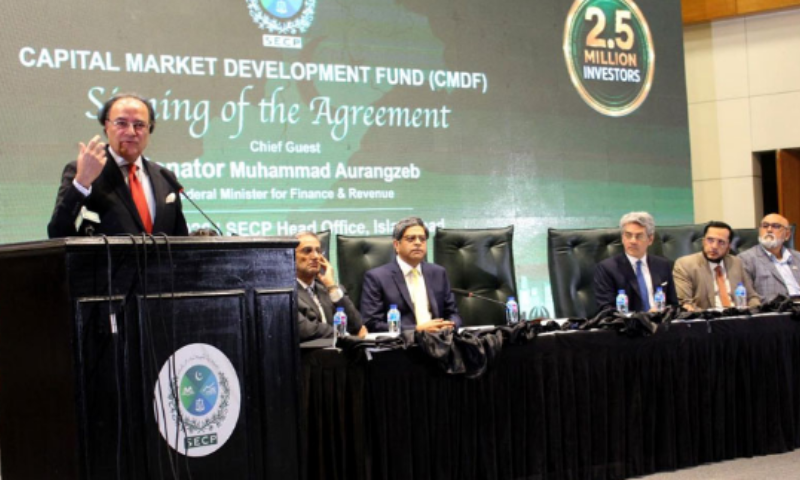
Islamabad, May 6, 2026: Finance Minister Muhammad Aurangzeb on Wednesday said Pakistan is actively pursuing diversified financing instruments, including green bonds, green sukuk, and a proposed Panda bond, to support its climate resilience and energy transition agenda.
Addressing a climate change conference in Islamabad, Aurangzeb said the country currently has access to around $600–700 million in climate finance and is working to expand this pool through structured and sustainable funding mechanisms.
He said the government is focusing on broadening its financing base through innovative instruments such as green bonds and locally issued green sukuk, aimed at mobilizing capital for climate-related and sustainable development projects.
The minister noted that Pakistan expects approximately $200 million in support from the International Monetary Fund, while the Asian Development Bank is also extending financial assistance. He further announced that preparations are underway to launch Pakistan’s inaugural Panda bond this month, expected to raise around $250 million in Chinese yuan (RMB).
Aurangzeb urged stakeholders to adopt a pragmatic approach, emphasizing efficient utilization of existing resources rather than focusing on theoretical funding gaps. He said discussions about multi-billion-dollar financing needs remain largely academic unless current allocations are effectively deployed.
Referring to global trends, he cited China’s rapid expansion in green finance, noting that the country accounts for nearly 40% of global green bond issuance, and said Pakistan could learn valuable lessons from such models. He also acknowledged support from international experts in developing Pakistan’s green investment pipeline and accelerator framework.
Highlighting broader economic priorities, the finance minister stressed the need for Pakistan to move beyond maintaining commercial reserves and instead build strategic reserves while accelerating its shift toward renewable energy.
He called for increased investment in solar, wind, and hydropower projects to reduce dependence on fossil fuels. Aurangzeb also pointed to ongoing policy measures, including energy efficiency initiatives, electric vehicle promotion, targeted subsidies, and risk-sharing mechanisms to facilitate the transition.
The minister further emphasized strengthening domestic capital markets to reduce reliance on bank-based financing, stating that Pakistan must mobilize indigenous financial resources and channel them into green and sustainable investments to ensure long-term economic and environmental stability.