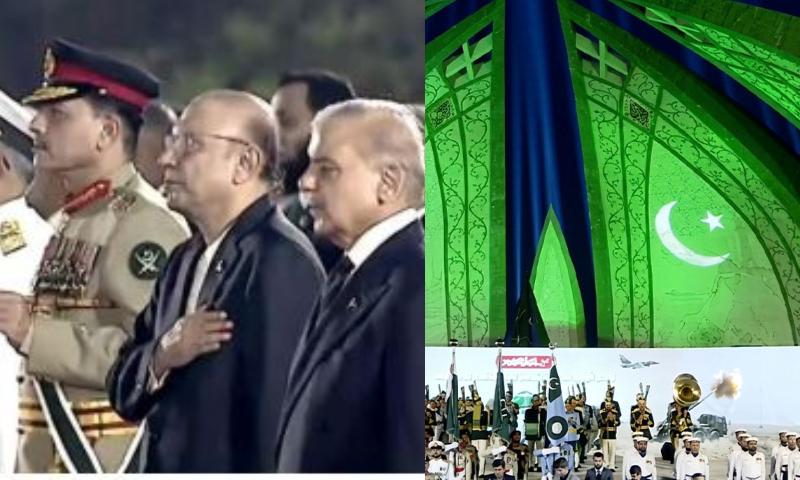
Islamabad, May 10, 2026: Prime Minister Muhammad Shehbaz Sharif on Sunday termed Pakistan’s response to India during Marka-i-Haq a “historic victory” as the country commemorated the first anniversary of the conflict at a ceremony held at the Pakistan Monument.
The conflict — spanning from the April 22 Pahalgam incident to the conclusion of Operation Bunyanum Marsoos with a ceasefire on May 10, 2025 — has officially been named “Marka-i-Haq” (Battle of Truth) by the state.
The ceremony was attended by President Asif Ali Zardari, Chief of Defence Forces and Chief of Army Staff Asim Munir, Chief of Naval Staff Naveed Ashraf, and Chief of Air Staff Zaheer Ahmad Baber Sidhu, along with senior civil and military officials.
The event commenced with the recitation of the Holy Quran and a march past, while a planned fly-past was later cancelled due to adverse weather conditions. Patriotic songs were also presented during the ceremony.
Beginning his address with a one-minute silence for the martyrs of the conflict, Prime Minister Shehbaz Sharif recalled the tense days of confrontation with India and accused New Delhi of launching “baseless allegations” against Pakistan after the Pahalgam incident.
“Despite Pakistan offering a transparent investigation, the enemy attacked our mosques and innocent civilians under the cover of darkness and imposed an unprovoked war on us,” the prime minister said.
He stated that Pakistan’s armed forces responded with courage and professionalism, adding that the country’s “Shaheens dominated the conflict,” forcing India to seek a ceasefire within hours.
The prime minister further claimed that even after one year, India had failed to provide evidence linking Pakistan to the Pahalgam attack.
“There is no doubt that Operation Bunyanum Marsoos is not merely a historic victory, but also a glowing symbol of our national honour, dignity and self-respect,” he said.
PM Shehbaz announced that May 10 would henceforth be observed annually as “Youm-i-Bunyanum Marsoos”.
Paying tribute to the armed forces, the premier particularly praised Field Marshal Asim Munir for what he described as exemplary courage and leadership during Marka-i-Haq.
“Field Marshal Asim Munir’s wise and brave leadership will be written in golden words in history. The entire nation salutes him,” he remarked.
He also commended Air Chief Marshal Zaheer Ahmad Baber Sidhu and the Pakistan Air Force for exposing what he called the “reality behind the adversary’s claims of aerial superiority”.
The prime minister lauded the Pakistan Navy as well, saying the enemy could not dare enter Pakistan’s waters during the conflict.
PM Shehbaz additionally acknowledged the support extended by the Pakistani public and friendly nations during the crisis, particularly thanking Donald Trump for playing what he termed a “historic role” in helping maintain peace in the region.
He warned that any further escalation between two nuclear-armed neighbours could have produced disastrous consequences.
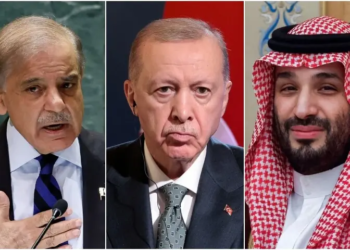
The premier also expressed gratitude to the leadership of Saudi Arabia, China, and Turkiye for their diplomatic support.
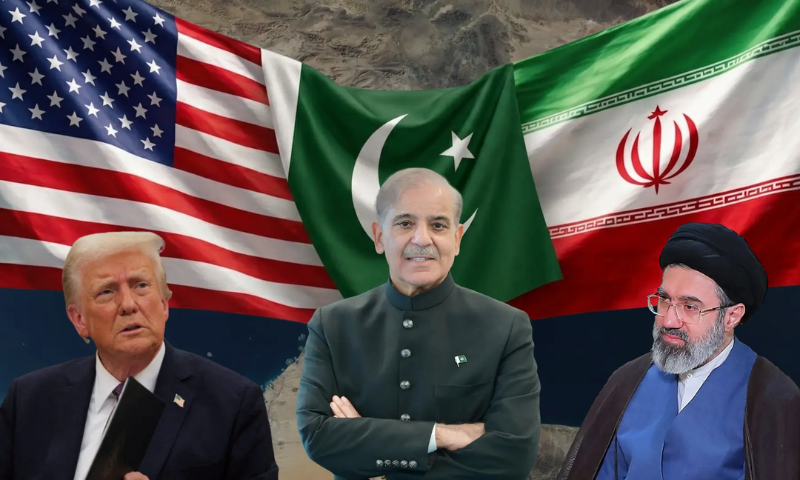
Referring to Pakistan’s mediation efforts between the United States and Iran, PM Shehbaz said Pakistan’s diplomatic engagement for de-escalation was continuing, while also appreciating the efforts of Deputy Prime Minister Muhammad Ishaq Dar.
In his address, President Asif Ali Zardari described Marka-i-Haq as “one of the most significant chapters” in Pakistan’s national history.
He accused India of carrying out unprovoked aggression on the basis of what he called a “false flag Pahalgam incident” and targeting civilian and religious sites in Pakistan without justification.
According to the president, Pakistan delivered a “calibrated and shocking response” under the leadership of Field Marshal Asim Munir while exercising restraint as a responsible state.
President Zardari praised the Pakistan Air Force, saying its pilots successfully defended the country’s airspace against a numerically larger adversary.
“Our pilots demonstrated extraordinary skill and confidence. Pakistan’s response became a defining moment of national resolve and pride,” he said.
He also commended the Pakistan Navy for maintaining operational preparedness and safeguarding the country’s maritime frontiers during the conflict.
The president said Pakistan’s victory reflected national unity and harmony, sending a clear message to the world that the nation stood united and vigilant.
He further criticised India’s unilateral suspension of the Indus Waters Treaty following the Pahalgam incident, calling it “hydro-terrorism”.
President Zardari reiterated Pakistan’s diplomatic support for the people of Indian Illegally Occupied Jammu and Kashmir and stressed that the Kashmir dispute must be resolved in line with relevant United Nations resolutions.
He also called for an end to what he termed “India-sponsored terrorism” in Pakistan through Afghan territory and urged Afghan authorities to prevent the use of their soil against neighbouring states.
Concluding his remarks, President Zardari said Pakistan’s diplomatic initiatives — particularly its role in facilitating dialogue between the United States and Iran — had strengthened the country’s reputation as a regional stabiliser.
“Pakistan’s armed forces are fully capable and always prepared to defend the country’s sovereignty and national interests against any challenge,” he asserted.