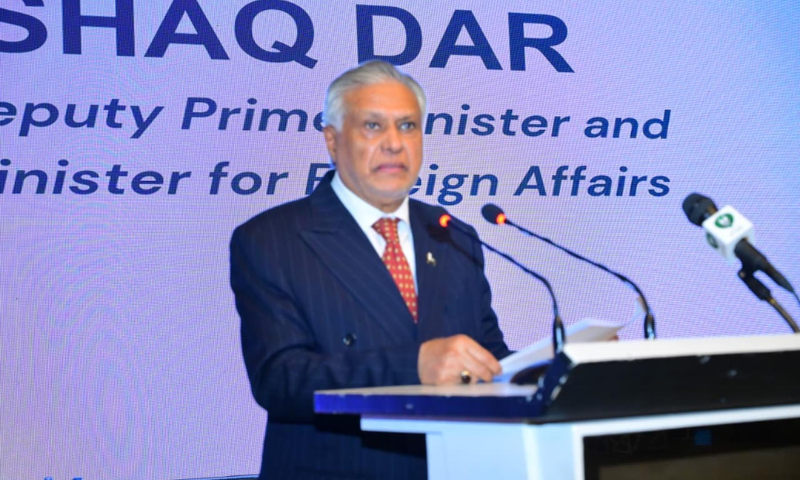
Islamabad, June 30, 2026: Deputy Prime Minister and Foreign Minister Ishaq Dar on Tuesday urged India to resolve all outstanding disputes through dialogue and diplomacy, warning that any violation of the Indus Waters Treaty (IWT) could have serious regional and international consequences.
Addressing an international seminar on the Indus Waters Treaty in Islamabad, Dar said Pakistan remained ready for comprehensive dialogue with India, stressing that lasting peace could only be achieved through mutual respect and recognition of each other’s sovereignty.
“We are ready to discuss all issues through a composite dialogue, but it takes two to tango,” he said.
Dar criticized India’s decision to place the Indus Waters Treaty in abeyance following the April 2025 attack in Indian-administered Kashmir, in which 26 people were killed. India accused Pakistan of involvement in the attack, an allegation Islamabad has consistently denied.
The deputy prime minister cautioned that violating an international treaty such as the IWT would set a dangerous precedent and undermine the credibility of international agreements.
“If Pakistan is deprived of its legitimate water rights, it will have serious consequences,” he warned.
Dar also criticized what he described as India’s politicization of sports and alleged democratic shortcomings, saying the international community should take notice of developments affecting democratic processes.
Speaking at the same seminar, Information Minister Attaullah Tarar reaffirmed Pakistan’s commitment to preserving the Indus Waters Treaty, describing it as one of the world’s most enduring and successful water-sharing agreements.
“We are not merely discussing a treaty, but the lifeline of 240 million people,” Tarar said, adding that water is a matter of national survival for Pakistan.
He warned that any attempt to stop or divert Pakistan’s share of water would receive an effective response, while emphasizing that the treaty can only be amended through mutual agreement between the two countries.
Tarar said Pakistan has consistently advocated peaceful relations, constructive dialogue and adherence to international agreements, adding that unilateral actions undermine regional peace and stability.
Pakistan’s Commissioner for the Indus Waters Treaty, Syed Mehr Ali Shah, alleged that India had not been fully complying with the treaty since August 2023.
He said Pakistan had recently written to India requesting the exchange of hydrological data as required under the agreement.
The commissioner further alleged that India was diverting water from the Chenab River in violation of the treaty by constructing a Chenab-Beas link without allowing Pakistan the inspections required under the agreement.
Addressing the seminar, Russian expert Roxolana Zigon said the Indus Waters Treaty remains one of the world’s most successful transboundary water-sharing agreements and contains no provision permitting unilateral suspension or withdrawal.
She noted that more than 90 percent of Pakistan’s agriculture depends on river water supplied by the Indus basin and warned that upstream dam construction and unilateral water policies could increase regional instability and erode confidence in international agreements.
She also described the Permanent Indus Commission as an effective dispute-resolution mechanism and stressed that preserving the treaty is essential for long-term peace and stability in South Asia.
Former President of the National Defence University, Lt Gen (retd) Amir Riaz, said the Indus River system supports Pakistan’s agriculture, economy and energy sector through one of the world’s largest irrigation networks.
He warned that any attempt to deprive Pakistan of its share of water would pose a serious threat to the country’s national security.