Tehran, July 5,2026: Funeral prayers for Iran’s former supreme leader Ali Khamenei and four of his family members were offered in Tehran on Sunday, the second day of ceremonies that drew huge crowds of mourners to the Iranian capital.
Khamenei, who led the Islamic republic from 1989 until his death at the age of 86, was killed in an airstrike on the opening day of the US-Israeli war with Iran on February 28.
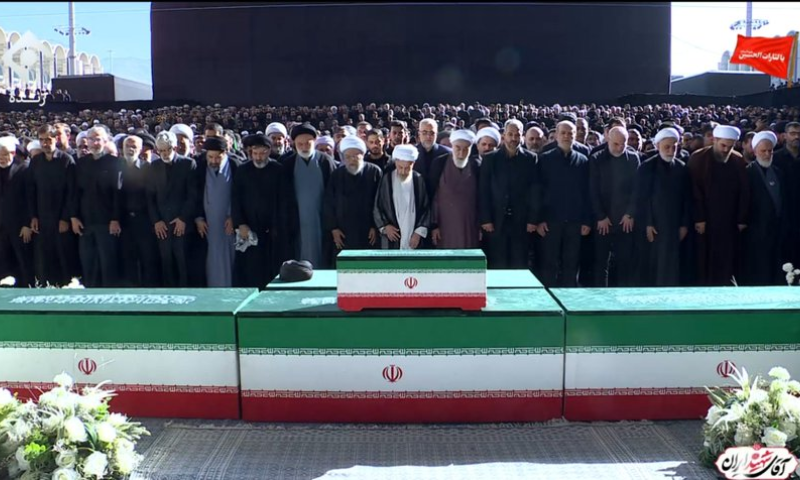
The funeral prayers were held at Tehran’s Grand Mosalla complex and led by prominent cleric Jafar Sobhani, a senior scholar based in the holy city of Qom.
Khamenei’s son and designated successor, Mojtaba Khamenei, who was reportedly wounded in the February 28 attack, did not appear at the ceremony. His absence marked his first major public no-show since being named supreme leader. However, Khamenei’s other sons — Masoud, Mostafa and Meysam — were present at the funeral prayers.
Iran had declared Sunday a public holiday to facilitate public participation in the ceremonies. Later in the day, Khamenei’s body was expected to be moved from the Grand Mosalla complex, where it had been lying in state, ahead of a major funeral procession through Tehran on Monday.
AFP journalists reported that the sprawling religious complex and surrounding roads were packed with mourners from early morning, many carrying Iranian flags and portraits of Khamenei. With temperatures rising above 35°C, volunteers distributed refreshments to attendees as they made their way to the venue.
Iranian President Masoud Pezeshkian attended the ceremony alongside senior officials, including parliament speaker and chief negotiator Mohammad Bagher Ghalibaf, according to state television footage.
Khamenei’s coffin, draped in the Iranian flag and topped with his trademark black turban, was placed alongside the coffins of four relatives who were also killed in the February strikes, including an infant granddaughter.
Iranian authorities have said they expect more than 10 million people to participate in the funeral ceremonies in Tehran, making it one of the largest public gatherings in the country’s recent history.
Funeral seen as test of public support
The funeral is also being closely watched outside Iran as a test of public support for the government after months of unrest and the devastating war with the United States and Israel.
Following five weeks of hostilities, the conflict is currently on hold under a ceasefire and an initial accord with Washington, although both sides have warned they are prepared to resume fighting if necessary.
Speaking on Saturday, President Pezeshkian said the public turnout and emotional scenes at the funeral reflected Khamenei’s standing among Iranians and supporters abroad.
“What is observed today in the emotions, tears and passionate presence of the people in various scenes is the clearest sign of his place among the Iranian nation and the free people of the world,” he said, while also accusing Israel of acting as a destabilising force in the Middle East.
Delegations from Iran’s regional allies were also present in Tehran. According to Iranian state media, representatives of Hamas, Hezbollah, the Houthis and Palestinian Islamic Jihad attended the funeral ceremonies and met Iranian Foreign Minister Abbas Araghchi.
According to the announced schedule, Khamenei’s coffin will be taken through Tehran in a public procession on Monday before being moved to Qom on Tuesday and then to neighbouring Iraq on Wednesday. He is due to be buried on Thursday in his hometown of Mashhad in northeastern Iran.
Authorities have imposed extensive security arrangements in the capital and warned mourners about the risk of overcrowding and possible stampedes during the ceremonies. Organisers have also taken measures to deal with the ongoing heatwave, including misting crowds with water at the Grand Mosalla complex to help people cope with temperatures expected to approach 40°C in the coming days.