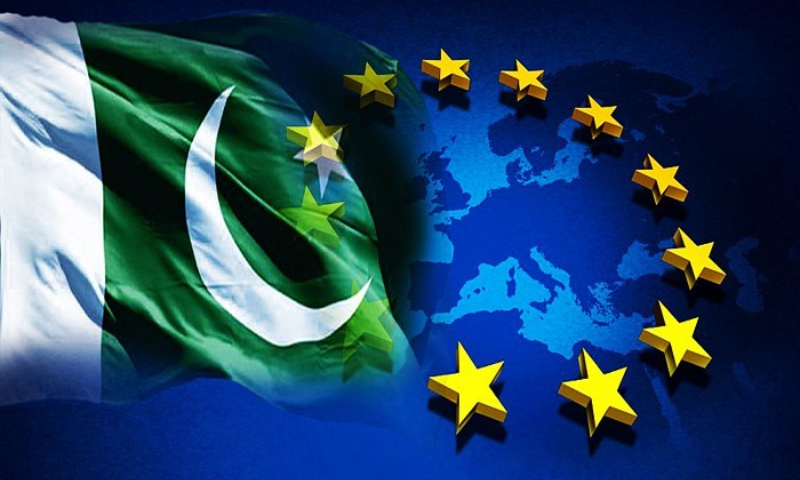
Islamabad, July 16,2026: The European Union has warned that Pakistan must address shortcomings in its compliance with the Generalised Scheme of Preferences Plus (GSP+) commitments if it hopes to retain preferential access to the European market under the revised GSP framework set to take effect in 2027.
In its latest report on the implementation of the GSP covering the 2023-2025 period, the European Commission said Pakistan had “been facing compliance issues with its GSP+ obligations” and had “regressed in a number of areas while positive change was limited.”
The report, jointly issued by the European Commission and the EU High Representative for Foreign and Security Policy, stressed that Pakistan’s continued eligibility under the revised framework would depend on measurable progress in fulfilling its international obligations.
The Commission identified several priority areas for future engagement, including ensuring accountability for human rights violations, intensifying efforts to combat torture, pursuing prison and capital punishment reforms, reversing trends related to enforced disappearances, and protecting freedom of expression.
The revised GSP regime, which will come into force on January 1, 2027, requires all existing beneficiary countries to reapply under stricter sustainability, governance and human rights criteria.
Progress acknowledged, concerns remain
While expressing concern over Pakistan’s overall compliance, the Commission acknowledged a number of positive legislative and institutional developments during the reporting period.
These included the establishment of a National Commission for Minorities, narrowing the scope of the death penalty, maintaining the de facto moratorium on executions, adopting implementing rules under the Anti-Torture Act, passing the Domestic Violence Bill for Islamabad Capital Territory, and securing Pakistan’s first conviction for marital rape.
The report also praised the National Commission for Human Rights for strengthening the country’s institutional framework for protecting human rights.
However, it noted that most of the progress had been legislative or administrative and had yet to translate into meaningful improvements on the ground.
Human rights, rule of law under scrutiny
The Commission raised serious concerns over the rule of law and shrinking civic space, stating that enforced disappearances and extrajudicial killings had increased while accountability for perpetrators remained absent.
It also expressed concern over declining freedom of expression, warning that amendments to cybercrime, anti-terrorism and blasphemy laws contained broadly worded provisions that could be used against journalists, human rights defenders, political dissidents and members of religious and ethnic minorities.
According to the report, media freedom continued to deteriorate despite legislation aimed at protecting journalists, with media personnel facing intimidation, harassment, violence and strategic lawsuits for reporting on sensitive issues.
The Commission further observed that provisions of the Pakistan Electronic Crimes Act (PECA), along with criminal defamation, sedition, blasphemy and counter-terrorism laws, had created a “significant chilling effect” on civil society and free expression.
The report also voiced concern that recent constitutional amendments could undermine judicial independence, military accountability and the rule of law.
Political rights and enforced disappearances
The assessment cited persistent concerns regarding the integrity of Pakistan’s 2024 general elections, treatment of opposition leaders and supporters, and the growing influence of the military in governance.
It said political rights had been negatively affected by judicial proceedings against opposition figures, prolonged detentions and concerns over fair trial guarantees.
The report also criticised the use of military courts for civilian trials, stating that such proceedings did not meet international fair trial standards under the International Covenant on Civil and Political Rights (ICCPR).
Enforced disappearances remained another major concern, particularly in Balochistan and Khyber Pakhtunkhwa. The Commission noted that the Commission of Inquiry on Enforced Disappearances had failed to establish accountability and reiterated concerns over the absence of legislation criminalising enforced disappearances.
The report additionally highlighted continuing discrimination against religious minorities, violence against women and children, child labour, child marriage, overcrowded prisons, high numbers of out-of-school children and concerns over the treatment of Afghan refugees repatriated from Pakistan.
Economic importance of GSP+
Despite its concerns, the European Commission acknowledged that Pakistan continued to derive significant economic benefits from the GSP+ arrangement.
The European Union remains Pakistan’s largest export destination, accounting for 28 percent of the country’s total exports. Textiles and clothing represent between 70 and 76 percent of Pakistan’s exports to the EU.
According to the report, EU imports from Pakistan stood at €9.4 billion in 2022, declined to €7.9 billion in 2023 amid weaker European demand, and recovered to €8.3 billion in 2024.
Around 90 percent of Pakistan’s exports to the EU qualified for GSP+ preferences between 2022 and 2024, with utilisation reaching 95 percent in 2024. The Commission estimated that Pakistan received approximately €732 million in tariff exemptions last year alone, equivalent to nearly 9 percent of its exports to the European market.
Labour and environmental commitments
Beyond human rights, the report reviewed Pakistan’s implementation of international conventions relating to labour rights, environmental protection, climate action and sustainable development.
It welcomed Pakistan’s ratification of the 2014 International Labour Organisation Protocol to the Forced Labour Convention and recognised improvements in labour inspection mechanisms. However, it noted that enforcement remained weak, forced labour continued to affect many workers and progress in eliminating child labour was gradual despite provincial action plans.
The Commission said Pakistan’s commitments on environmental protection, climate change and good governance would continue to be closely monitored under the revised GSP framework from 2027.