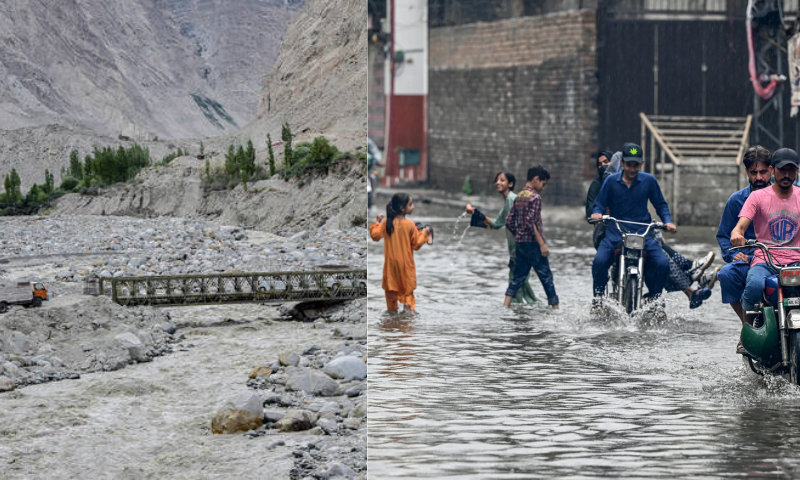
Islamabad, July 26, 2026: Flood risks continued across several parts of Pakistan on Sunday as authorities reported low-level flooding in major rivers, warned of fresh monsoon rains from July 29 and issued a glacial lake outburst flood (GLOF) alert for Gilgit-Baltistan (GB) and Khyber Pakhtunkhwa (KP), where flash floods have already cut off road links and stranded commuters.
According to the Provincial Disaster Management Authority (PDMA) Punjab, the flooding situation in the Chenab River eased from medium to low levels during the past 24 hours, while water flows in other major rivers remained stable despite continued monsoon rains.
The authority said low-level flooding persisted at Kalabagh, Chashma and Taunsa on the Indus River, where water flows were recorded at 334,000, 370,000 and 313,000 cusecs, respectively. The Chenab River also remained in low flood at Marala, Khanki, Qadirabad and Trimmu barrages, while low-level flooding continued at Balloki and Sidhnai headworks on the Ravi River. Water levels in the Jhelum and Sutlej rivers remained within normal limits.
However, authorities reported a medium flood in Narowal’s Basantar Nullah and a high flood at Wazirabad’s Phalko Nullah, where water discharge reached 5,000 cusecs.
The PDMA urged residents living along riverbanks and floodplains to immediately move to safer locations, assuring that flood relief camps had been established with essential supplies, medicines and emergency services.
Punjab continued to receive heavy rainfall over the past 24 hours, with Noorpur Thal recording the highest rainfall of 115 millimetres, followed by Gujranwala (107mm), Gujrat (94mm), Narowal (68mm), Mandi Bahauddin (65mm), Sialkot Airport (52mm), Okara (46mm), Jauharabad (40mm) and Sargodha (38mm).
Lahore received another 37mm of rain, bringing the city’s cumulative rainfall over the past five days to 450mm. Rain was also reported in Rawalpindi, Faisalabad, Multan, Attock, Murree and Bahawalpur.
The authority warned that continued rainfall could trigger urban flooding in low-lying areas, river and canal overflows, landslides in hilly regions, particularly Murree, and damage to vulnerable mud houses. Emergency control rooms and district operation centres remain on high alert, while citizens have been advised to contact the PDMA helpline (1129) in case of emergencies.
According to the PDMA, at least seven people, including two children, lost their lives and 20 others were injured in rain-related incidents across Punjab on Saturday. Since the onset of the current monsoon spell on June 25, the death toll in the province has risen to 29, while 203 people have been injured. Nearly 400 square kilometres of land across Punjab have also been inundated by floodwaters.
PDMA Director General Irfan Ali Kathia said the Punjab government would provide financial assistance ranging from Rs1 million to Rs5 million to the families of those killed in monsoon-related incidents and directed authorities to strictly enforce Section 144 along rivers and streams.
Meanwhile, the Pakistan Meteorological Department (PMD) forecast a fresh spell of monsoon rains beginning July 29 over the upper catchments of all major rivers, Islamabad, upper Punjab, Khyber Pakhtunkhwa, Azad Jammu and Kashmir, and Gilgit-Baltistan.
The Met Office said no flood-generating rainfall was expected before July 28, but warned that scattered rain and thunderstorms would continue over northern parts of the country during the next 24 hours.
Rain is forecast in several districts of KP, including Abbottabad, Mansehra, Swat, Chitral, Dir, Kohistan, Haripur, Mardan and Nowshera, while Punjab is expected to receive rain in Rawalpindi, Lahore, Gujranwala, Faisalabad, Multan, Bahawalpur, Sialkot, Narowal, Gujrat, Attock, Jhelum, Sheikhupura, Kasur, Khanewal, Sargodha, Okara, Vehari and several other districts.
Light to moderate rainfall is also expected in parts of Sindh, including Hyderabad, Mirpurkhas, Sanghar, Badin, Tharparkar and Umerkot, while isolated showers are forecast for Barkhan, Loralai, Musakhel, Khuzdar, Kalat and other districts of Balochistan.
For Karachi, the PMD forecast cloudy and humid conditions with chances of light rain, drizzle and isolated thunderstorms through Tuesday.
Separately, the Met Office issued a fresh GLOF alert for Gilgit-Baltistan and Khyber Pakhtunkhwa, warning that continued high temperatures combined with intermittent rainfall are expected to accelerate glacier melt until the first week of August.
The PMD said rising temperatures could rapidly expand existing glacial lakes and lead to the formation of new ones, significantly increasing the risk of glacial lake outburst floods, flash floods, landslides and debris flows in vulnerable mountain valleys.
Authorities warned that downstream communities, settlements near rivers and streams, and narrow valleys face heightened danger from sudden surges in water levels. Residents have been advised to avoid riverbanks, glacial lakes, stream beds and unstable mountain slopes, while tourists have been urged not to camp or trek in high-risk areas.
Pakistan is home to more than 13,000 glaciers—the largest concentration outside the polar regions—and experts have repeatedly warned that rising temperatures linked to climate change are accelerating glacier retreat, particularly in Gilgit-Baltistan and Chitral.
The situation remains critical in Gilgit-Baltistan, where flash floods and GLOF incidents have severed road connections to several districts for the fifth consecutive day.
Chief Minister Amjad Hussain directed authorities to restore all affected highways on an emergency basis, including the Baltistan Highway, where a temporary Bailey bridge was being installed to reconnect stranded areas.
Army personnel, Frontier Works Organisation (FWO) engineers, National Highway Authority (NHA) teams, the Gilgit-Baltistan Disaster Management Authority (GBDMA) and other agencies are continuing round-the-clock restoration work, while food, medical assistance and other relief supplies are being provided to stranded travellers.
According to the GBDMA, Gilgit-Baltistan has recorded 89 flash flood, mudflow, cloudburst, river erosion and GLOF incidents during the current monsoon season. The disasters have destroyed 130 houses, damaged another 162 homes, washed away 20 bridges, damaged more than 18 kilometres of roads, displaced 230 people, and resulted in the loss of 73 livestock.
Several key roads, including the Baltistan Road, Haramosh Road, Naltar Road, Hisper Road, Astore Valley Road and Hushe Valley Road, remain closed as restoration efforts continue.