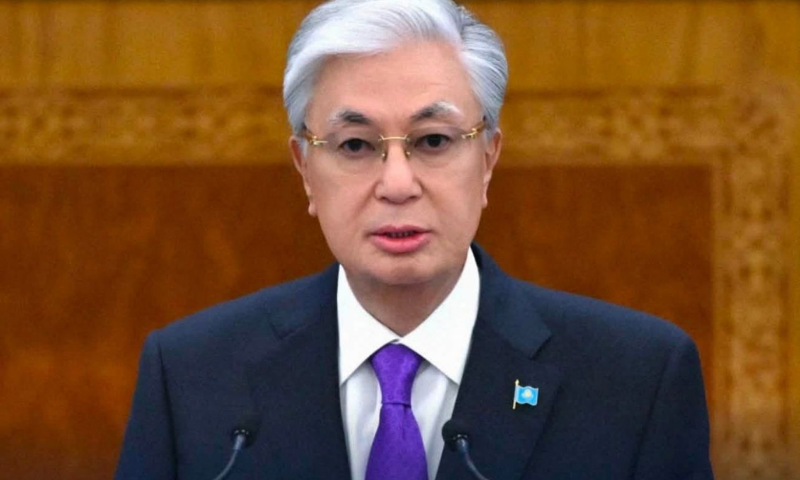
Astana, August 28,2026: Kazakhstan President Kassym-Jomart Tokayev has opened the first session of the country’s newly established Kurultai, describing the legislature as the beginning of a new phase in Kazakhstan’s political development under a new Constitution approved through a nationwide referendum.
Addressing the inaugural session on Friday, Tokayev said the new unicameral Kurultai would assume broader powers in legislation, institutional appointments and oversight of the Government, marking a major restructuring of the country’s political system.
Under the new constitutional framework, Tokayev nominated Aibek Dadebay as Chair of the Kurultai and called on deputies to support his candidacy.
The President said the Government had resigned its mandate before the newly elected legislature. Following the formation of the Kurultai, he will submit candidates for Vice-President and Prime Minister, consult with deputies and subsequently appoint members of the Government.
Tokayev said he would deliver his annual Address to the People of Kazakhstan once the Kurultai and Government had been fully constituted, stressing that the executive and legislature would be expected to implement its initiatives jointly and efficiently.
He also announced that the Kazakhstan People’s Council, known as the Halyk Kenesi, would be established in the second half of September. He described it as the country’s first supreme consultative body representing its ethnic, regional, social and political diversity. The body will have a constitutional right of legislative initiative.
Wider powers for parliament
Tokayev said the new Kurultai would have stronger oversight powers and a greater role in key state appointments. Its approval will be required for the appointment of Constitutional Court judges and members of the Central Election Commission and Supreme Audit Chamber.
Deputies will also appoint and dismiss Supreme Court judges on the President’s proposal and will have powers concerning the legal immunity of senior judicial officials and lawmakers.
The Kurultai will review reports on execution of the national budget and hear the Constitutional Court’s annual address. It will also have the authority to express no confidence in the Government and recommend the dismissal of individual ministers.
Tokayev called on the first convocation of the Kurultai to review existing legislation and bring sectoral laws into conformity with the new Constitution.
AI and digital transformation
The President urged the rapid introduction of an E-Parliament information system to improve legislative analysis, identify legal risks at an early stage and increase parliamentary efficiency.
He also called for the responsible use of artificial intelligence in law-making, saying AI could help improve the quality of legislation and reduce corruption risks but could not replace professional legal expertise.
Tokayev directed the Government to prepare legislation related to the introduction of AI in secondary education, development of the digital-assets industry and implementation of the Digital Qazaqstan strategy.
The Kurultai will also consider regulation of online platforms and mass media, with a focus on protecting citizens’ rights in the digital information environment.
Economic development and investment
The President said Kazakhstan’s economic reforms would focus on improving living standards through industrialisation, new production facilities and infrastructure development.
He highlighted investment in municipal services, transport, energy, water supply and other essential infrastructure across the country.
Defending the strategic use of the National Fund, Tokayev said its resources should be directed toward projects capable of delivering long-term economic and social benefits for future generations.
He also backed the introduction of a Golden Visa programme to attract highly qualified professionals, advanced technologies and foreign investment, while calling for broader reforms to the country’s migration policy.
Energy security and technological resilience were also identified as priorities, with the Kurultai expected to advance legislation supporting modernisation of the energy sector and development of alternative energy sources.
Kazakhstan’s foreign policy
Addressing the international situation, Tokayev said the world was becoming increasingly unpredictable, with declining trust among major powers and growing challenges to the effectiveness of the international system.
He described Kazakhstan as a middle power and said regional organisations and middle powers were assuming a greater role in an increasingly fragmented global environment.
Tokayev stressed that Kazakhstan’s sovereignty must be strengthened through national capabilities in the economy, science, defence and diplomacy, alongside investment in human potential.
He reaffirmed Kazakhstan’s commitment to defending its national interests while promoting peace, friendship and mutually beneficial partnerships with other countries.
Focus on children and social protection
The President placed particular emphasis on protecting children and supporting people with disabilities.
He called for legislation providing comprehensive and targeted assistance to children with disabilities, including improved access to education as well as higher-quality medical and social services.
He proposed establishing dedicated support centres in every regional capital and large district and encouraged sponsors to complement government efforts.
Tokayev also endorsed the Government’s proposal to prohibit children under the age of 16 from registering on social-media platforms, urging the Kurultai to treat the matter as a priority.
The Government has additionally been tasked with preparing a new law on libraries and publishing during the current year.
Political participation and renewal
Tokayev said more than 74 percent of citizens participated in the Kurultai elections, while around 800 international observers visited Kazakhstan, describing the election as open, fair and well organised.
He noted that the Adilet party secured the largest share of voter support and a constitutional majority in the Kurultai, saying the result carried a particular responsibility for the party to contribute to national unity and the reform process.
The President also highlighted the increased representation of women and young people in the new legislature, describing leadership renewal across all branches of government as a key objective of the reforms.
He urged deputies to reject populism and empty promises and instead promote legality, transparency, mutual respect and political pluralism.
Tokayev concluded by calling for a forward-looking national identity based on knowledge, science, hard work and self-discipline, saying Kazakhstan’s unity would remain the foundation for building a “Just, Safe, Clean and Strong Kazakhstan.”