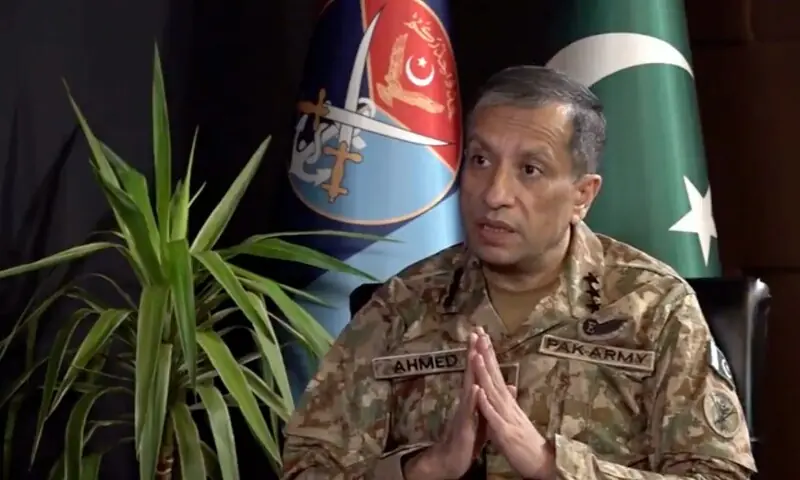
Rawalpindi, October 9,2026: Inter-Services Public Relations (ISPR) Director General Lieutenant General Ahmed Sharif Chaudhry has said Pakistan is acting as an “honest broker” in efforts to mediate between the United States and Iran, reaffirming Islamabad’s commitment to a negotiated and peaceful resolution of the conflict.
In an interview with CNN correspondent Ivan Watson, the military’s spokesperson said Pakistan had been clear in its position on the conflict and had condemned both Israeli attacks on Iran and Iran’s retaliatory campaign in the Gulf.
“We have been exhibiting that we are a very honest broker,” Lt Gen Chaudhry said, adding that Pakistan had a direct stake in regional peace and stability.
He stressed that no country would benefit from an expansion of the war, saying Islamabad was making every possible effort to narrow differences between the parties.
“We want that the conflict should not expand horizontally or vertically,” he said.
Pakistan’s troops in Saudi Arabia
Addressing questions about the deployment of Pakistani troops in Saudi Arabia under the Makkah defence alliance, Lt Gen Chaudhry said Pakistani forces had been stationed in the kingdom for decades and had served across multiple domains.
In a longer clip of the interview shared by state-run Pakistan Television on X on Friday, he said the implementation of the defence pact and the deployment of forces would remain strictly defensive in nature.
He explained that decisions regarding the deployment, composition and operational use of forces would rest with the relevant operational commanders, adding that countries involved in a military conflict did not disclose sensitive operational details.
Lt Gen Chaudhry reiterated that any deployment under the arrangement would be defensive, while emphasizing that all countries had the right to self-defence under the United Nations Charter.
He said collective deterrence could help prevent threats from escalating into military operations or armed conflict.
Collective deterrence and regional security
The ISPR chief said Pakistan, Saudi Arabia and Turkiye possessed significant military and diplomatic capabilities, which could discourage potential aggression against any signatory of the defence pact.
He explained that the purpose of collective deterrence was to make potential aggressors reconsider their actions and prevent a wider conflict.
The remarks come amid escalating Houthi attacks on Saudi Arabia and the continuing US-Israeli war on Iran, as Pakistan seeks to facilitate diplomatic efforts to contain the conflict.
The defence pact between Pakistan, Saudi Arabia and Turkiye, signed on August 7, aims to strengthen collective deterrence and deepen security cooperation among the three countries. Under the arrangement, an attack against one signatory is to be treated as an attack against all.
The three countries also agreed on Monday, during an emergency meeting of the alliance in Riyadh, to facilitate the rapid deployment of military forces and capabilities to Saudi Arabia in an emergency.