
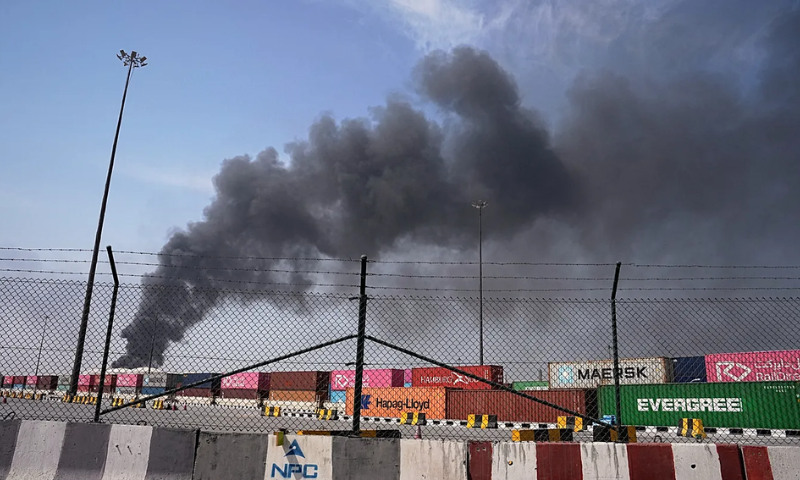
Riyadh/Sanaa, November 1,2026: A strike on an industrial complex in Dammam, eastern Saudi Arabia, triggered a major fire on Sunday, Iran’s state-run IRNA News Agency reported.
“A Yemeni strike hit an industrial complex in Dammam, eastern Saudi Arabia, sparking a large fire at the facility,” IRNA said in a post on X. The report did not provide details about casualties or the extent of the damage.
The reported strike comes amid escalating hostilities between the Iran-backed Houthi movement and Saudi Arabia, which supports Yemen’s internationally recognised government. The two sides have exchanged attacks since a fragile truce collapsed in July.
On Thursday, the Houthis reported that 12 people had been killed and three others critically injured in what they described as Saudi strikes on residential areas in western Yemen. The group’s health ministry said the casualties occurred when homes belonging to two families were targeted in Al-Barah, in Maqbana district.
The claims could not be independently verified. The Houthis had also reported at least 14 deaths in Saudi strikes on a petrol station and market on Wednesday. Meanwhile, the group targeted the airport in Aden, a stronghold of Yemen’s internationally recognised government, reportedly wounding civilians.
The latest escalation followed the breakdown of the 2022 truce in July, after the Houthis allowed an Iranian aircraft to land in Sanaa in defiance of Saudi control over Yemeni airspace. The move triggered renewed attacks, with the Houthis subsequently targeting Saudi territory, shipping and oil facilities.
The group has also intensified attacks on Saudi Arabia, including strikes on Riyadh airport that reportedly forced its closure for two weeks and led to the cancellation of major events, raising concerns over the impact on the kingdom’s economic diversification plans.
Yemen has been embroiled in conflict since 2014, when the Houthis seized the capital, Sanaa, prompting a Saudi-led coalition to intervene the following year in support of the government. According to United Nations figures cited in reports, more than 1,600 people have been killed and over 275,000 displaced since hostilities resumed.
Yemen appoints new governors for two Houthi-held provinces
Separately, Yemen’s Presidential Leadership Council issued two decrees on Sunday appointing new governors for al-Bayda in central Yemen and al-Jawf in the north, two provinces partially controlled by the Houthis.
The government-run Saba News Agency reported that Major General Hussein al-Ajji Ali al-Awadhi had been appointed governor of al-Bayda. Major General Amin Ali al-Akimi was named governor of al-Jawf and commander of its military axis.
Al-Awadhi replaces former al-Bayda governor Nasser al-Sawadi, while al-Akimi takes over al-Jawf from al-Awadhi, who previously served as the province’s governor.
The appointments come as both provinces face a complex military situation, with clashes continuing between government forces and the Houthis over strategic positions.
The Houthis control most areas of al-Bayda, while al-Jawf remains divided between the group and government forces.
Al-Bayda is strategically important because of its central location and borders with eight other provinces, four in the north and four in the south. Al-Jawf is also significant because it shares a land border with Saudi Arabia and lies near the Houthi-controlled provinces of Saada, Amran and Sanaa. It also borders Marib and Hadhramaut, which are under government control.
Yemeni government forces launched Operation “Dawn of Yemen” on October 5 to restore state institutions from Houthi control and retake the capital, Sanaa.
Military escalation between government forces and the Houthis resumed in July, resulting in thousands of deaths and injuries and displacing more than a quarter of a million people, according to UN reports.
The renewed fighting ended a period of relative calm that had prevailed since April 2022, while continued hostilities and displacement have further worsened Yemen’s humanitarian crisis.
Yemen has been at war since the Houthis seized Sanaa and several other provinces in September 2014, prompting a Saudi-led coalition to intervene in March 2015 in support of the internationally recognised government.