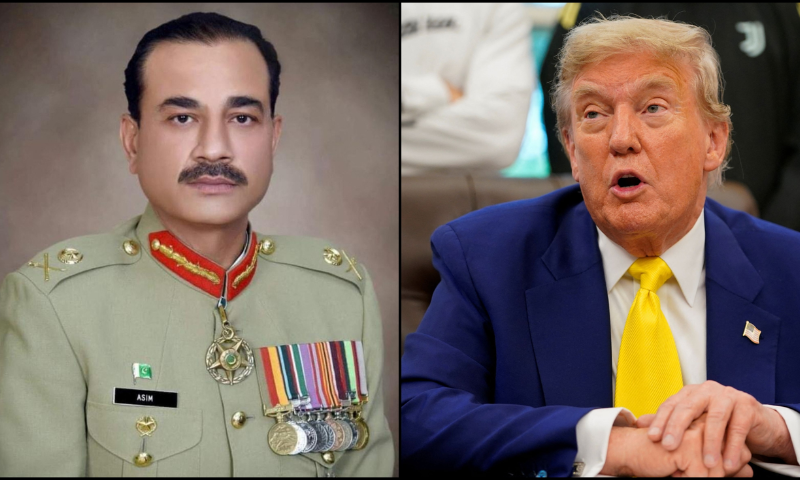
Washington, June 19, 2025: In a historic first, U.S. President Donald Trump met with Pakistan’s Chief of Army Staff (COAS), Field Marshal Syed Asim Munir, at the White House to discuss counterterrorism cooperation and economic engagement, the Inter-Services Public Relations (ISPR) said in a statement on Thursday.
The meeting, held in the Cabinet Room and followed by a visit to the Oval Office, marked the first formal reception of a serving Pakistani army chief by a sitting U.S. president without the COAS holding political office or presiding under martial law.
Field Marshal Munir’s visit was accompanied by Pakistan’s National Security Adviser and intelligence chief, Lt Gen Muhammad Asim Malik. On the U.S. side, Secretary of State Senator Marco Rubio and Special Representative for Middle Eastern Affairs Steve Witkoff joined the discussions.
Originally scheduled for an hour, the talks extended to over two hours, reflecting the “depth and cordiality of the dialogue,” according to the ISPR.
President Trump praised Pakistan’s efforts for regional stability and expressed appreciation for the country’s role in combating terrorism. Both sides reaffirmed their commitment to ongoing counterterrorism collaboration.
The agenda also included expanding cooperation across diverse sectors, including trade, economic development, mining, artificial intelligence, energy, cryptocurrency, and emerging technologies. Trump reportedly showed “keen interest in forging a long-term, strategic trade partnership” with Pakistan.
The U.S. president also commended Field Marshal Munir’s “leadership and decisiveness during a period of complex regional dynamics.” In a reciprocal gesture, Munir extended a formal invitation to President Trump, on behalf of the Government of Pakistan, to visit Islamabad at a mutually convenient time.
According to the ISPR, COAS Munir conveyed the Pakistani government’s gratitude for Trump’s “constructive and result-oriented role” in facilitating a recent ceasefire with India. The press release also quoted Munir as acknowledging Trump’s statesmanship and his grasp of global challenges.
The leaders also held a “comprehensive exchange” on the ongoing conflict between Iran and Israel, emphasizing the need for peaceful resolution amid continued missile exchanges between the two rivals.
“The engagement marks a significant milestone in the effort to strengthen the enduring Pakistan-U.S. partnership, rooted in shared goals of peace, security, and prosperity,” the ISPR concluded.
Trump: ‘Honoured to Meet Him’
Speaking to reporters after the meeting, President Trump said he was “honoured” to host Field Marshal Munir. Asked about the Iran-Israel conflict, Trump remarked, “They [Pakistan] know Iran very well, better than most… they’re not happy about anything.”
He added, “The reason I had him [Munir] here was that I wanted to thank him for not going into the war [with India]. I want to thank Prime Minister Modi as well. These two very smart people decided not to continue a war that could have become nuclear. Pakistan and India are two large nuclear powers.”
Earlier, Trump had remarked that “this man [Munir] was extremely influential in stopping the fighting from the Pakistan side,” referring to the recent Pakistan-India standoff.
According to White House spokesperson Anna Kelly, Trump hosted Field Marshal Munir following the latter’s suggestion that the president be nominated for a Nobel Peace Prize for averting a potential nuclear conflict between South Asia’s two arch-rivals.
However, diplomatic sources revealed that the meeting was not arranged through conventional channels. Instead, it stemmed from behind-the-scenes efforts led by a mix of influential advisers, lobbyists, and business figures.
The initiative, in the works for several months, was kept under wraps until Trump’s official schedule was released on Tuesday. Sources indicated that enhanced counterterrorism coordination, connections with crypto-influence networks, and lobbying via Republican-aligned firms in Washington played a key role in securing the high-profile meeting.
Historically, Pakistani military leaders have only met U.S. presidents after assuming political power. While Field Marshal Ayub Khan, Gen Ziaul Haq, and Gen Pervez Musharraf met with American presidents as heads of state, this is the first time a serving army chief has been hosted at the White House in a purely military capacity. A brief, informal encounter between then-COAS Gen Ashfaq Parvez Kayani and President Obama in 2010 remains the only partial precedent.