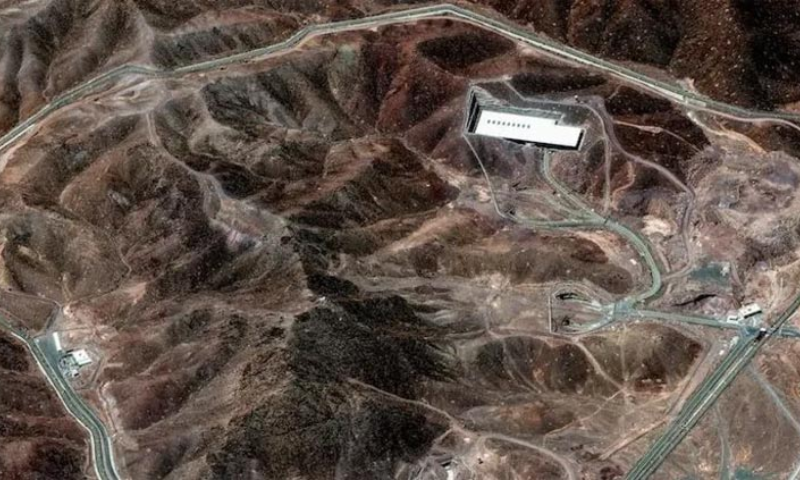
Tehran/Washington, June 22, 2025: The United States launched a series of targeted airstrikes on three Iranian nuclear facilities early Sunday, marking a dramatic escalation in the ongoing Israel-Iran conflict. Former President Donald Trump, addressing the nation from the White House, claimed the operation had “completely and fully obliterated” key components of Iran’s nuclear infrastructure.
The strikes—carried out in coordination with Israeli forces—hit the heavily fortified nuclear sites at Fordo, Natanz, and Isfahan, which Iranian authorities later confirmed had been attacked. Trump described the mission as a “historic moment” and warned Iran of severe consequences if it retaliates.
“There will either be peace or there will be tragedy for Iran,” Trump said during his televised address, further vowing that any attack on American interests would prompt additional strikes.
While the Atomic Energy Organization of Iran acknowledged the attacks, it insisted that Iran’s nuclear program would continue, undeterred.
The operation marks the first direct U.S. military intervention in the nine-day-long Israeli assault on Iran, which has focused on dismantling Tehran’s missile capabilities and degrading its nuclear development infrastructure. U.S. officials stated that American stealth bombers deployed the 30,000-pound GBU-57 Massive Ordnance Penetrator, capable of breaching deep underground bunkers, to destroy the Fordo enrichment plant.
In a social media post, Trump claimed, “We have completed our very successful attack on the three nuclear sites in Iran… A full payload of BOMBS was dropped on the primary site, Fordow. All planes are now safely on their way home.”
He later added:
“This is an HISTORIC MOMENT FOR THE UNITED STATES OF AMERICA, ISRAEL, AND THE WORLD. IRAN MUST NOW AGREE TO END THIS WAR. THANK YOU!”
Israeli Prime Minister Benjamin Netanyahu hailed Trump’s decision, calling it a “bold” move that “will change history.” In a direct message to the American president, Netanyahu said:
“The U.S. has done what no other country on Earth could do.”
Although the White House and Pentagon have not released full details of the operation, Fox News host Sean Hannity, citing a conversation with Trump, reported that six bunker-buster bombs were used on Fordo and 30 Tomahawk missiles were launched from U.S. submarines against Natanz and Isfahan.
The International Atomic Energy Agency (IAEA) has previously confirmed that Iran was enriching uranium at Fordo to levels near weapons-grade. There is now growing concern about potential nuclear contamination if the GBU-57 bombs were used.
The airstrikes represent a risky strategic choice for Trump, who has long campaigned on promises to avoid foreign entanglements. Critics have pointed out the contradiction between his America First doctrine and this significant escalation in the Middle East. UN Secretary-General António Guterres warned of a “dangerous escalation” with the potential for “catastrophic consequences for civilians, the region, and the world.”
The Trump administration had previously attempted to prevent this scenario through diplomacy. High-level negotiations with Tehran over the past two months failed to yield a breakthrough, despite Trump twice urging Netanyahu to delay military action in April and May.
However, U.S. officials now believe that Israel’s initial assault successfully degraded Iran’s air defenses, opening a brief window to strike the most deeply buried parts of its nuclear infrastructure.
Iran’s Supreme Leader Ayatollah Ali Khamenei, in a speech last week, warned that any U.S. involvement would trigger “irreparable damage.” Iranian officials have since reiterated that the American strikes amount to a declaration of war.
In a significant development, Iranian-backed Houthi rebels in Yemen have also threatened to resume attacks on U.S. vessels in the Red Sea, ending a temporary pause in hostilities arranged in May.
The U.S. Embassy in Israel has begun assisted departure flights for American citizens, in a precautionary measure reminiscent of evacuations during the Gaza war in 2023.
Military analysts noted that this may be the first known combat use of the GBU-57, a weapon designed specifically to penetrate fortified underground bunkers. Experts warn that if deployed repeatedly, it could cause geological shifts or release radioactive material if nuclear enrichment facilities were damaged at depth.
The standoff now enters a volatile new phase. Trump’s posturing has shifted dramatically in recent weeks—from calling for diplomacy to issuing threats against Khamenei personally.
“We know exactly where the so-called ‘Supreme Leader’ is hiding,” Trump wrote online. “He is an easy target—but we are not going to take him out (kill!), at least not for now.”
The current confrontation is rooted in Trump’s 2018 withdrawal from the Obama-era Joint Comprehensive Plan of Action (JCPOA), which limited Iran’s nuclear activity in exchange for sanctions relief. Trump had long criticized the deal as inadequate and vowed never to allow Iran to obtain a nuclear weapon.
Whether this bold military move achieves long-term strategic gains—or drags the region into broader conflict—remains to be seen. For now, the world watches as a potentially catastrophic escalation plays out.