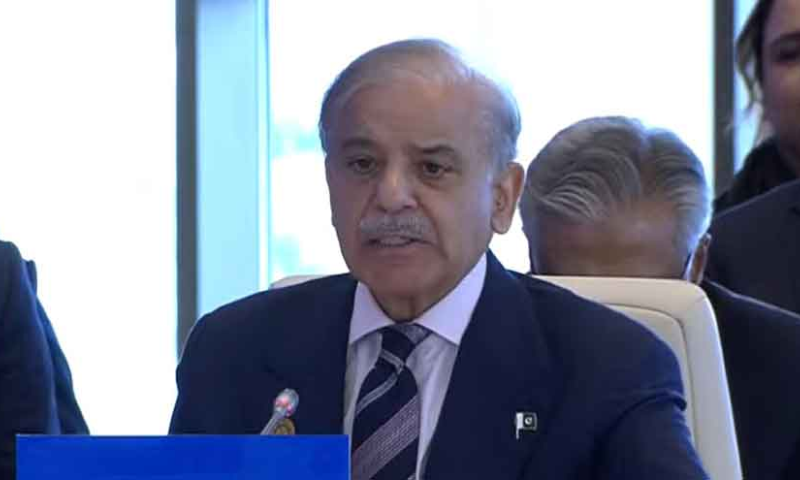
Khankandi, Azerbaijan, July 4, 2025: Prime Minister Shehbaz Sharif on Friday issued a strong rebuke of Indian provocations and unilateral actions regarding the Indus Waters Treaty, warning that any attempt to suspend the treaty constitutes an act of aggression against Pakistan’s people.
Addressing the Economic Cooperation Organization (ECO) Summit in Khankandi, the Prime Minister said, “India continues to act irresponsibly, weaponizing water and challenging the Indus Waters Treaty. The International Court of Arbitration has rightly rejected India’s position. Any unilateral suspension of this vital treaty is not just a violation of international law, but a direct threat to Pakistan’s livelihood.”
Condemning recent escalations in the region, PM Shehbaz referenced a recent “unfortunate incident” in occupied Kashmir, blaming New Delhi for endangering regional peace. “The world saw the courage and professionalism of our brave forces, led by Field Marshal Syed Asim Munir, as they defended Pakistan against Indian aggression,” he stated.
The Prime Minister also denounced Israel’s attacks on Iran, describing them as “illegal and illogical,” and part of broader efforts to destabilize the region. He reaffirmed Pakistan’s support for oppressed communities in Palestine, occupied Kashmir, and Iran, calling the Gaza siege a “man-made humanitarian catastrophe.”
In his keynote address, PM Shehbaz emphasized the urgency of regional cooperation on climate change and sustainable development. “We are entering a new era of interdependence and knowledge expansion,” he said. “Technological development, regional connectivity, and climate resilience must go hand in hand.”
The summit’s theme, ‘Sustainable and Climate Resilient Future’, was described by the Prime Minister as timely and crucial. He cited Pakistan’s climate vulnerabilities, particularly the catastrophic 2022 floods that affected over 33 million people, and called for the creation of a Low Emission Corridor across ECO member states.
He also stressed the need for climate financing, renewable energy promotion, ecotourism, and collective disaster response mechanisms. “Pakistan is among the top 10 countries most affected by climate change,” he warned, highlighting melting glaciers, flash floods, and rising temperatures that threaten food security and livelihoods.
PM Shehbaz welcomed ECO’s decision to name Lahore as the ECO Tourism Capital for 2027, calling it a recognition of Pakistan’s rich cultural and natural heritage. He also urged faster development of the Turkey-Iran-Pakistan transport corridor, calling it vital for boosting trade and connectivity in the region.
Earlier, PM Shehbaz held a bilateral meeting with Azerbaijani President Ilham Aliyev, where both leaders reaffirmed their commitment to strengthening economic ties. The Prime Minister thanked Azerbaijan for its consistent support to Pakistan on regional issues, particularly during periods of tension with India.
“Azerbaijan has always stood by Pakistan,” he said, adding that Azerbaijan’s growing investment interest in Pakistan is a “positive sign for deepening our economic partnership.”
PM Shehbaz concluded his address by calling for unity and vision among ECO member states. “Together, we must transform this region into a hub of peace, resilience, and shared prosperity.”