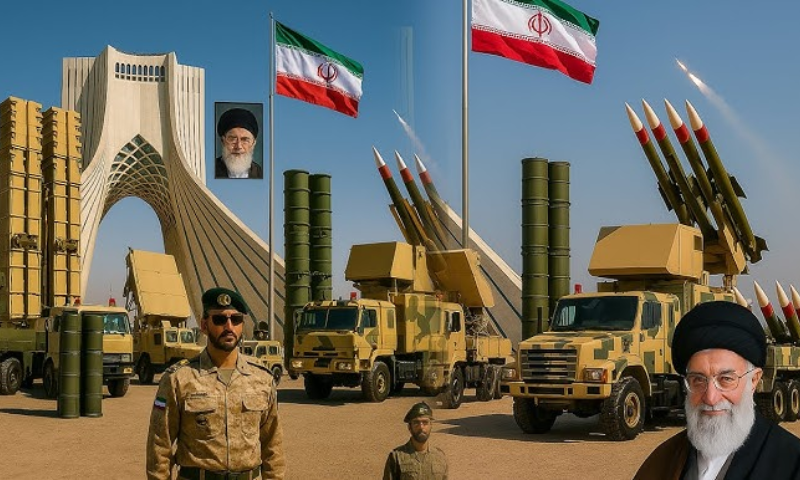
Tehran, July 20, 2025: Iran has replaced key components of its air defence systems that were damaged during last month’s conflict with Israel, according to a report by Defah Press, quoting Mahmoud Mousavi, deputy for operations of Iran’s regular army.
“Some of our air defences were damaged — this is not something we can hide — but our colleagues have used domestic resources to replace them with pre-arranged systems stored at strategic locations,” Mousavi stated, assuring that Iran’s airspace is now secure once again.
During the brief but intense conflict in June, Israel’s air force temporarily dominated Iranian airspace, inflicting significant damage on Iran’s defence infrastructure, while Iranian forces launched a series of missile and drone strikes against Israeli targets.
Iran’s current air defence capabilities include the domestically developed Bavar-373 long-range system and the Russian-made S-300 system. The report did not mention any new imports of foreign defence equipment since the June conflict. Following previous Israeli strikes in October on Iranian missile production sites, Tehran had publicly showcased Russian systems in a bid to project resilience and recovery.
Meanwhile, Iran could return to the negotiating table with European powers next week, according to a report by semi-official Tasnim news agency. Talks may involve the so-called E3 — Britain, France, and Germany — amid growing pressure to resume diplomacy over Iran’s nuclear programme.
“The principle of talks has been agreed upon, but consultations are ongoing regarding the time and venue,” Tasnim quoted a source close to the matter as saying.
The possible resumption of talks follows the first high-level contact between Iranian Foreign Minister Abbas Araqchi and the foreign ministers of the E3 and the EU’s foreign policy chief since Israeli and U.S. forces targeted Iranian nuclear sites last month.
The E3 has warned that failure to resume meaningful negotiations could trigger the reimposition of international sanctions through the UN’s “snapback mechanism” — a provision under the 2015 Joint Comprehensive Plan of Action (JCPOA). The mechanism allows for the automatic restoration of UN sanctions if Iran is found in non-compliance with the nuclear deal, which the U.S. exited in 2018.
Iranian officials have strongly criticised the E3 stance. “If EU/E3 want to have a role, they should act responsibly and abandon worn-out tactics of threats and pressure,” Araqchi said earlier this week, arguing the West has “no moral or legal ground” to invoke snapback.
The urgency is growing as the current UN Security Council resolution endorsing the JCPOA expires on October 18, potentially opening the door to unrestricted arms and nuclear activity.
Before the latest escalation, Iran and the United States had completed five rounds of nuclear negotiations mediated by Oman. However, key sticking points — including uranium enrichment levels — remain unresolved. Western powers seek a complete halt to enrichment to eliminate any weapons-grade capability, while Tehran maintains its nuclear programme is strictly for civilian use.